Magnetic Bead Genomic DNA Kits for Insects
Magnetic bead genomic DNA kits for insects use paramagnetic beads to bind DNA released from lysed insect material, then a magnetic separator handles wash and elution steps without centrifugation, processing up to 96 samples of insect-derived material (one leg or wing up to whole body) in under an hour, either manually or on automated platforms. This format works across mosquitoes, flies, ants, and other arthropods, producing DNA suitable for PCR, qPCR, cloning, and sequencing.
Population genetics and pest-surveillance labs running automated extraction pipelines can scale from single-leg samples to whole-body specimens with the same bead chemistry, and MBP's specialist team can help match bead chemistry to your liquid handler. Request a quote today by contacting customerservice@mbpinc.net
Mag Beads
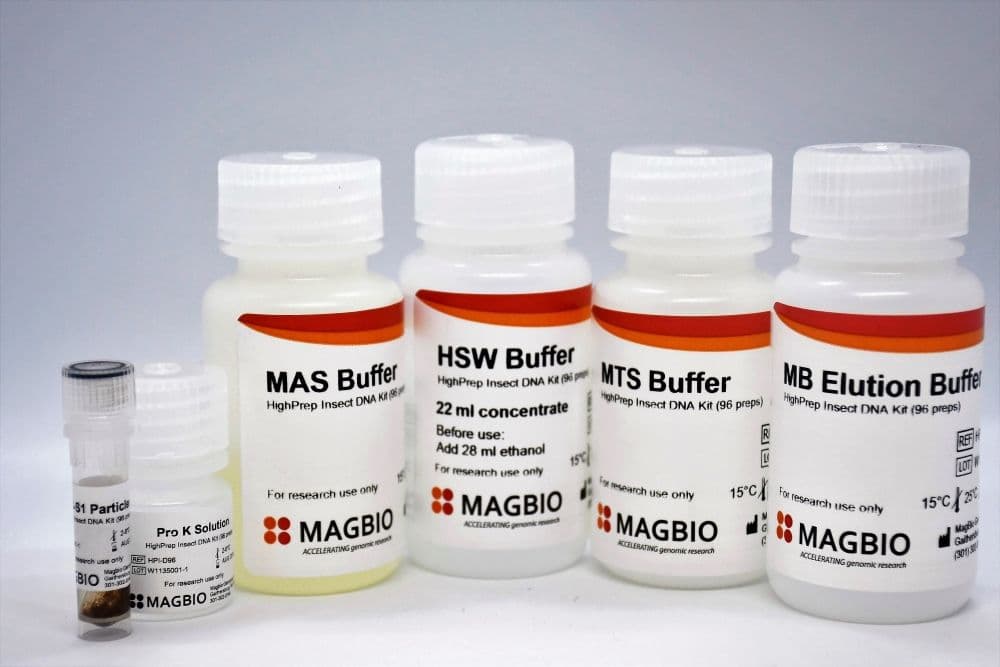
Showing 1 to 1 of 1 results
What are magnetic bead genomic DNA kits for insects?
A magnetic bead genomic DNA kit for insects uses paramagnetic beads to bind DNA released by a lysis and proteinase K digestion step from insect-derived material ranging from a single leg or wing to a whole body, with a magnetic separator handling wash and elution steps instead of centrifugation, processing up to 96 samples in under an hour manually or via automation. Related entities include deep-well plate sample loading, MAG-S1-type magnetic particles, manual or automated magnetic separation devices, and downstream PCR, qPCR, cloning, and sequencing applications. Choose magnetic bead kits for insect genomic DNA when working from minimal tissue input (single leg or wing) or building an automated extraction pipeline for arthropod samples.
What you will find:
- Automated insect genomic DNA isolation using Silica-coated Mag Beads for
- Maximum yield from small invertebrates using high-binding arthropod magnetic particles
- Compatible Automated insect DNA reagents with high-throughput liquid handlers
- Walk-away invertebrate genomic DNA purification using Functionalized Mag Beads
How to choose a magnetic bead insect genomic DNA kit
Tissue input flexibility
Magnetic bead insect kits are documented to work from a single leg or wing up to a whole insect body, across species including mosquitoes, flies, and ants, with samples loaded into deep-well plates and brought to volume with a buffer before bead-based binding. This flexibility is useful for non-destructive or minimally destructive sampling protocols where preserving the rest of the specimen (e.g., for morphological identification) is important.
Manual vs. automated throughput
Up to 96 samples of insect legs or wings can be processed in less than an hour using magnetic bead chemistry, either manually with a magnetic stand or via automated extraction systems. If your lab already runs an automated nucleic acid extraction system for other sample types, confirm the bead chemistry and plate format are compatible before adopting for insect samples.
Storage and handling of kit components
Magnetic bead particles and proteinase K solutions in insect kits commonly require refrigerated storage (2-8 degrees Celsius), while other buffer components are stored at room temperature; extracted DNA is generally stored at -20 degrees Celsius. Plan reagent storage space accordingly, especially for kits ordered in bulk for large specimen collections.
Downstream application range
DNA from magnetic bead insect kits is documented as suitable for PCR, qPCR, cloning, sequencing, and other molecular biology applications, with high yields and quality reported across the input range from single legs to whole bodies. For applications requiring higher molecular weight DNA from insects, confirm whether the kit's chemistry is optimized for HMW output or standard fragment sizes.
Specifications context
The specs that most differentiate magnetic bead insect kits from silica plate or spin-column alternatives are minimum tissue input (down to a single leg or wing), processing time without centrifugation (under an hour for 96 samples), and storage requirements for bead and enzyme components. A kit that processes a single leg through to a whole body with the same chemistry gives flexibility for both non-destructive and destructive sampling protocols in the same lab. Labs running automated extraction pipelines for population genetics often pair this category with 96-well plate insect kits during validation, while labs processing individual specimens for method development typically start with insect spin-column kits. The parent insect genomic DNA extraction kits category and broader genomic DNA extraction kits hub link to related formats, and blood/tissue mag bead kits use comparable bead chemistry for animal samples.
MBP's specialist team can help match kit chemistry, format, and throughput to your sample type and downstream application. Contact the MBP team for personalized guidance.
FAQ