Sanger Sequencing for Chain-Termination DNA Sequence Verification
Sanger Sequencing covers the reagents used for chain-termination DNA sequencing: dye-terminator chemistry kits including BigDye and equivalent, PCR cleanup reagents to remove primers and dNTPs before sequencing reactions, sequencing-grade primers, and purification reagents for the completed sequencing reaction. Sanger sequencing remains the gold standard for confirming specific sequence changes, verifying plasmid constructs, and genotyping single loci too targeted for next-generation sequencing (NGS). Academic and core laboratories performing Sanger sequencing can benefit from guidance when selecting chemistry, primer design, and cleanup strategies for reliable read quality and sequence confirmation.
Looking for Sanger sequencing reagents? Contact customerservice@mbpinc.net for a quotation and expert guidance on selecting the right chemistry, primers, and cleanup workflow for your sequencing applications.
Sanger Sequencing
Showing 1 to 2 of 2 results
What are Sanger sequencing reagents?
Sanger sequencing reagents are the chemical components used in chain-termination DNA sequencing, the method developed by Frederick Sanger in which a DNA polymerase extends a primer along a single-stranded template and is terminated at random positions by the incorporation of fluorescently labeled dideoxynucleotide terminators (ddNTPs) that lack the 3'-OH group needed for further elongation. The reaction produces a nested set of labeled fragments that, when resolved by capillary electrophoresis, gives the DNA sequence. Key reagents include dye-terminator mastermix (BigDye v3.1 or equivalent), template DNA, sequencing primer, and cleanup reagents.
What you will discover:
-
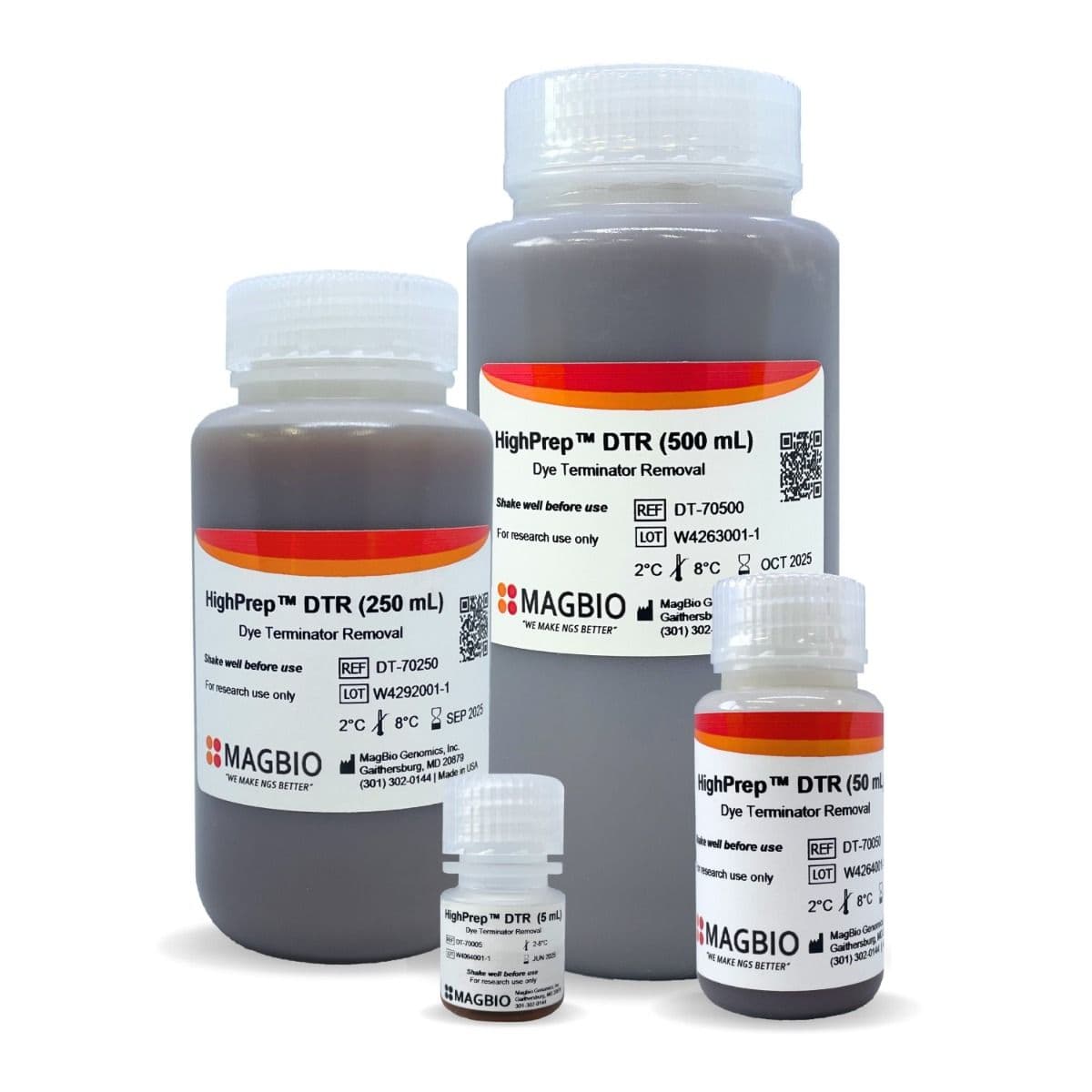
Sanger DTR (Dye Terminator Removal): Effective purification systems such as Magbio HighPrep DTR employs paramagnetic bead technology to effectively eliminate surplus terminators and salts, guaranteeing clear baselines and extended read lengths.
-
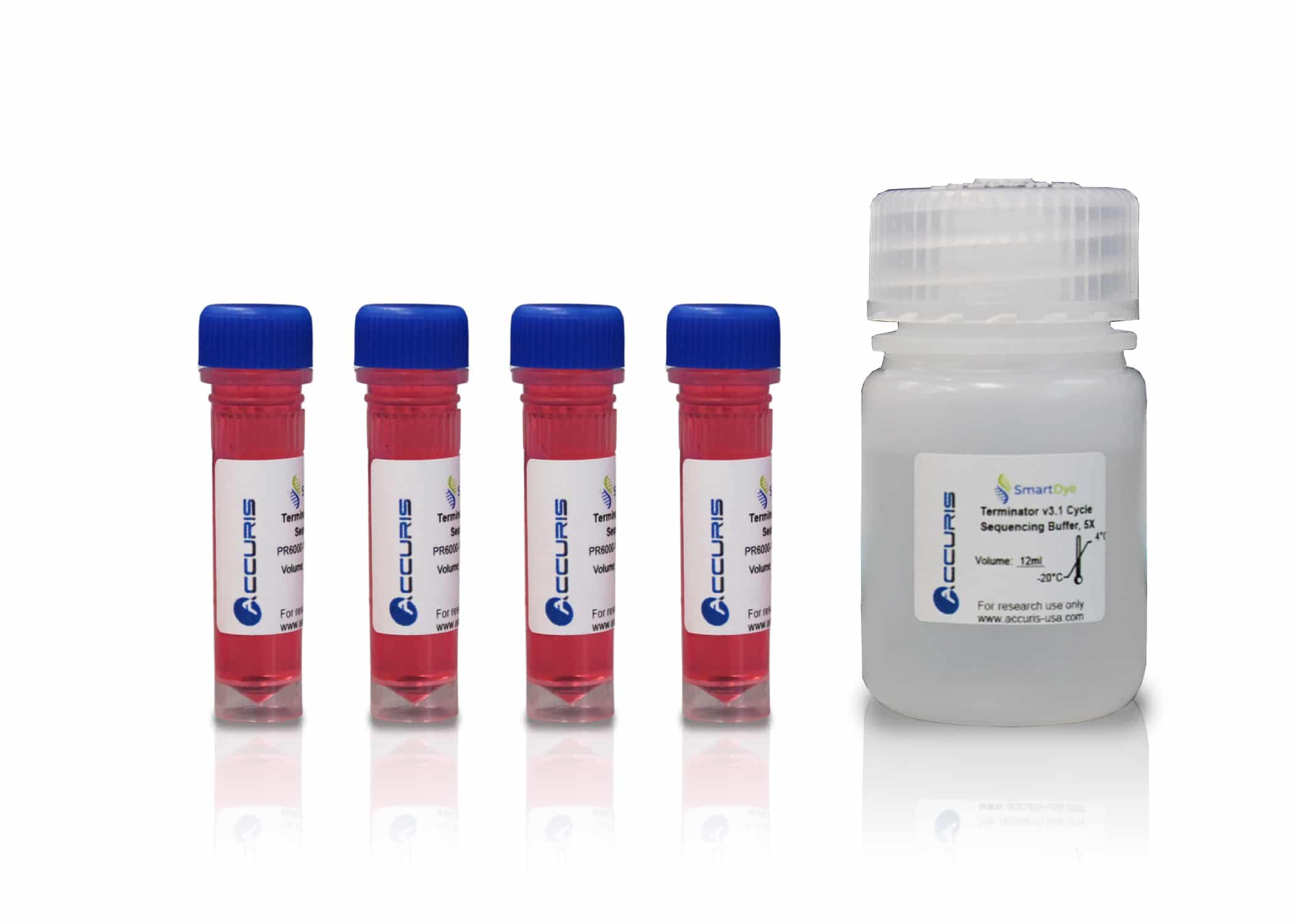
Cycle Sequencing Kits: Durable formulations like the SmartDye Terminator 3.1, designed to deliver consistent peak heights and excellent processivity across various DNA templates, including plasmids and PCR products.
How to use Sanger sequencing reagents
Clean up PCR products before sequencing reactions
Residual PCR primers and unincorporated dNTPs can interfere with the sequencing reaction by competing with the sequencing primer or being incorporated by the polymerase. ExoSAP enzymatic cleanup or column-based purification removes these contaminants before the sequencing reaction is set up.
Set up sequencing reactions with the minimum recommended cycle number
Sanger sequencing cycle sequencing reactions typically require 25–30 thermocycler cycles, fewer than a standard PCR, since only one primer is used and each cycle synthesizes a new set of terminated fragments rather than doubling the product. Using too many cycles can deplete the dye-terminator terminators and reduce signal quality.
Clean up the completed sequencing reaction before capillary electrophoresis
Unincorporated dye-terminator ddNTPs must be removed before capillary electrophoresis injection, since free fluorescent ddNTPs obscure the first 25–50 bases of the read. Column purification, ethanol-EDTA precipitation, or size-exclusion spin columns are standard cleanup approaches.
Use 10–50 ng of purified PCR product as template
Too little template produces weak, noisy signal; too much produces dye blobs from terminator over-incorporation. Typically 10–50 ng of PCR product or 200–500 ng of plasmid DNA is appropriate for a single sequencing reaction.
Position the sequencing primer at least 100 bp from the target region
Sanger reads have lower quality in the first 50–100 bases, with the high-quality window running from approximately base 100 to 900 from the primer. Placing the sequencing primer so that the target region falls within this window gives the best data quality.
Specifications context
BigDye Terminator v3.1 has been the dominant commercial dye-terminator chemistry since its introduction, incorporating fluorescently labeled ddNTPs with distinct emission wavelengths for reads of consistently high quality up to approximately 1000 bp. As of 2026, Sanger sequencing remains the method of choice for mutation confirmation, plasmid verification, and colony screening, because its per-sample cost and turnaround for single loci is substantially more practical than NGS for these routine targeted applications.
Ensure the precision of your sequence—reach out to the MBP team now for a quote on our expert Sanger sequencing services.
FAQ



