Cycle Sequencing Kits for Sanger DNA Sequencing and Capillary Electrophoresis
Cycle sequencing kits provide pre-mixed BigDye Terminator (or equivalent) chemistry — fluorescently labeled ddNTPs, polymerase, dNTPs, and buffer — for Sanger sequencing of single- and double-stranded DNA, PCR fragments, plasmids, and large templates. Available in v1.1 (short-read, high-resolution) and v3.1 (robust, long-read) formulations, plus dGTP chemistry for GC-rich templates, in 24–25,000 reaction sizes. Compatible with all Applied Biosystems capillary electrophoresis platforms. MBP ships to labs across the United States, Canada, and internationally with PO and Quick Order procurement at mbpinc.net.
Need help selecting the right cycle sequencing kit for your workflow? Contact customerservice@mbpinc.net for product recommendations, pricing, and procurement support.
Cycle Sequencing Kit
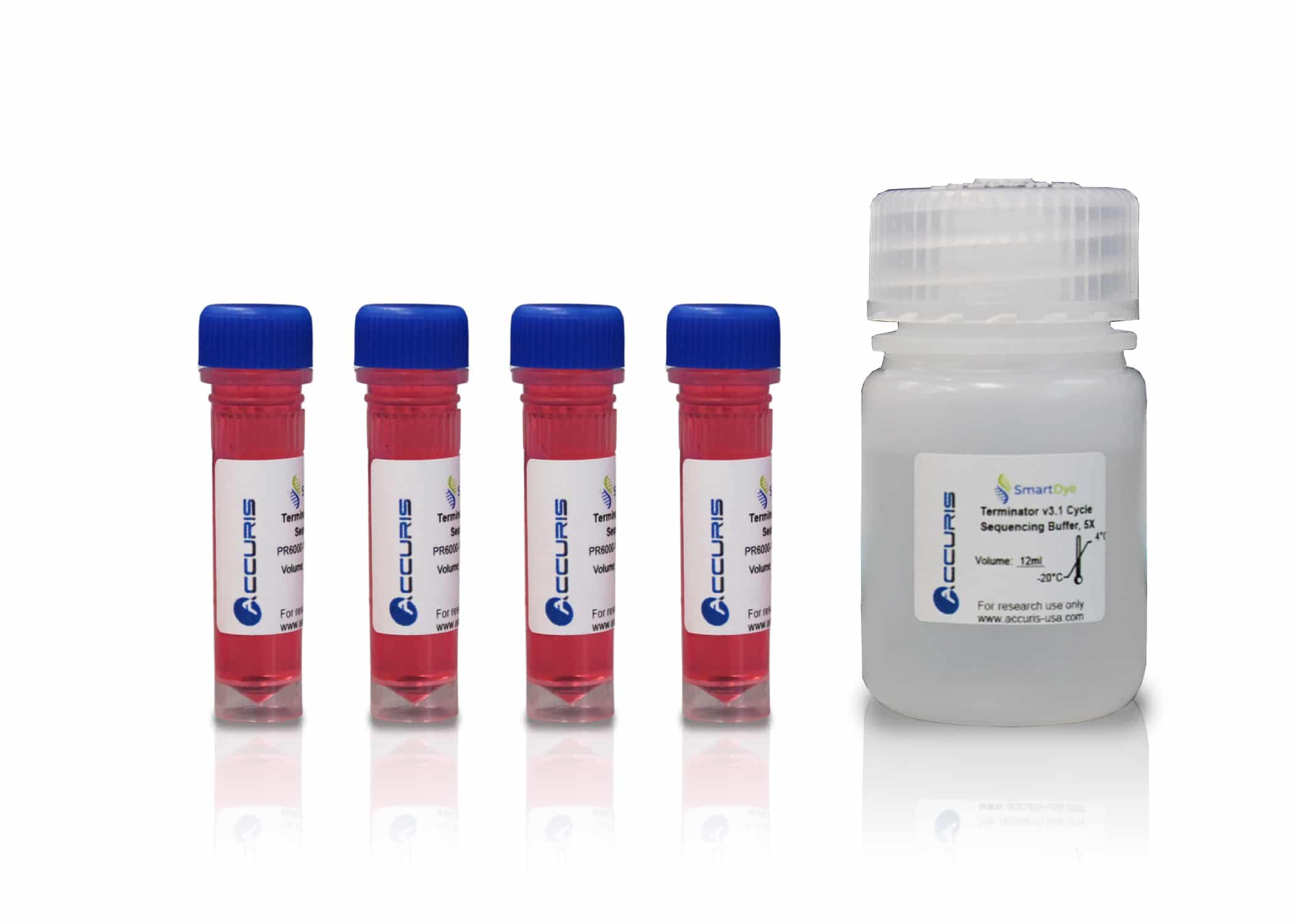
Showing 1 to 1 of 1 results
What are cycle sequencing kits?
Cycle sequencing kits provide all the reagents required to perform Sanger (dye-terminator) DNA sequencing. These kits contain a Ready Reaction Mix with DNA polymerase, standard deoxynucleotides (dNTPs), fluorescently labeled dideoxynucleotide terminators (ddNTPs), and a sequencing buffer. During thermal cycling, a sequencing primer is extended along a DNA template, and random incorporation of fluorescent ddNTPs terminates strand synthesis at different positions. This creates a collection of DNA fragments of varying lengths, each ending with a fluorescent label.
After the reaction, the fragments are separated by capillary electrophoresis. The instrument detects the fluorescent dye attached to the terminal base of each fragment and reconstructs the DNA sequence.
What you will find:
-
SmartDye Terminator 3.1 Kits: A high-performance sequencing chemistry designed as a direct, economical replacement for industry standards, providing long, high-quality reads with minimal noise.
-
Robust Template Processing: Optimized reagents engineered to handle challenging molecular structures, ensuring reliable signal intensity and accurate base-calling across a wide variety of starting materials, from PCR amplicons to large plasmids.
How to choose a cycle sequencing kit
Chemistry version
BigDye Terminator v3.1 is the preferred chemistry for general sequencing applications. It provides long read lengths, balanced signal intensity, and reliable performance across PCR products, plasmids, fosmids, BAC clones, and resequencing projects. Its consistent peak patterns make it particularly useful for mutation detection and sequence finishing.
BigDye Terminator v1.1 is optimized for shorter sequencing reads and delivers enhanced resolution near the 5' end of templates. It is often selected for short-fragment sequencing and applications involving detection of low-frequency sequence variants.
GC-rich and difficult templates
Templates with long GC-rich regions can produce weak signals, compression artifacts, or premature read termination when standard chemistry is used. dGTP BigDye Terminator chemistry is specifically designed for these situations. By replacing ddITP with a dGTP-based formulation, it improves sequencing through difficult GC-rich stretches, although G peaks may appear somewhat compressed in the electropherogram.
For challenging templates, laboratories often combine dGTP chemistry with elevated denaturation temperatures and additives such as DMSO or betaine to improve read quality.
Reaction count and throughput
Cycle sequencing kits are available in a wide range of sizes. Small kits containing 24 or 100 reactions are suitable for research laboratories performing occasional sequencing. Larger formats containing 1,000, 5,000, or even 25,000 reactions are commonly used by sequencing cores and high-throughput facilities where lower per-sample cost is important.
Thermal cycling and storage
Most cycle sequencing reactions use approximately 25 amplification cycles with denaturation, annealing, and extension steps. Proper reagent storage is important for maintaining performance. Sequencing buffers are typically stored at 4°C, while Ready Reaction Mixes should remain frozen and protected from light. Frequent freeze-thaw cycles should be avoided, and aliquoting reagents upon receipt is often recommended.
Post-reaction cleanup
Following cycle sequencing, excess fluorescent terminators, salts, and unincorporated nucleotides must be removed before capillary electrophoresis. Failure to perform cleanup can result in artifacts such as dye blobs and reduced sequencing quality. Dye terminator removal systems are commonly used for this purification step.
Specifications context
Cycle sequencing kits are designed for use with capillary electrophoresis instruments such as the Applied Biosystems SeqStudio Flex, SeqStudio, 3500 Series, and legacy 310, 3100, 3130, 3700, and 3730 platforms. Before routine sequencing, instruments require spectral calibration using appropriate matrix or sequencing standards to ensure accurate dye discrimination.
As of 2026, BigDye Terminator v3.1 remains the most commonly specified cycle sequencing chemistry in academic, clinical research, and commercial sequencing facilities worldwide. Smaller laboratories typically use 24- or 100-reaction kits for confirmatory sequencing, while dedicated sequencing cores generally rely on 1,000-reaction or larger formats for daily production workflows.
Maximize your read lengths— contact the MBP team today for a quote on our professional cycle sequencing solutions.
FAQ



