Sanger DTR Kits for Dye Terminator Removal and Sequencing Cleanup
Sanger DTR (Dye Terminator Removal) kits remove unincorporated fluorescent dye terminators, dNTPs, salts, and primers from completed cycle sequencing reactions before capillary electrophoresis, preventing dye blob artifacts and improving sequencing data quality. Gel-filtration formats, including Edge BioSystems Performa DTR and Optima DTR, are available in single-sample spin cartridges, 8-well, and 96-well plate formats, supporting contiguous read lengths over 800 bases. Compatible with BigDye, DYEnamic ET, and other dye terminator chemistries. MBP ships to labs across the United States, Canada, and internationally with PO and Quick Order procurement at mbpinc.net.
Explore available DTR kit formats or request a quotation by contacting customerservice@mbpinc.net. Our team can help identify the best sequencing cleanup solution for your workflow and instrument platform.
Sanger DTR
Showing 1 to 1 of 1 results
What are Sanger DTR kits?
Sanger DTR (Dye Terminator Removal) kits are post-sequencing cleanup products used to remove excess fluorescent dye terminators, unincorporated nucleotides, salts, and short primer fragments from completed cycle sequencing reactions before capillary electrophoresis. During Sanger sequencing, a large excess of fluorescently labeled dideoxynucleotide terminators (ddNTPs) is required to generate DNA fragments of varying lengths. After the reaction, most of these labeled terminators remain unused.
If these contaminants are not removed, they produce strong fluorescent signals known as dye blobs at the beginning of the electropherogram. Dye blobs can obscure the first portion of the sequence, reduce base-calling accuracy, and increase sequencing failure rates. DTR cleanup kits solve this problem by separating the desired labeled DNA fragments from smaller unwanted molecules prior to loading the sample onto a sequencing instrument.
What you will find:
-
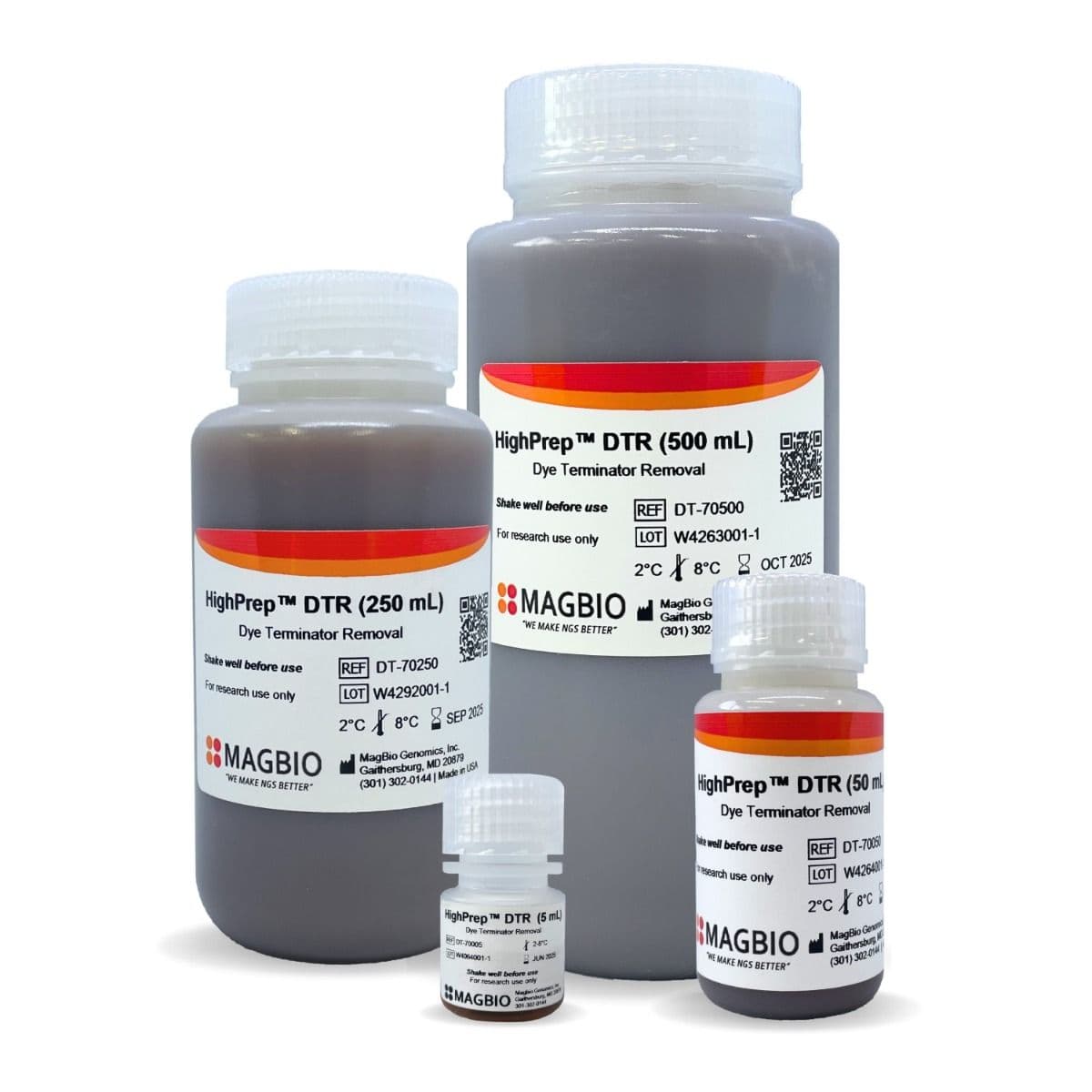
HighPrep DTR Magnetic Reagents: A robust paramagnetic bead-based system designed for the rapid removal of BigDye™ terminators, primers, and non-targeted amplicons to ensure reliable, high-resolution DNA readings.
-
Scalable Purification Formats: Flexible volume options ranging from 1mL to 500mL, optimized for both manual workflows and seamless integration into fully automated liquid handling workstations for high-throughput sequencing labs.
How to choose a Sanger DTR product
Cleanup chemistry
Gel-filtration cleanup remains one of the most commonly used approaches for Sanger sequencing purification. Products such as Performa DTR remove excess dye terminators, salts, nucleotides, and short primers without introducing additional chemicals that may affect downstream analysis. Optima DTR products use proprietary resin technology to achieve similar purification performance while offering additional format flexibility.
Processing format
Single-sample spin cartridges are suitable for laboratories performing occasional sequencing runs or troubleshooting individual samples.
Eight-well strip formats provide a practical solution for laboratories processing small to medium batches without requiring a full 96-well workflow.
Ninety-six-well plate formats are the preferred option for sequencing cores and high-throughput facilities because they allow simultaneous purification of large sample sets and direct transfer into sequencing plates.
Throughput requirements
Laboratories running a few sequencing reactions per week often prioritize convenience and flexibility. High-volume sequencing facilities generally select plate-based DTR systems that minimize handling time and support automated workflows.
Alternative cleanup methods
Ethanol precipitation is a low-cost cleanup method but requires multiple reagent additions, centrifugation steps, and careful sample handling. While effective, it is more labor-intensive and can introduce variability.
Bead-based systems such as BigDye XTerminator offer rapid purification with minimal hands-on time. These systems are often selected when workflow speed is more important than maximizing read length.
Read quality and read length
For laboratories focused on obtaining the longest possible sequence reads and minimizing retests, gel-filtration DTR methods remain the preferred choice. These systems consistently produce high-quality sequence traces with strong early-read performance and reduced dye contamination.
Chemistry compatibility
Most DTR products are compatible with multiple dye-terminator sequencing chemistries, including BigDye Terminator v1.1, BigDye Terminator v3.1, DYEnamic ET, WellRED terminators, and related sequencing reagents. This broad compatibility makes them suitable for both current and legacy sequencing workflows.
Specifications context
Modern Sanger DTR products are designed for compatibility with major capillary electrophoresis platforms and sequencing chemistries. Gel-filtration systems typically use hydrated matrices that require no additional preservatives or buffer exchanges and allow purified sequencing products to be loaded directly into sequencing plates after centrifugation.
As of 2026, gel-filtration DTR cleanup in 96-well plate format remains the most widely adopted purification method in academic, clinical, and commercial Sanger sequencing facilities because of its strong performance in read length, sequence quality, and retest reduction. Bead-based purification systems continue to gain adoption in laboratories where rapid turnaround and high-throughput processing are primary workflow priorities.
Optimize your sequencing cleanup— contact the MBP team today for a quote on our professional HighPrep DTR solutions.
FAQ