Urine DNA Extraction Kits for Cell-Free and Cellular DNA
Urine DNA extraction kits purify cellular and/or cell-free DNA from up to 40 ml of urine using a conditioning or stabilization buffer followed by precipitation, lysis, and silica spin-column purification, producing DNA suitable for qPCR, sequencing, arrays, and DNA methylation analysis. A urine stabilization reagent can preserve DNA at ambient temperature for up to one month after collection, addressing the rapid degradation of cell-free DNA in untreated urine.
Researchers working on liquid biopsy or non-invasive genotyping projects can choose a kit based on whether cell-free, cellular, or both DNA fractions are needed, and MBP's specialist team can help match stabilization chemistry to your sample collection workflow. Request a quote today by contacting customerservice@mbpinc.net for expert assistance.
Urine
Showing 1 to 1 of 1 results
What are urine DNA extraction kits?
A urine DNA extraction kit purifies cellular and/or cell-free DNA from urine using a stabilization or conditioning buffer to prevent degradation, a precipitation step, chemical lysis and enzymatic digestion, and silica spin-column purification, yielding DNA suitable for qPCR, sequencing, arrays, and DNA methylation analysis. Related entities include cell-free circulating DNA (cfDNA), liquid biopsy biomarker discovery, urine stabilization reagents, and downstream methylation-sensitive PCR. Choose a urine-specific kit over a general blood/tissue kit whenever cell-free DNA recovery or extended ambient storage of urine samples is needed, since cfDNA in untreated urine degrades rapidly.
What you will find:
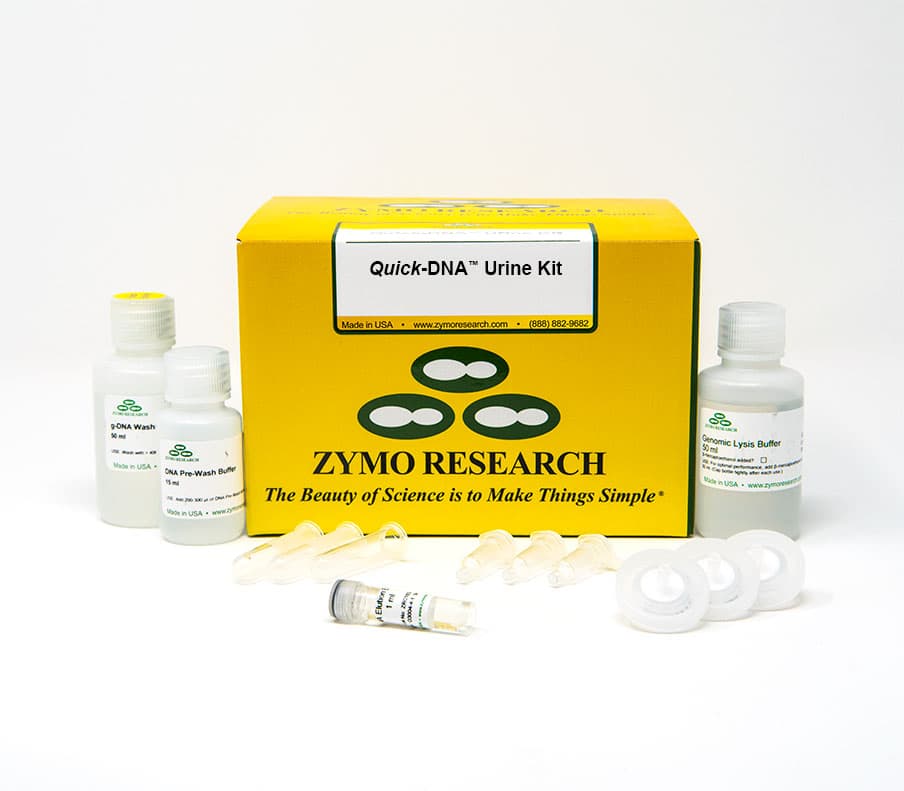
- Quick-DNA™ Urine Kit is designed for high-quality purification of cell-free DNA (cfDNA) and cellular DNA from urine samples
- Enables efficient recovery of nucleic acids suitable for sensitive downstream molecular biology workflows
- Supports PCR and qPCR-based analysis with high sensitivity and reproducibility
- Widely used in biomarker discovery and liquid biopsy research applications
- Suitable for non-invasive diagnostic and translational research studies
How to choose a urine DNA extraction kit
Cell-free vs. cellular vs. total DNA
Some urine DNA kits target cell-free DNA only, others cellular DNA only, and some recover both fractions from the same sample with different processing steps; cellular DNA generally requires pelleting cells by centrifugation before lysis, while cell-free DNA requires the supernatant after this step. Identify which fraction your application needs, since cfDNA-focused biomarker work and cellular DNA genotyping have different processing requirements.
Stabilization at collection
Because circulating cell-free DNA in non-stabilized urine is rapidly degraded by high nuclease activity after collection, a stabilization or conditioning buffer added at collection can preserve DNA at ambient temperature for up to about one month; without stabilization, samples should be processed immediately, including a centrifugation step right after collection to separate cellular and cell-free fractions. Plan your collection logistics around whether a stabilization buffer will be available at the point of sample collection.
Input volume and concentration needs
Urine DNA kits vary in input volume capacity, from smaller-volume kits processing 250 ul to 2 mL for cell-free circulating DNA, up to larger-volume kits processing up to 40 mL for combined cellular and cell-free DNA with a precipitation step. Match input volume capacity to your typical collected sample volume rather than diluting or splitting samples across multiple preps.
Downstream application fit
DNA from urine extraction kits is generally compatible with qPCR, methylation-sensitive PCR, microarrays, NGS, and Southern blot analysis, with cfDNA fragment size profiles varying by donor and by extraction kit chemistry. For liquid biopsy applications sensitive to nucleosomal-sized fragments, confirm the kit's reported fragment size distribution matches your assay's requirements.
Specifications context
The key specs for urine DNA extraction are which DNA fraction (cellular, cell-free, or both) the kit targets, whether a stabilization buffer is included for ambient storage, and input volume capacity matched to your collection protocol. A kit processing up to 40 ml with a stabilization reagent good for about one month at ambient temperature addresses the core logistical challenge of urine-based cfDNA work - rapid post-collection degradation. Researchers combining urine-based liquid biopsy work with other sample types often keep this category alongside viral DNA extraction kits for plasma/serum-based cfDNA work, since both address cell-free DNA but from different matrices. The parent genomic DNA extraction kits hub and broader DNA extraction kits hub link to related sample-type categories, including FFPE DNA extraction kits and blood/tissue genomic DNA kits.
MBP's specialist team can help match kit chemistry, format, and throughput to your sample type and downstream application. Contact the MBP team for personalized guidance.
FAQ