Genomic DNA Quantitation for NGS Input Quality Control
Genomic DNA quantitation covers the reagents and kits used to accurately measure the amount and quality of genomic DNA before NGS library preparation, ensuring the correct input mass is used for library construction. Fluorometric methods using intercalating dyes like PicoGreen and Qubit reagents give more accurate double-stranded DNA mass than spectrophotometry, which overestimates by detecting RNA and free nucleotides. Accurate quantitation before library prep directly affects library complexity and cluster density. Academic and core laboratories can benefit from guidance when selecting quantitation methods based on sensitivity, accuracy, and compatibility with downstream sequencing workflows.
Looking for a DNA quantitation method? Contact customerservice@mbpinc.net for a quotation and expert guidance on selecting the right assay format and workflow for your NGS sample preparation needs.
Genomic DNA quantitation
Showing 1 to 1 of 1 results
What is genomic DNA quantitation for NGS?
Accurate genomic DNA quantitation before NGS library preparation determines how much high-quality double-stranded DNA is available as library prep input, which directly affects whether the library has adequate complexity to represent the genome without excessive duplicate reads. The key methods are fluorometric quantitation using intercalating dyes like PicoGreen or Qubit dsDNA assay reagents, which specifically detect double-stranded DNA and ignore RNA and free nucleotides; spectrophotometric quantitation using NanoDrop A260 absorbance, which detects all nucleic acids and overestimates usable DNA when RNA or degraded DNA is present; and qPCR-based amplifiable DNA quantitation, which specifically measures PCR-amplifiable intact DNA.
What you will find:
DNA Normalization and Concentration:
-
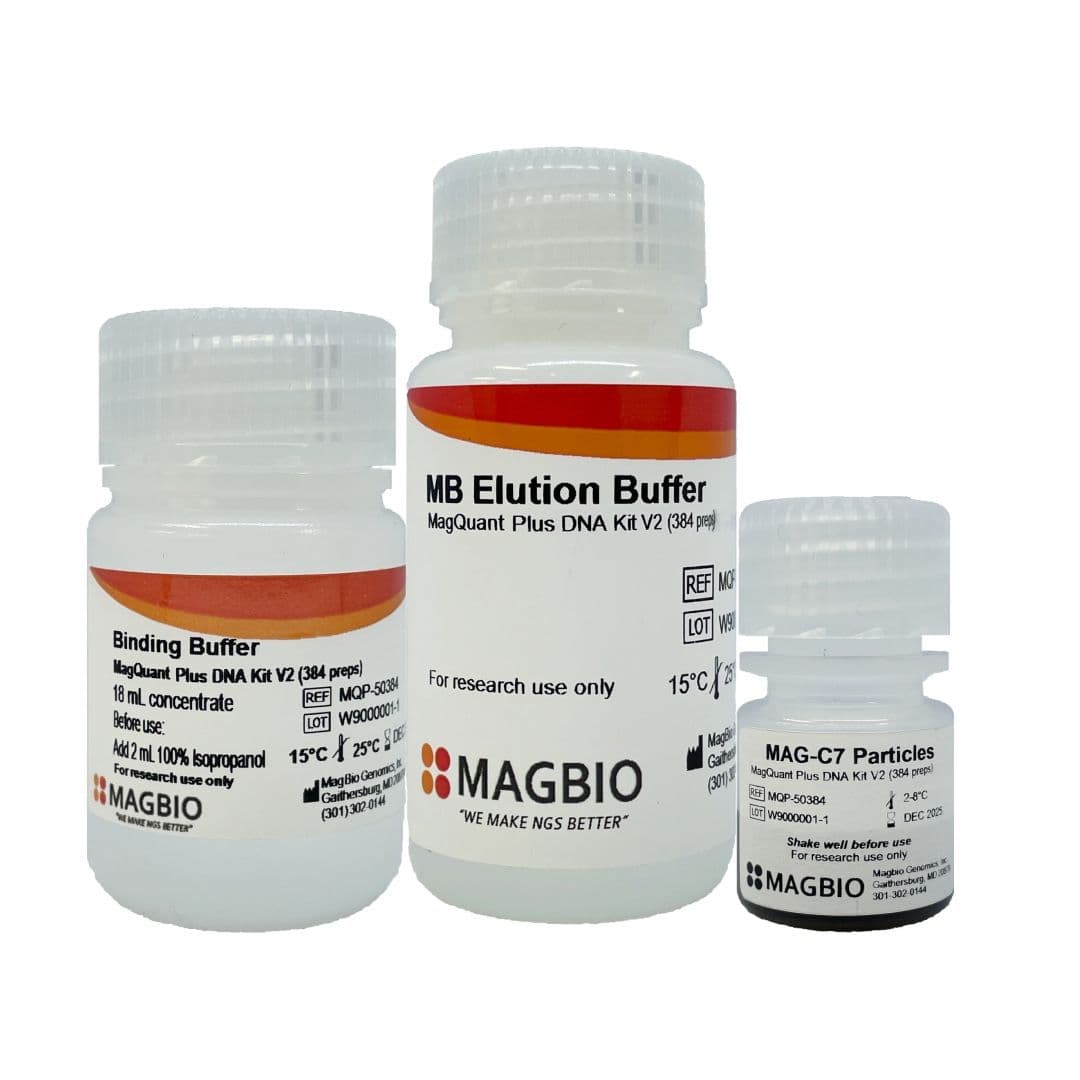
Advanced kits like MagQuant Plus DNA V2 that leverage magnetic bead ratios to normalize DNA concentrations across diverse sources, ensuring consistent input for sensitive molecular applications.
-
Proprietary Quantitation Technology: Rapid, reliable systems designed to bypass traditional quantification bottlenecks, providing a scalable solution for genomic DNA normalization and high-throughput amplicon balancing.
How to choose and use DNA quantitation for NGS
Use fluorometric quantitation for NGS input DNA — not NanoDrop alone
Fluorometric assays using dsDNA-specific dyes like PicoGreen quantify only intact double-stranded DNA, giving a more accurate measure of usable library prep input than NanoDrop, which reads total nucleic acid absorbance at 260 nm without discriminating between dsDNA, RNA, and degraded fragments. NanoDrop is useful for quick purity checks (260/280 and 260/230 ratios) but should not be used alone to determine NGS input mass.
Assess DNA integrity alongside quantity
DNA quantity alone does not confirm whether DNA is intact or degraded. A sample showing 100 ng by fluorometric assay could be fully intact high-molecular-weight DNA or a mix of intact and degraded fragments. Assessing integrity by agarose gel or Agilent TapeStation alongside quantitation confirms the DNA is useful for library preparation.
Run samples in duplicate with fluorometric quantitation
Fluorometric quantitation has inherent measurement variability. Running samples in duplicate or triplicate alongside a fresh dilution series of DNA standards allows the mean and CV to be assessed, giving confidence in the measured concentration before committing the sample to library preparation.
Check 260/280 and 260/230 ratios as purity indicators
A 260/280 ratio of approximately 1.8 and a 260/230 ratio of approximately 2.0–2.2 indicate acceptably pure DNA for library preparation. Low 260/230 ratios suggest carryover of chaotropic salts or organic solvents that can inhibit library prep enzymes.
Consider qPCR-based quantitation for the most accurate amplifiable DNA measurement
qPCR-based genomic DNA quantitation using reference locus primers amplifies specific genomic loci and quantifies only DNA templates intact enough to be amplified, providing the most accurate measure of amplifiable input DNA. This is the most informative quantitation for samples from archived or degraded sources.
Specifications context
PicoGreen fluorescence increases more than 1000-fold upon binding dsDNA, giving a sensitive and dsDNA-specific signal for quantifying genomic DNA from approximately 25 pg/ml to 1 µg/ml against lambda DNA standards. As of 2026, Qubit Fluorometer-based quantitation is the standard pre-library-prep method in most sequencing cores, with the dsDNA HS assay covering 10 pg/µl to 100 ng/µl and the BR assay covering 100 pg/µl to 1 µg/µl.
Standardize your DNA input—contact the MBP team today for a quote on our professional genomic quantitation solutions.
FAQ