DNA Normalization and Concentration for NGS Library Pooling
DNA normalization and Concentration covers the reagents and methods used to equalize DNA library concentrations and volumes after quantitation, before pooling multiple indexed libraries into a single multiplexed sequencing run. Magnetic SPRI bead-based cleanup methods are most commonly used for both size selection and normalization of sequencing libraries. Accurate normalization ensures each library contributes equal sequencing depth in a multiplexed run. Academic and core laboratories performing multiplexed sequencing can benefit from guidance when selecting normalization strategies and bead-based cleanup workflows for consistent library pooling.
Looking for a DNA normalization workflow? Contact customerservice@mbpinc.net for a quotation and expert guidance on selecting the right normalization method and SPRI-based cleanup system for your sequencing libraries.
DNA normalization and Concentration
Showing 1 to 1 of 1 results
What is DNA normalization and concentration for NGS?
DNA normalization for NGS is the process of adjusting all individual indexed sequencing libraries to the same molar concentration before pooling them into a single multiplexed sequencing run, so that each library contributes approximately the same number of sequencing reads to the total run output. Concentration may also be needed when a library is too dilute after cleanup or elution. SPRI (solid-phase reversible immobilization) magnetic bead-based cleanup, most commonly using AMPure XP beads, is the standard method for post-library-prep cleanup, size selection, and concentration in NGS workflows.
What you will find:
-
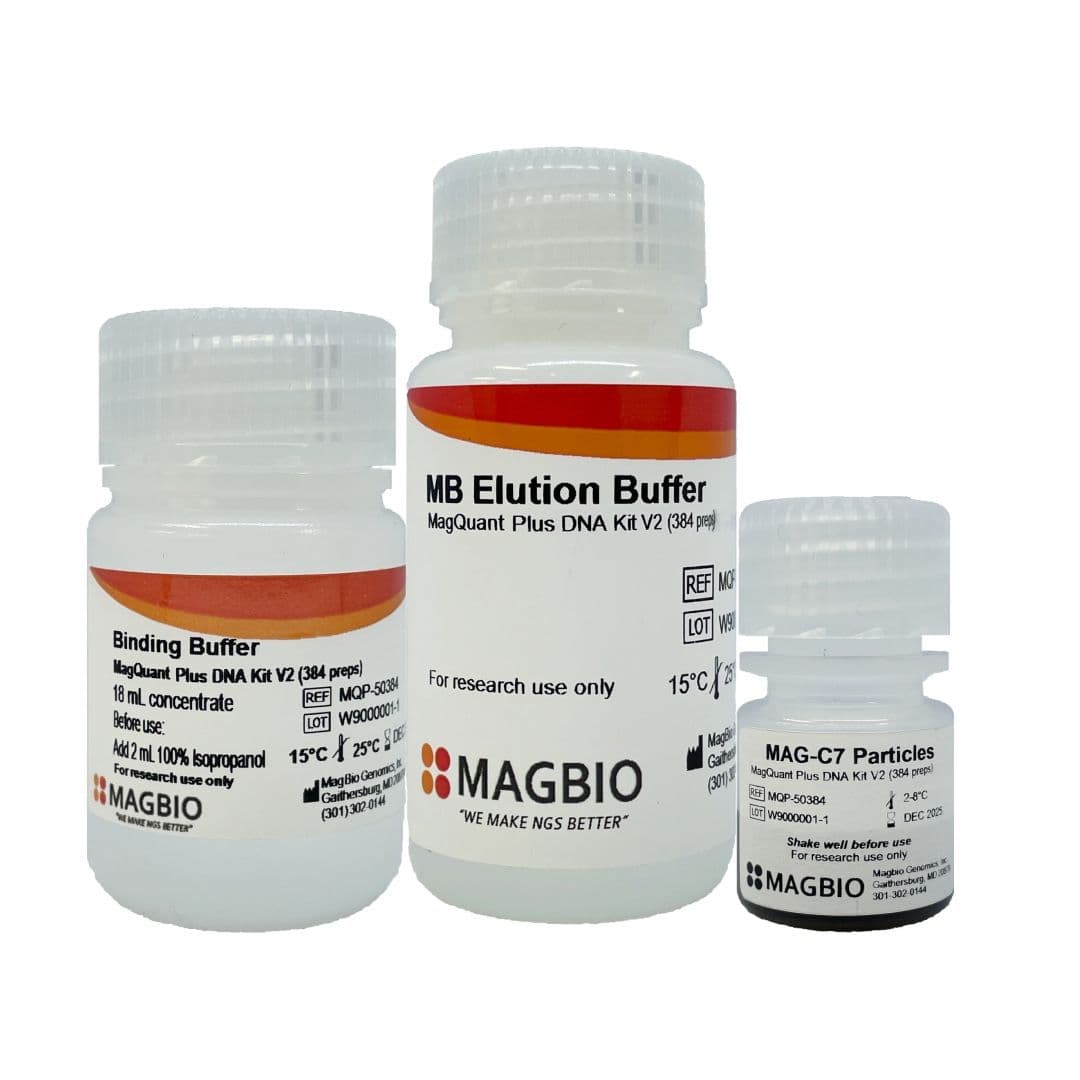
Magbio MagQuant Plus DNA Kit: for automated, high-throughput nucleic acid concentration and normalization workflows
How to normalize and concentrate NGS libraries
Quantify each library by qPCR to calculate molar concentration accurately
Kapa Library Quantification qPCR kits or equivalent measure the amplifiable, adapter-ligated molecules in a library, providing a molar concentration based on insert size that can be used to pool libraries at equal molar ratios. Fluorometric quantitation gives mass per volume but not molar concentration, and libraries with different insert sizes have different mass-to-moles conversion factors.
Calculate library molar concentration using measured mass and average insert size
If molar quantitation by qPCR is not available, the molar concentration of a library can be estimated from its fluorometric mass concentration and the average insert size from Bioanalyzer or TapeStation: molar concentration (nM) = (mass in ng/µl × 10^6) / (insert size in bp × 660 g/mol/bp). This converts mass to moles using the average molecular weight per base pair.
Pool indexed libraries at equal molar ratios for balanced depth
After calculating the molar concentration of each library, pool volumes delivering equal moles of each library into the final pool. Even small quantitation errors translate into coverage imbalances between samples in the sequencing output.
Use SPRI bead cleanup to concentrate libraries and remove adapter dimers
SPRI bead cleanup with AMPure XP beads at the appropriate bead-to-sample ratio selects for DNA fragments above a size cutoff while removing smaller adapter dimers and free adapter molecules. The final elution in a smaller volume of buffer concentrates the library. The bead ratio determines the minimum retained fragment size, with higher ratios retaining smaller fragments.
Verify the pooled library before sequencing
After pooling and final SPRI cleanup, measure the pooled library by qPCR and Bioanalyzer to confirm molar concentration and size distribution before loading, since loading concentration determines cluster density and affects sequencing performance.
Specifications context
AMPure XP SPRI beads use polyethylene glycol and sodium chloride to precipitate DNA onto paramagnetic beads in a size-dependent manner, making the bead-to-sample volume ratio the key parameter for controlling the minimum retained fragment size. As of 2026, automated bead-based normalization kits that combine quantitation and normalization remain available for high-throughput settings, though most academic labs perform manual quantitation and normalization before pooling.
Browse through the catalog and contact the expert team to book high-quality DNA normalization and concentration products today.
FAQ