NGS Library Preparation Kits for Next-Generation Sequencing Workflows
NGS Library Preparation Kits covers the kits used to convert input DNA or RNA into indexed, adapter-ligated sequencing libraries compatible with next-generation sequencing platforms. Kits span whole genome sequencing, whole exome sequencing, RNA-seq, targeted panel sequencing, and amplicon sequencing, with formats for Illumina short-read and long-read platforms including PacBio and Oxford Nanopore. Academic and core laboratories building sequencing libraries can benefit from guidance when selecting platform compatibility, library type, and application-specific workflows for optimal sequencing performance.
Looking for a specific NGS library prep kit? Contact customerservice@mbpinc.net for a quotation and expert guidance on selecting the right library format, platform compatibility, and workflow for your sequencing application.
NGS Library Preparation Kits
Showing 1 to 1 of 1 results
What are NGS library preparation kits?
NGS library preparation kits convert input nucleic acids into sequencing-ready libraries: DNA or RNA input is fragmented or amplified, end-repaired and A-tailed, ligated to platform-specific sequencing adapters, amplified by PCR to increase library quantity, and quality-checked before loading onto a sequencer. Different kit types are optimized for different input types and experimental goals, including whole genome sequencing (WGS) from genomic DNA, RNA-seq from total RNA or mRNA, targeted enrichment panel sequencing, and amplicon sequencing from PCR products.
What you will discover:
-
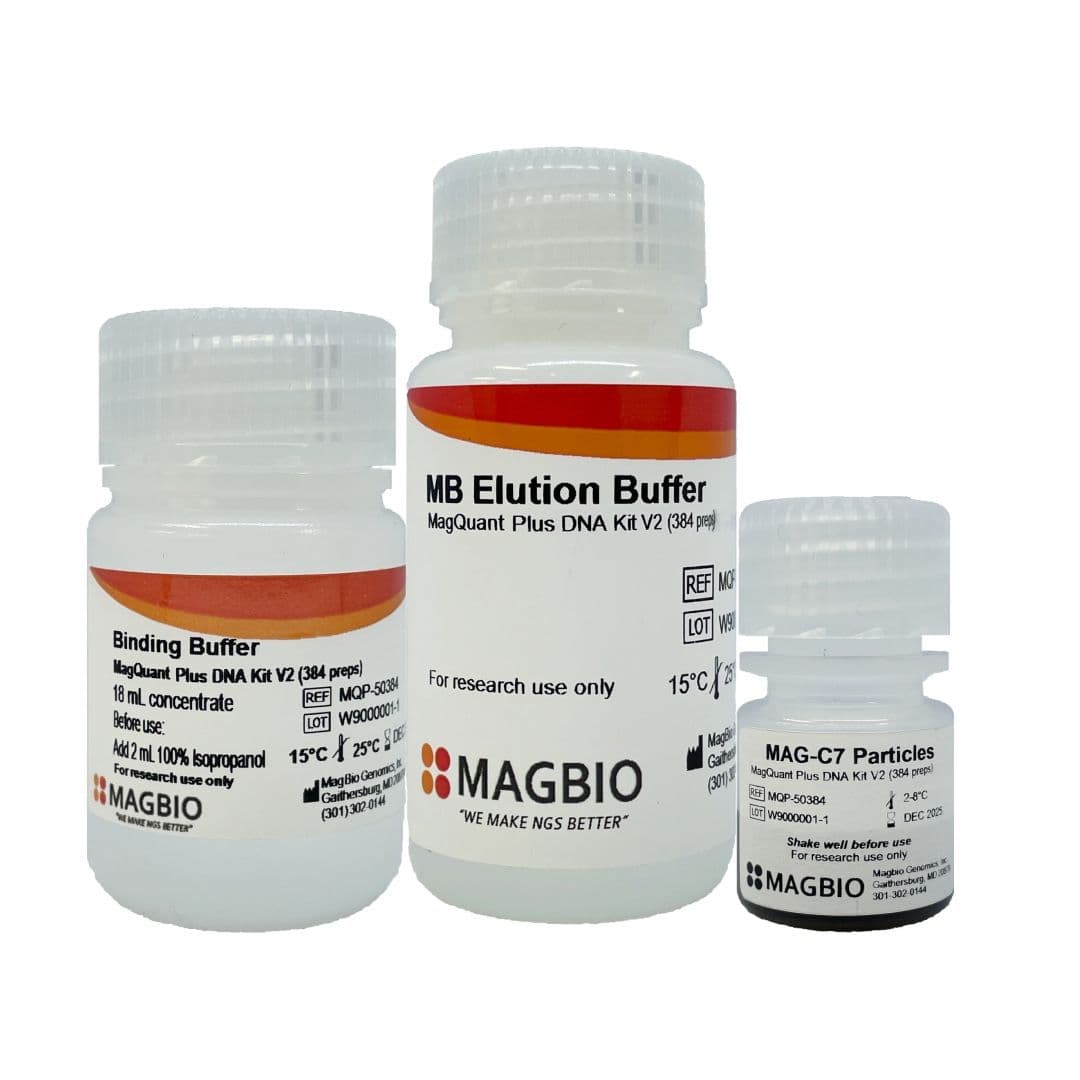
Advanced systems such as the MagQuant Plus DNA Kit V2 employ paramagnetic technology to concurrently measure and normalize DNA concentrations from various sources without requiring standard curves.
-
Flexible kit sizes varying from 10 to 5000 preparations, intended to accommodate all needs from small pilot studies to large-scale industrial NGS library creation and amplicon normalization.
How to choose NGS library preparation kits
Match your library prep kit to your input nucleic acid type
DNA library prep kits for WGS or targeted sequencing start with genomic DNA and include fragmentation (mechanical or enzymatic), end-repair, A-tail addition, and adapter ligation steps, while RNA-seq kits start with total RNA or polyA-selected mRNA, convert it to cDNA, and proceed with double-stranded cDNA library construction steps.
Confirm the kit is compatible with your sequencing platform
Adapter sequences, library structure, and minimum insert sizes differ between Illumina short-read libraries, PacBio SMRT sequencing libraries, and Oxford Nanopore long-read libraries, making platform-specific kit selection essential. Using an Illumina-optimized kit for a PacBio run will produce a library that cannot be sequenced on that instrument.
Choose a low-input or ultra-low-input kit for limited samples
Standard library prep kits are optimized for 100 ng to 1 µg of input DNA or RNA, while low-input kits support 1–100 ng and ultra-low-input or single-cell kits can work from picogram-scale input. Starting with insufficient DNA for a standard kit produces libraries of low complexity with high duplicate rates.
Decide whether a PCR-free or PCR-amplified library protocol is appropriate
PCR-free WGS library protocols avoid amplification bias at GC-extreme regions and reduce PCR duplicate rates, which is critical for variant calling accuracy, but require higher input DNA amounts. PCR-amplified protocols use fewer nanograms of input DNA but introduce bias that reduces uniformity of coverage at GC-extreme regions.
Confirm the indexing strategy supports your multiplexing depth
Dual-index libraries, using unique combinations of two barcodes per sample, provide more reliable sample demultiplexing in highly multiplexed sequencing runs and dramatically reduce index-hopping errors compared with single-index strategies, particularly on Illumina patterned flow cells.
Specifications context
PCR-free whole genome sequencing library protocols require a higher DNA input amount than PCR-amplified protocols, typically at least 200–300 ng of high-quality genomic DNA, because no amplification step increases the library amount after adapter ligation. As of 2026, enzymatic DNA fragmentation approaches for library preparation have continued to expand as alternatives to mechanical sonication, offering comparable library quality without specialized sonication equipment and enabling more consistent fragmentation of smaller input amounts.
Enhance your library complexity—reach out to the MBP team now for a price on our expert NGS preparation kits.
FAQ