Product Filters

AAV DIO / FLEX Cre-Inducible Gene Expression Vectors


MBP Inc. supplies AAV DIO (Double-Floxed Inverted Orientation) vectors for Cre recombinase-dependent, cell-type-specific gene expression. These constructs maintain the transgene in an inactive orientation until Cre-mediated recombination inverts the expression cassette into its active configuration, enabling conditional gene expression studies in vitro and in vivo for research labs across the USA and Canada.

Contact customerservice@mbpinc.net to discuss the optimal Cre-dependent vector configuration for your experimental design and target cell population.

Cre-Inducible Gene Expression (DIO) Vectors
Per Page:
Sort By:
AAV-CMV-DIO-Blank-SV40-GFP Vector
List Price:
USD362.48
Online Price:
USD258.91
Your Price:
AAV-CMV-DIO-Blank-SV40-Puro Vector
List Price:
USD362.48
Online Price:
USD258.91
Your Price:
AAV-CMV-DIO-copGFP Vector
List Price:
USD362.48
Online Price:
USD258.91
Your Price:
AAV-CMV-DIO-copGFP-SV40-Puro Vector
List Price:
USD362.48
Online Price:
USD258.91
Your Price:

Showing 1 to 4 of 4 results

What Are AAV DIO/FLEX Vectors?


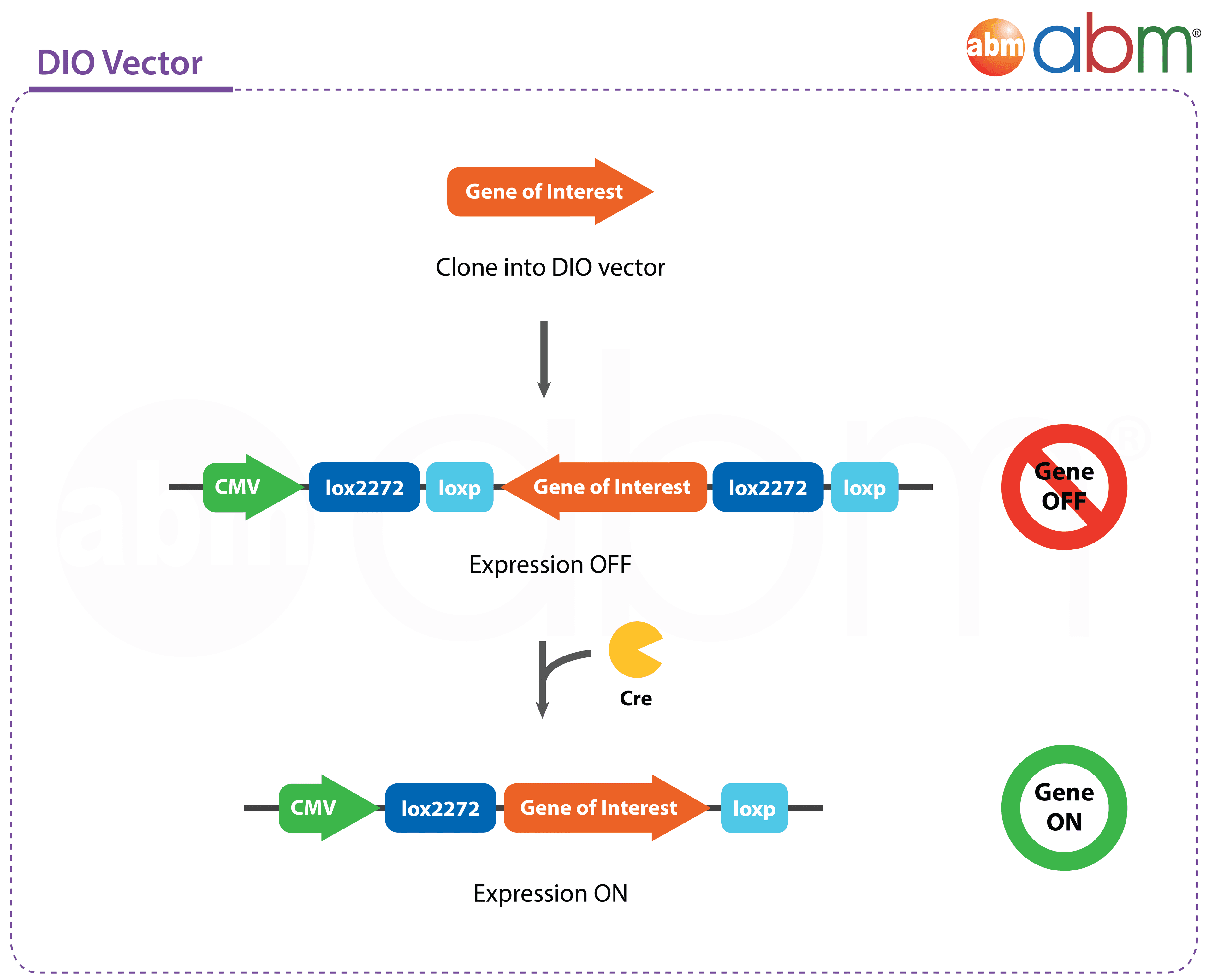
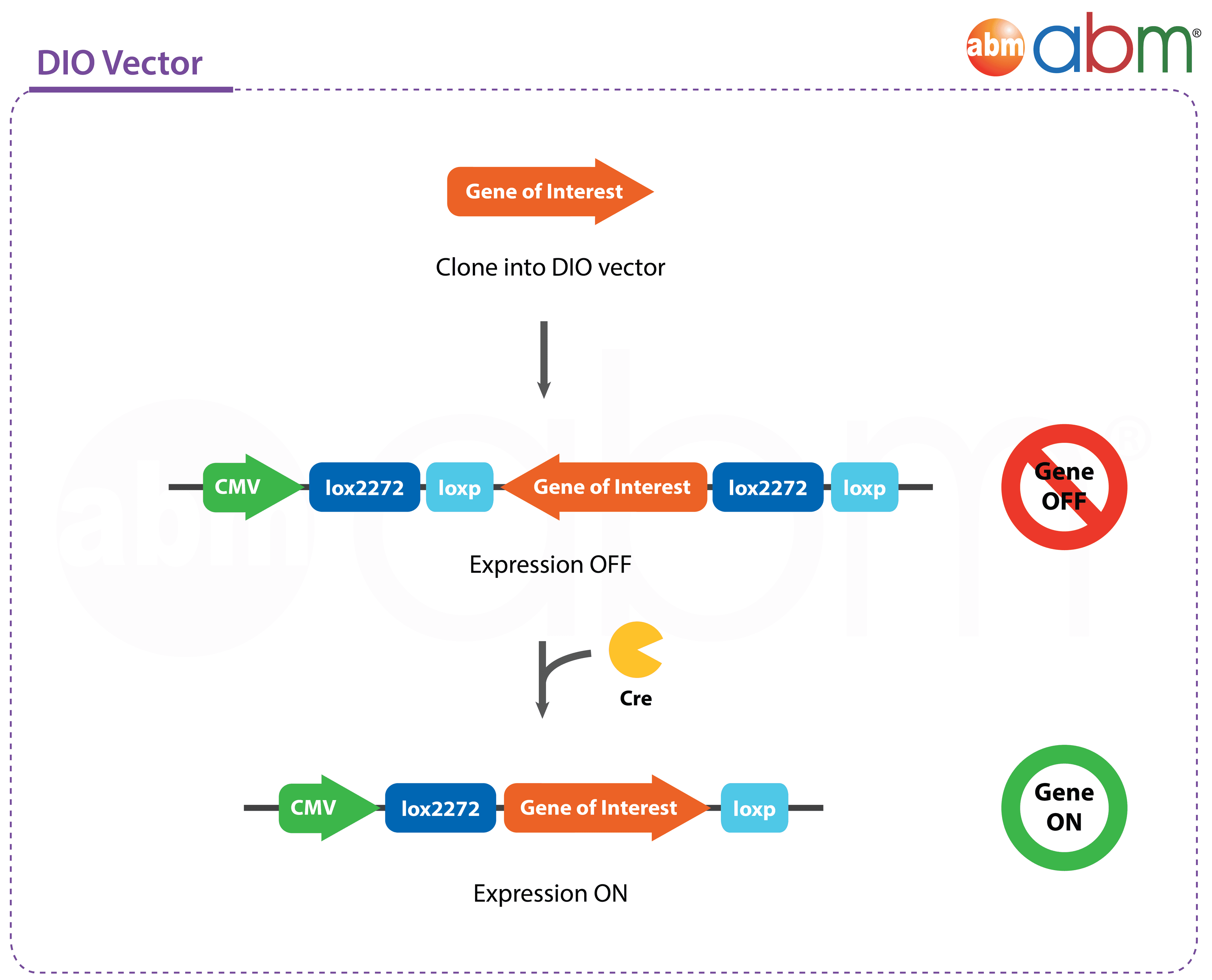
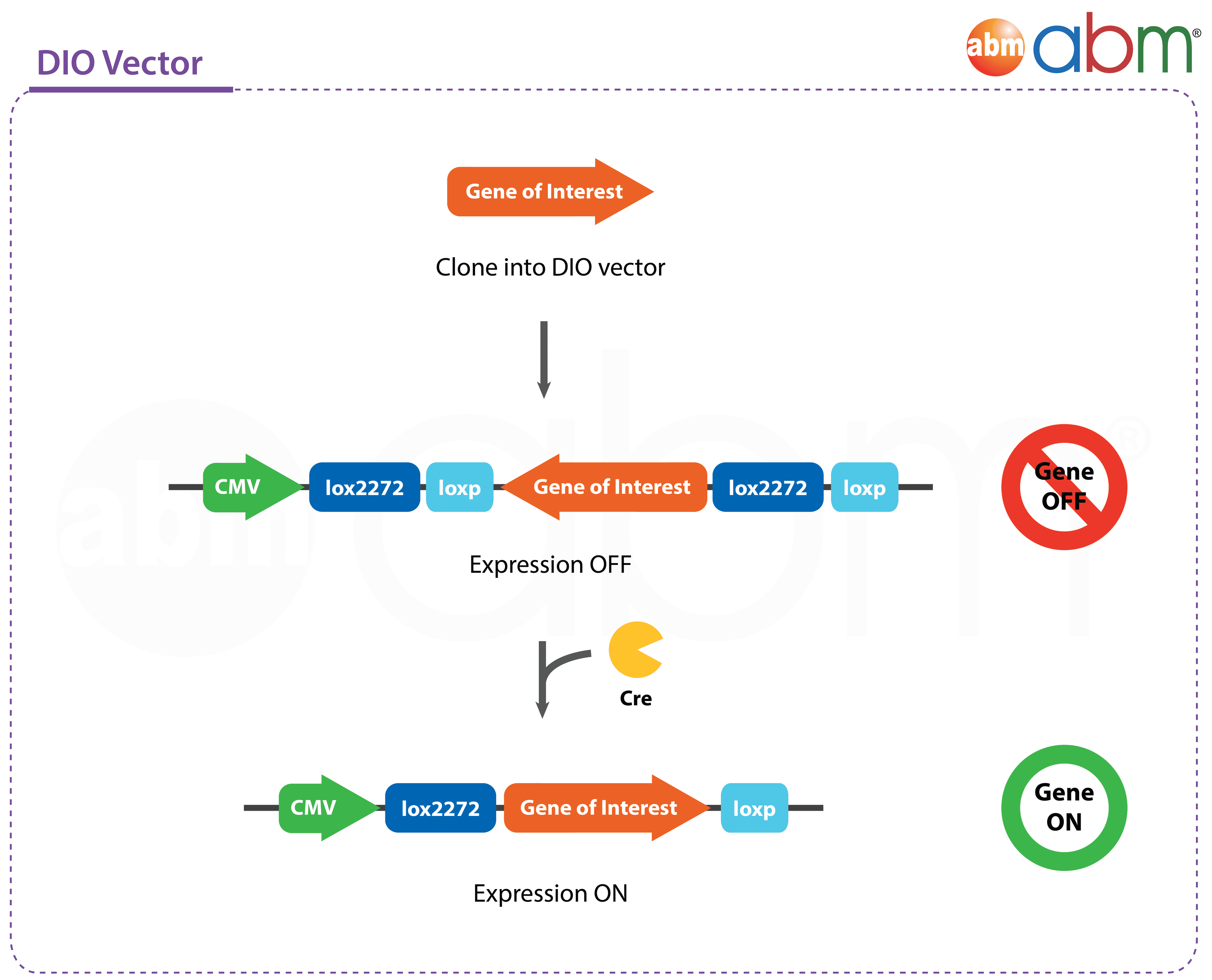
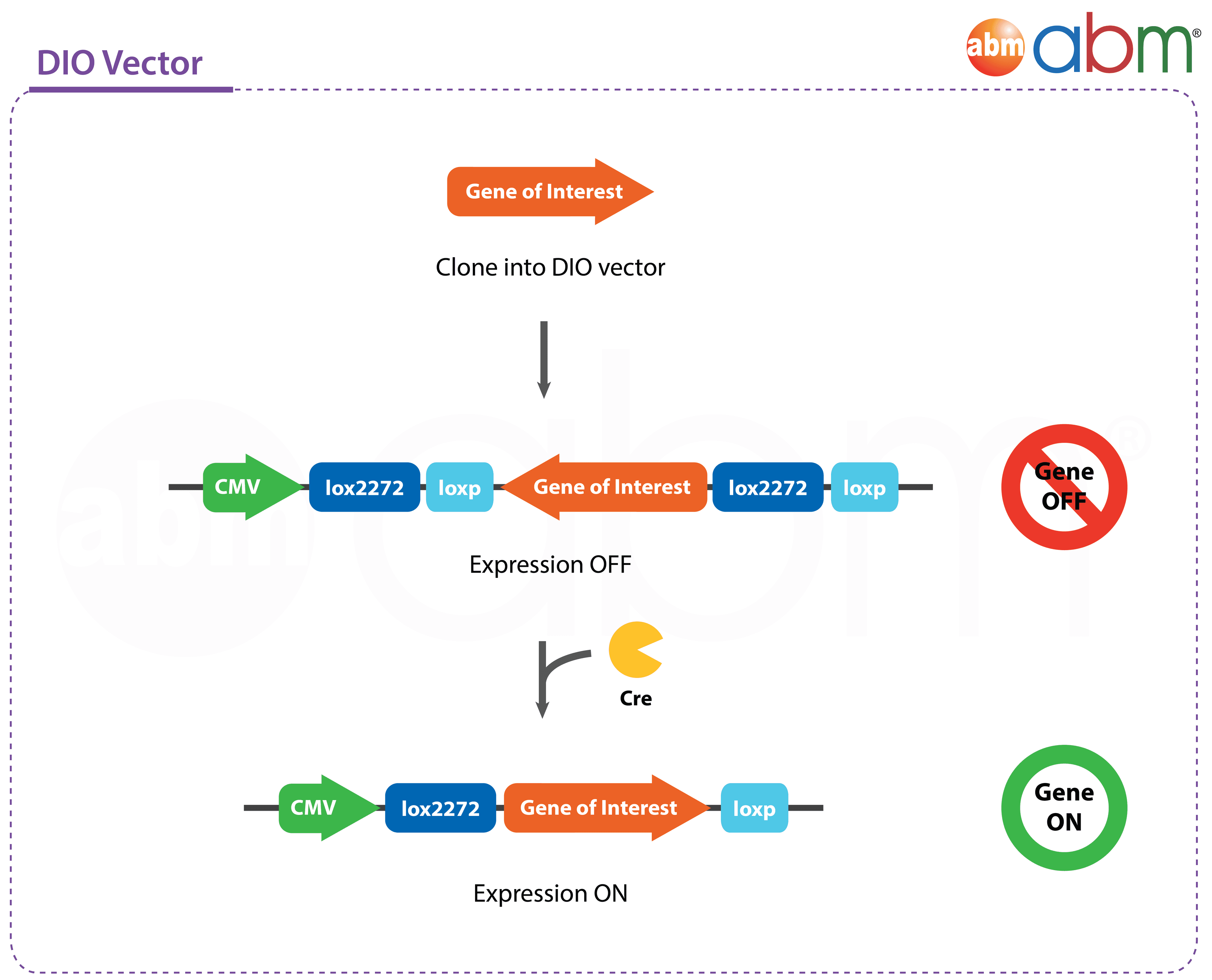
The DIO (Double-floxed Inverted Open reading frame) architecture — also called FLEX (FLip-EXcision) or Cre-ON — is the standard approach for restricting AAV transgene expression to defined cell populations in Cre-driver transgenic mouse lines. The transgene ORF is placed in an antisense (inverted) orientation flanked by two pairs of heterotypic loxP recombination sites until Cre recombinase is present.


What you will find:


  • DIO CMV Expression Vectors use the CMV promoter for Cre-dependent and highly specific transgene expression.
  • Selection-Ready DIO Plasmids used for efficient selection of antibiotics in transduced cells, and feature SV40-Puro markers.
  • Fluorescent Reporter DIO Vectors carry copGFP or GFP for visually verifying recombination.
  • Customizable DIO Blank Backbones for insertion of specific genes of interest into a conditional framework.


How to Choose an AAV DIO/FLEX Vector


Packaging Capacity Constraint
AAV DIO vectors are limited to expression cassettes of approximately 4.2 kb due to the ~4.7 kb AAV genome capacity, including the loxP recombination architecture itself — a key consideration for larger transgenes.

Cre-Driver Line Compatibility
The vector must be paired with a Cre-driver transgenic mouse line expressing Cre in the cell population of interest, or with co-delivery of a Cre-expressing vector for cell-culture validation.

Serotype for Target Region
As with standard AAV over-expression, serotype selection determines tissue tropism — critical for targeting specific brain regions or cell types in neuroscience applications.

Permanence of Activation
Once Cre flips the ORF into sense orientation and excises one site from each loxP pair, the transgene is permanently locked in the ON orientation — heritable expression is maintained without continued Cre activity.

Validation Strategy
Before in vivo injection, co-transfection of the AAV DIO vector with a Cre expression plasmid in HEK293T cells confirms efficient inversion and expected expression; transfecting the DIO vector alone confirms the absence of leaky expression.


Specifications Context


AAV DIO (Double-Floxed Inverted Orientation) vectors are widely used for cell-type-specific conditional gene expression in Cre-driver animal models, supporting applications such as circuit mapping, optogenetics, chemogenetics, and in vivo functional studies. Because transgene expression depends on Cre-mediated recombination, researchers should verify Cre-driver specificity and recombination efficiency in their chosen model before large-scale experiments. Low-level Cre-independent ("leaky") expression can occasionally occur in DIO systems and should be evaluated using appropriate control vectors. The practical packaging capacity of AAV is approximately 4.7 kb, which may limit the size of the transgene cassette that can be accommodated. Product availability reflects MBP's catalogue as of mid-2026.


Contact the expert team at MBP today and get a quote for premium AAV DIO vector requirements.

FAQ

An AAV DIO (Double-floxed Inverted Open reading frame) or FLEX vector places the transgene ORF in an antisense (inverted) orientation flanked by two pairs of heterotypic loxP recombination sites (loxP and lox2272) in alternating antiparallel arrangement. In cells lacking Cre recombinase, the inverted ORF is not transcribed. When Cre is present, it catalyzes inversion of the ORF into sense orientation, activating permanent expression that is heritable in all daughter cells.
AAV is preferred for in vivo neuronal DIO delivery because it provides highly efficient stereotactic transduction of neurons, minimal immunogenicity, and long-term episomal expression without chromosomal integration risk. AAV serotypes such as AAV2, AAV5, and AAV9 have well-characterized neuronal tropisms. Lentiviral DIO vectors offer larger cargo capacity but are less suitable for in vivo use due to integration risk and higher immunogenicity.
A DIO/FLEX Cre-ON vector has the ORF in antisense orientation by default -- it is OFF until Cre inverts it into the active sense orientation. A Cre-OFF vector has the ORF in sense orientation by default -- it is ON until Cre inverts it into the silent antisense orientation. Cre-ON is far more commonly used for selective activation of transgenes in defined cell populations.
Cre can be delivered by: injection of a separate Cre-expressing AAV into the same brain region; stereotactic injection of the DIO AAV into a Cre-driver transgenic mouse line (where Cre is expressed from a cell-type-specific promoter); or co-transfection of a Cre plasmid in cell culture for in vitro validation experiments.
Leaky expression occurs because spontaneous recombination during bacterial plasmid amplification converts 0.1 to 0.8 percent of viral genomes to the active sense orientation before packaging. This means a small fraction of DIO AAV particles can express the transgene in Cre-negative cells. Published research confirms that at standard experimental doses, leaky expression of DIO-hM3Dq-mCherry in wild-type mice produces no detectable functional effects. Using appropriate wild-type AAV controls and optimizing MOI minimizes this issue.
AAV DIO vectors are available in multiple serotypes depending on the target brain region and cell type. AAV2 is commonly used for local injection; AAV9 provides broader CNS coverage and can cross the blood-brain barrier; AAV5 is used for cortical and striatal targeting; AAV8 is used when liver off-target expression must be minimized in systemic delivery. Contact MBP for serotype guidance for your specific Cre-driver line and injection site.
Yes. DIO vectors should be validated in vitro before in vivo experiments by co-transfecting or co-transducing the DIO vector with a Cre recombinase expression construct in HEK293T or Neuro2A cells. Fluorescent reporter DIO constructs (DIO-GFP, DIO-mCherry) allow direct visualization of Cre-dependent inversion by fluorescence microscopy. Absence of signal in Cre-negative cells confirms acceptable leaky expression levels.
Common transgenes in AAV DIO vectors include: optogenetic actuators (ChR2, eNpHR3.0, Arch), chemogenetic tools (hM3Dq and hM4Di DREADDs), fluorescent proteins for cell labeling and fate mapping (GFP, mCherry, YFP, tdTomato), calcium indicators for in vivo imaging (GCaMP6), and functional proteins for conditional over-expression or loss-of-function rescue experiments in specific neuronal subtypes.
We provide the highest quality of products and anytime customer service.
Featured Categories
    online payment
    online payment
    fast delivery
    fast delivery
    technical support
    technical support
    24/7 support
    24/7 support
    copy right
    2026 All Right Reserved