Product Filters

Organoids, Spheroids, and 3D Cell Culture Reagents for Advanced In Vitro Models


Organoids, spheroids, and 3D cell culture reagents support the growth of three-dimensional cell models, including patient-derived organoids, tumor spheroids, and stem cell-derived 3D structures, in a basement-membrane matrix environment. This category includes cell culture matrices (such as basement membrane extract products), growth factor cocktails, and media supplements optimized for 3D rather than monolayer culture. Academic researchers building organoid biobanks can use MBP's specialist team to confirm matrix lot qualification and growth factor compatibility for a specific organoid type.

Explore available organoid and 3D cell culture reagents or request a quotation by contacting customerservice@mbpinc.net. Our team can help identify the appropriate matrix, growth factor combination, and media formulation for your organoid model system.

Organoids, Spheroids & 3D Cell Culture
Per Page:
Sort By:
GelNest™ Matrix, for Angiogenesis Experiment, with Phenol Red, LDEV-Free, 5 mL/bottle, 1 bottle/bag
List Price:
USD258.36
Online Price:
USD184.54
Your Price:
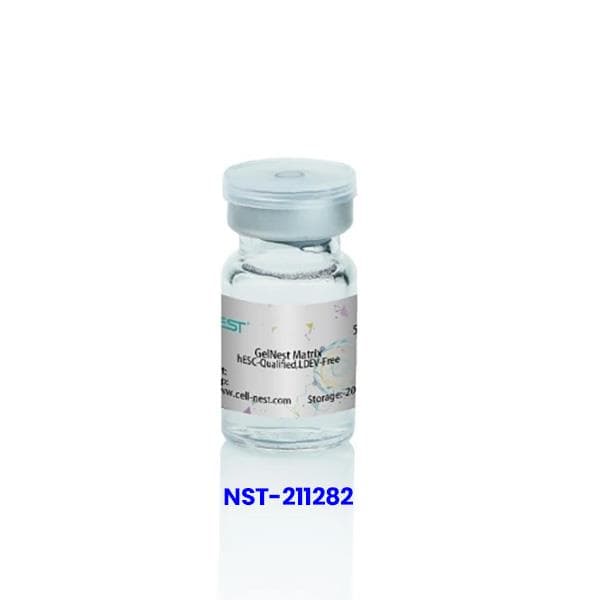
NEST GelNest Matrix, for hESC Culture, with Phenol Red, LDEV-Free, 5 mL/bottle, 1 bottle/bag
List Price:
USD263.08
Online Price:
USD187.92
Your Price:
NEST GelNest Matrix, for Organoid Culture, Phenol Red-Free, LDEV-Free, 5 mL/bottle, 1 bottle/bag
List Price:
USD245.18
Online Price:
USD175.13
Your Price:
NEST GelNest Matrix, Growth Factor Reduced, Phenol Red-Free, LDEV-Free, 5 mL/bottle, 1 bottle/bag
List Price:
USD228.23
Online Price:
USD163.02
Your Price:
NEST GelNest Matrix, High Concentration, Phenol Red-Free, LDEV-Free, 5 mL/bottle, 1 bottle/bag
List Price:
USD299.89
Online Price:
USD214.21
Your Price:
NEST GelNest Matrix, High Concentration, with Phenol Red, LDEV-Free, 5 mL/bottle, 1 bottle/bag
List Price:
USD282.55
Online Price:
USD201.82
Your Price:
NEST GelNest Matrix, Phenol Red-Free, LDEV-Free, 5 mL/bottle, 1 bottle/bag
List Price:
USD199.53
Online Price:
USD142.52
Your Price:
NEST GelNest Matrix, with Phenol Red, Growth Factor Reduced, LDEV-Free, 5 mL/bottle, 1 bottle/bag
List Price:
USD238.18
Online Price:
USD170.13
Your Price:
NEST GelNest Matrix, with Phenol Red, LDEV-Free, 5 mL/bottle, 1 bottle/bag
List Price:
USD194.50
Online Price:
USD138.93
Your Price:

Showing 1 to 9 of 9 results

What are organoid, spheroid, and 3D cell culture reagents?


Organoid, spheroid, and 3D cell culture reagents encompass the basement membrane matrices, growth factor cocktails, and media supplements used to grow three-dimensional cell models that better recapitulate tissue architecture than monolayer culture. The dedicated cell culture matrix sub-category covers basement membrane extract (BME) products used as the structural scaffold. Related entities include patient-derived organoids, tumor spheroids/tumoroids, Engelbreth-Holm-Swarm (EHS)-derived matrix, hydrogel alternatives to animal-derived matrix, and organoid biobanking.


What you'll find in this category:


  • Cell Culture Matrix: High-purity structural scaffolds and hydrogels optimized to mimic natural basement membranes, supporting multicellular organization and realistic tissue development.


How to choose organoid and 3D culture reagents


Matrix lot qualification

Basement membrane matrix products derived from EHS mouse tumors show batch-to-batch variability in growth factor content and elastic modulus (gel stiffness). For long-term organoid biobanking or reproducible screening studies, lot qualification against the specific organoid type is important before committing to large-volume purchases.

Animal-derived vs defined/synthetic matrix alternatives

Traditional basement membrane matrix is animal-derived and compositionally undefined, while newer hydrogel-based systems are more chemically defined and batch-consistent. The choice depends on whether the protocol was validated with native EHS matrix (which provides intrinsic growth factors) or supports defined alternatives designed for xeno-free workflows.

Phenol red-free and reduced growth factor formats

Phenol-red-free matrices are preferred for imaging-based organoid assays where background color or weak estrogenic activity of phenol red may interfere with readouts. Reduced growth factor formulations are used when researchers want full control over signaling inputs from externally added growth factors rather than matrix-derived contributions.

Format (dome culture vs pre-coated plates)

Matrix can be applied as embedded domes/droplets for true 3D growth or as thin coatings for “on-top” 2.5D culture systems. Dome embedding is standard for organoids requiring full ECM encapsulation, while pre-coated formats are preferred for higher-throughput screening and improved handling consistency.


Specifications context


Basement membrane matrices are characterized by protein concentration (mg/mL), endotoxin levels, LDEV-free status, and mechanical properties such as elastic modulus, which influences organoid morphology and growth behavior. Typical packaging ranges from 1 mL to 10 mL vials, with cost significantly higher than standard 2D culture reagents due to extraction complexity and lot qualification requirements.

This hub category contains the cell culture matrix sub-category for basement membrane products. Labs assessing organoid viability may also use cell stains and dyes, while those studying signaling within 3D systems often integrate receptors and modulators, including ion channel modulators, to probe functional responses in tissue-like environments. MBP’s specialist team can assist with matrix selection and lot qualification for organoid biobanking or screening workflows.

Need to secure bulk quantities of structural gels or specialized multi-well screening plates for your automation runs? Connect with the MBP sales desk today, and we'll help you configure your 3D culture setup.

FAQ

Organoids are 3D cell structures derived from stem cells or tissue progenitors that self-organize to recapitulate some structural and functional features of an organ, often requiring a basement membrane matrix for growth. Spheroids are simpler 3D aggregates of cells, often used for tumor or general 3D culture models, and may or may not require a matrix depending on the formation method.
Basement membrane matrix products derived from EHS mouse tumors are extracted from biological material, resulting in batch-to-batch variability in growth factor content and gel stiffness (elastic modulus). For long-term organoid biobanking, lot qualification testing against the specific organoid type before committing to a large purchase of a single lot is recommended.
Reduced growth factor basement membrane matrix has had certain endogenous growth factors removed or reduced compared to standard matrix, allowing a protocol's own defined growth factor cocktail to dominate the culture environment rather than competing with matrix-derived factors. This format is often paired with phenol-red-free formulations for imaging-based assays.
Defined hydrogel-based alternatives to traditional EHS-derived basement membrane matrix are available and offer more batch-consistent, often xeno-free compositions. The choice between traditional matrix and a defined alternative depends on whether the specific organoid protocol has been validated with that alternative.
Dome or droplet culture embeds cells within a matrix dome for fully 3D organoid formation, while pre-coated plate formats provide a thin matrix layer for 'on-top' 2.5D culture. The organoid type and published protocol generally determine which format is appropriate, with pre-coated formats reducing handling variability for higher-throughput screens.
LDEV (lactose dehydrogenase elevating virus) is a virus that can sometimes be present in EHS tumor-derived basement membrane matrix preparations. LDEV-free certification confirms the matrix has been tested and found free of this virus, which is important for downstream applications including animal studies and certain cell line maintenance.
Basement membrane matrix usage depends on the dome size and number of domes per well, but academic labs commonly purchase 1-10 mL vials for ongoing organoid culture programs. Cost per mL is substantially higher than standard 2D culture reagents, reflecting the specialized extraction and qualification process.
Phenol-red-free matrix is preferred for imaging-based organoid assays where phenol red's color or weak estrogenic activity could interfere with fluorescence imaging or hormone-sensitive readouts. For organoid cultures not involving imaging or hormone-responsive endpoints, standard phenol-red-containing matrix is generally acceptable and often more widely stocked across suppliers.
hESC/iPSC-qualified basement membrane matrix is formulated to support feeder-free pluripotent stem cell culture and is also used as a starting substrate in some pluripotent stem cell-derived organoid differentiation protocols. Confirm the specific differentiation protocol's matrix requirements, since organoid-specific matrix formulations may differ from those optimized for pluripotency maintenance alone.
We provide the highest quality of products and anytime customer service.
Featured Categories
    online payment
    online payment
    fast delivery
    fast delivery
    technical support
    technical support
    24/7 support
    24/7 support
    copy right
    2026 All Right Reserved