Thin Film Distillation for Continuous High-Purity Separation
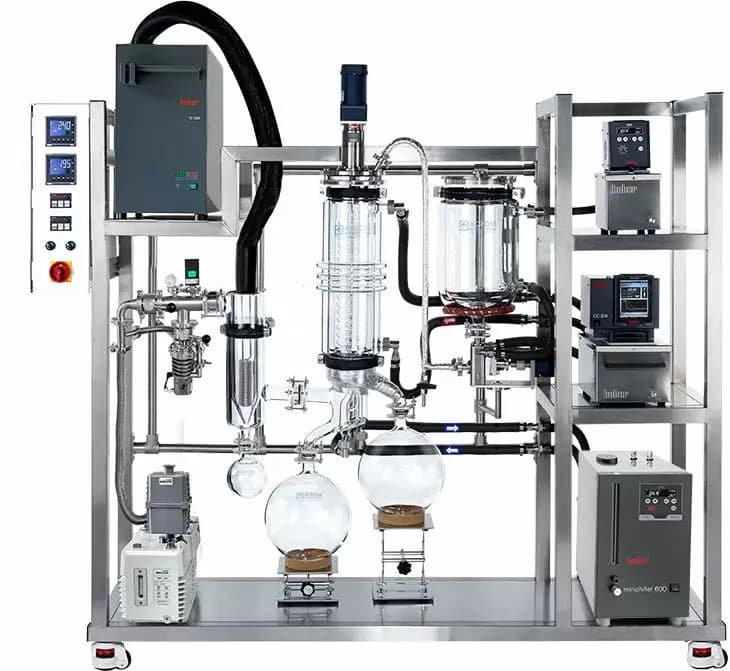
Thin film distillation systems - also called wiped film evaporators or wiped film stills - use rotating mechanical wiper assemblies to spread feed material as a thin, continuously renewed film on the inner wall of a heated vertical cylinder. This design promotes efficient heat transfer and short residence times, making thin film distillation suitable for thermally sensitive, high-boiling, or viscous compounds.
MBP provides quote-based procurement and purchase order support for thin film distillation systems for US and Canadian research and process development laboratories. Request a quote by contacting customerservice@mbpinc.net.
Thin Film Distillation
Showing 1 to 1 of 1 results
What Is Thin Film Distillation?
Thin film distillation (also called wiped film distillation, wiped film evaporation, or molecular distillation under high vacuum conditions) is a continuous thermal separation technique in which feed material is introduced at the top of a heated vertical cylinder and distributed into a thin film by a rotating mechanical wiper system. The thin film provides a large evaporation surface area, improves heat and mass transfer, and minimizes the time the product remains exposed to heat. Volatile components evaporate from the film and condense in a separate condenser, while non-volatile residue is collected independently. Operating under vacuum lowers effective boiling temperatures and helps protect thermally sensitive compounds from degradation.
What You Will Find
- Mechanically assisted film distribution systems designed for efficient evaporation and short residence times.
- High-vacuum operation to support the separation of heat-sensitive and high-boiling compounds.
- Glass and stainless steel system configurations suitable for research, process development, and production environments.
- Integrated safety and control features designed for reliable operation and process monitoring.
- Turnkey system options that simplify installation and deployment.
How to Choose a Thin Film Distillation System
Wiper system design
Wiper system design influences film formation, heat transfer efficiency, and overall process performance. Different blade and roller configurations may be available depending on feed characteristics, viscosity, and process requirements. Confirm the wiper design and material specifications of the selected system before purchase.
Vacuum level
Operating pressure is a critical factor in thin-film distillation performance. Lower pressures reduce effective boiling temperatures and help minimize thermal degradation. Confirm that the vacuum system is capable of achieving the pressure range required for the target separation.
Material of construction
Borosilicate glass systems provide process visibility and broad chemical resistance, while stainless steel systems offer enhanced mechanical durability and suitability for larger-scale operation. Verify compatibility between all wetted materials and the intended feed chemistry.
Feed viscosity
Thin film distillation is commonly used for materials ranging from low-viscosity liquids to highly viscous products. Feed properties may influence equipment configuration, operating conditions, and the need for feed preheating. Review manufacturer recommendations for the intended application.
Specifications Context
Key operating parameters for thin film distillation include residence time, vacuum level, condenser performance, and feed viscosity. Residence time should be minimized when processing thermally sensitive materials, while vacuum conditions must be appropriate for the desired separation. Condensation capacity should be sufficient to efficiently recover vaporized fractions under operating conditions. System performance depends on the proper balance of evaporation, condensation, and vacuum generation components.
Scale your production with confidence—explore our glass and stainless steel thin film systems and contact the MBP team for a quote today.
FAQ