PC Media Bottles — Autoclavable Polycarbonate for In-House Media Preparation
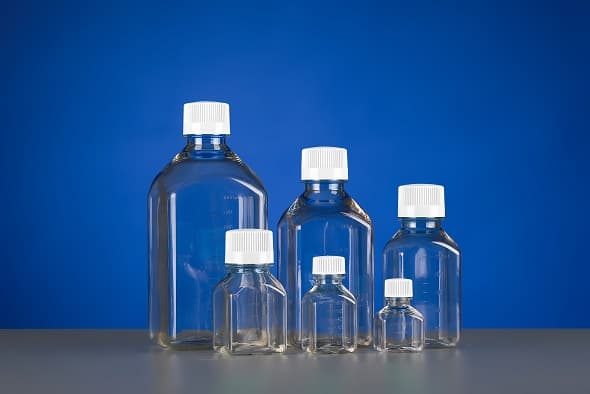
PC (polycarbonate) media storage bottles are autoclavable, shatterproof, window-clear containers rated from −135 °C to +135 °C, withstanding 5–10 autoclave cycles at 121 °C. They are the standard format for labs that prepare and sterilize large volumes of media or buffer in-house. GL45 round bottles are compatible with Millipore and Corning bottle-top vacuum filtration systems. PC contains BPA; for hormone-sensitive applications, use BPA-free PET or PETG alternatives.
MBP carries PC media bottles with direct PO ordering for labs across the USA, Canada, and worldwide. Request a quote by contacting customerservice@mbpinc.net today!
PC Media Bottles

Showing 1 to 2 of 2 results
What are PC Media Bottles?
PC (polycarbonate) media storage bottles are reusable, autoclavable, highly transparent plastic containers used to prepare, sterilize, store, and dispense tissue culture media, sera, buffers, and other aqueous solutions. Polycarbonate — a rigid aromatic polyester with carbonate linkages — is the strongest standard thermoplastic, rated for use from −135 °C to +135 °C, making it suitable for ultra-low freezer storage through repeated autoclave sterilization at 121 °C. PC is window-clear, virtually shatterproof compared to glass, and dimensionally stable after autoclaving when not placed under vacuum stress. PC media bottles are the correct choice for any in-house media or buffer preparation workflow requiring autoclave sterilization, where cost amortization across multiple autoclave cycles justifies the higher per-bottle price versus single-use PET/PETG.
What you will find:
-
30mL PC Media Bottles for small-scale reagent sampling
-
60mL PC Media Bottles for compact laboratory storage
-
125mL Polycarbonate Bottles for routine buffer handling
-
250mL PC Media Bottles for mid-range media volumes
-
500mL PC Media Bottles for standard cell culture prep
-
1000mL PC Media Bottles for large-batch reagent storage
-
2000mL Large Capacity Bottles for high-volume liquid transfer
-
5000mL PC Media Bottles for industrial-scale stock solutions
How to Choose PC Media Bottles
Number of Autoclave Cycles
Standard PC lab bottles withstand 5–10 autoclave cycles at 121 °C before mechanical strength begins to degrade, and discoloration may appear. Nalgene polycarbonate bottles (USP Class VI virgin resin, Thermo Fisher) are rated for use up to the manufacturer's cycle guidance. Each autoclave cycle causes mild hydrolytic attack on carbonate linkages — do not use PC bottles for vacuum applications after they have been autoclaved, as mechanical strength reduction raises implosion risk.
BPA Consideration
Polycarbonate contains bisphenol A (BPA) as a consequence of its carbonate-monomer chemistry. Trace BPA can leach from PC surfaces into aqueous solutions, particularly at elevated temperatures (autoclaving, warm media). For applications using estrogen receptor–positive cell lines (MCF-7, T47D), primary endocrine cells, or embryonic stem cells, BPA-free alternatives (PET or PETG) are the safer choice. For standard media preparation and non-hormone-sensitive applications, the trace BPA levels in USP Class VI PC do not affect results.
Chemical Compatibility
PC resists weak acids, alcohols (ethanol up to 70%), and aliphatic hydrocarbons. PC is not compatible with strong bases (NaOH, KOH), organic solvents (acetone, DMSO at high concentration), concentrated acids, or hydrolytic conditions at elevated pH — all rapidly degrade carbonate linkages, causing crazing, cracking, or failure. Never autoclave PC with alkaline or oxidizing cleaning agents. For compatibility questions, consult the manufacturer's chemical resistance guide.
Round (GL45) vs. Square Format
PC round bottles (Boston round profile, GL45 threaded neck) are the dominant format for media preparation because they directly accept bottle-top vacuum filtration assemblies (Millipore Stericup, Corning) and are compatible with GL45 lids and pouring rings. PC square bottles conserve refrigerator shelf space and are preferred for cold-storage media archiving. Confirm whether your bottle-top filter threading matches GL45, 38-430, or 45-400 before ordering round bottles.
Volume and Headspace
PC media bottles are available from 125 mL to 10 L. Standard cell culture volumes — 125 mL, 250 mL, 500 mL, 1,000 mL — correspond to common media kit sizes. Each bottle nominally includes 15% additional headspace for autoclaving thermal expansion (liquid expands ~4% on autoclave heating) and safe pouring; never fill above the marked maximum fill line before autoclaving.
Specifications Context
Nalgene polycarbonate bottles are manufactured from USP Class VI laboratory-grade PC resin compliant with USP and ASTM biocompatibility testing, EP monographs, EU food-contact directives, CONEG, and RoHS requirements. Temperature use range: −135 °C to +135 °C; autoclavable at 121 °C per cycle guidance. Mechanical properties: PC has a tensile strength of approximately 55–75 MPa and impact resistance that remains >50 J/m at −40 °C, making it effectively shatterproof under typical lab handling. After autoclaving, PC retains clarity but loses some tensile strength with each cycle — monitor for crazing, discoloration, or cracks that indicate end-of-service-life. As of 2026, MBP carries PC media bottles suitable for autoclave-based media preparation workflows.
Reach out to the Molecular Biology Products Inc. experts for a quote and upgrade your storage standards today.
FAQ