TC-Treated Cell Culture Flasks for Adherent Mammalian Cell Culture
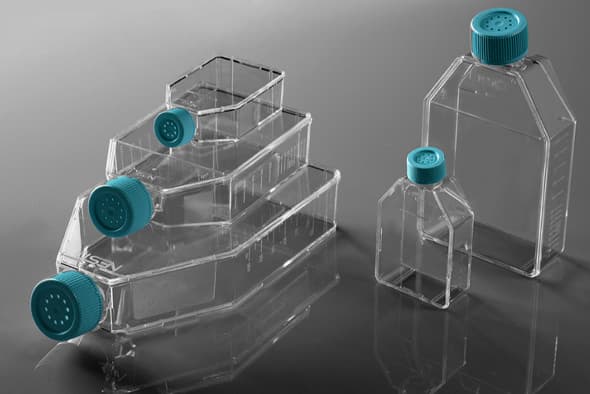
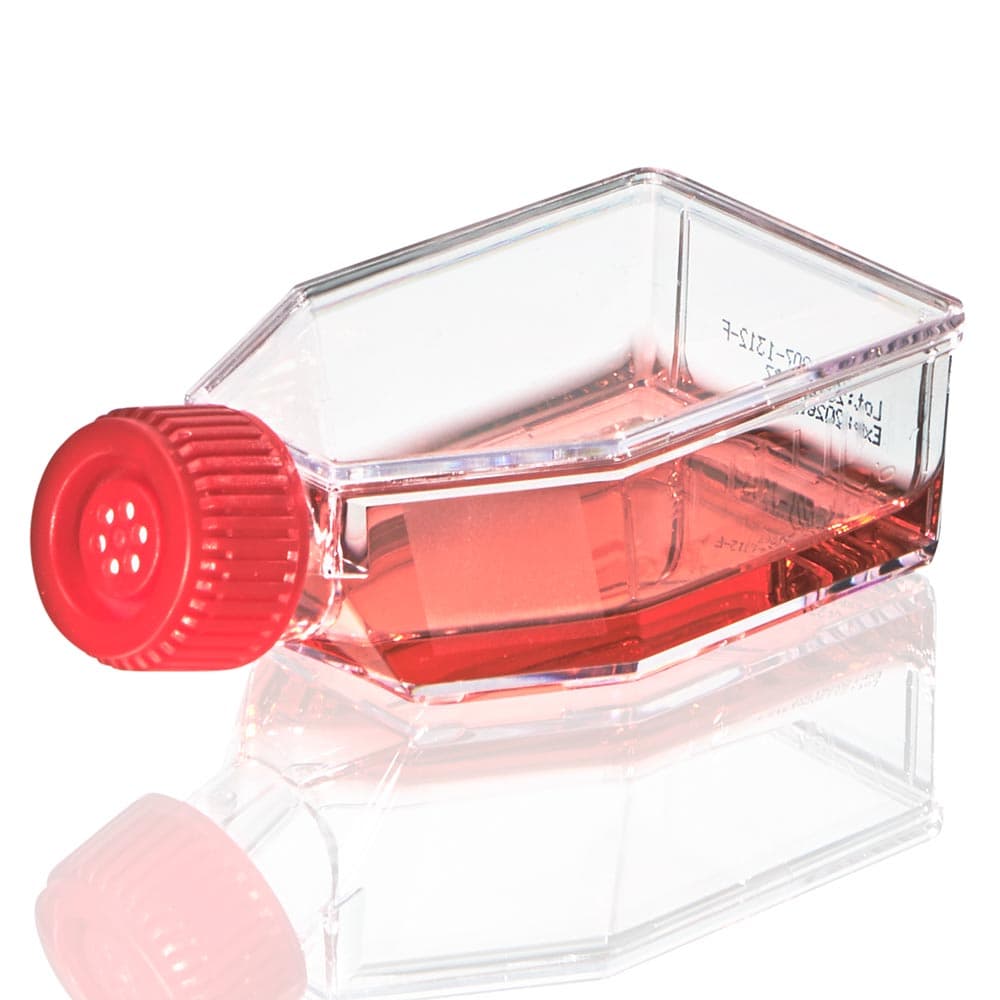
TC-treated (tissue culture–treated) cell culture flasks have a vacuum plasma–modified polystyrene inner surface with a contact angle below 10°, enabling attachment, spreading, and monolayer formation of adherent mammalian cells, including HeLa, HEK293, CHO-K1, Vero, A549, and primary cells. NEST Scientific TC-treated flasks are available in T25 (25 cm²), T75 (75 cm²), T175 (175 cm²), and T225 (225 cm²) with 0.2 µm vented or plug seal caps; E-beam sterilized to SAL 10⁻⁶; ISO 9001:2015 and ISO 13485 certified.
MBP carries the full NEST Scientific line with direct PO ordering for labs across the USA, Canada, and worldwide. Request a quote today by contacting customerservice@mbpinc.net
Treated Cell Culture Flasks

Showing 1 to 5 of 5 results
What are TC-Treated Cell Culture Flasks?
Tissue culture–treated (TC-treated) cell culture flasks are sterile polystyrene T-flasks whose inner growth surface has been modified by vacuum plasma treatment to introduce negatively charged, oxygen-containing functional groups (carboxyl, carbonyl, hydroxyl) that reduce the water contact angle from ~75–90° (hydrophobic, untreated PS) to below 10° (hydrophilic). This surface modification directly promotes cell attachment, spreading, and cytoskeletal organization in adherent mammalian cell lines. Without TC treatment, virtually all primary mammalian cells and established adherent lines, including HeLa, HEK293 (adherent), CHO-K1, Vero, A549, NIH 3T3, MDCK, and primary fibroblasts, fail to attach and undergo anoikis within 24–48 hours. TC-treated flasks are the correct default for any adherent mammalian cell line unless the experimental protocol explicitly specifies non-treated or specialized surfaces (ultra-low attachment, poly-D-lysine, collagen I).
What you will find:
-
TC-Treated Surfaces: Vacuum-plasma modified polystyrene for maximum cellular adhesion and uniform growth kinetics.
-
Gas Exchange Efficiency: Vented caps with 0.22µm hydrophobic membranes ensure sterile CO2 exchange while preventing contamination.
-
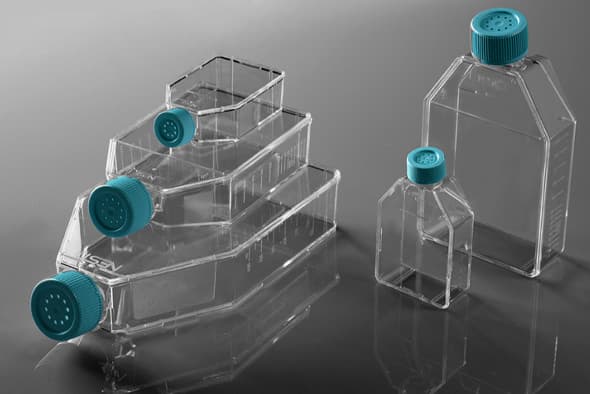
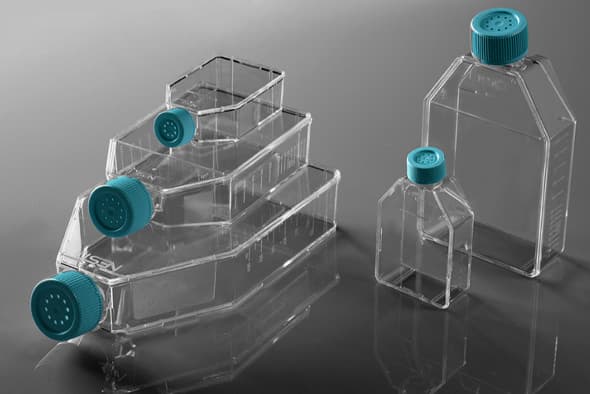
Scalable Geometry: Available in T25, T75, T175, and T225 formats to support both routine maintenance and high-yield production.
-
Advanced Ergonomics: The angled neck design facilitates complete access for cell scrapers and serological pipettes, minimizing media waste.
-
Optical Excellence: USP Class VI high-clarity material provides distortion-free microscopy for precise monitoring.
-
Certified Purity: Validated RNase, DNase, and Pyrogen-free to ensure experimental data integrity.
How to Choose TC-Treated Cell Culture Flasks
Size by Growth Area and Workflow Stage
T25 (25 cm², 5–10 mL): seed stocks, low-passage critical cell lines, newly thawed cells, and experiments requiring fewer than ~8 × 10⁶ cells. T75 (75 cm², 15–25 mL): the standard research-lab flask for routine weekly passage of most adherent cell lines; the most commonly stocked format. T175 (175 cm², 35–50 mL): scale-up for transient transfection (lipofection, calcium phosphate, PEI), viral vector production (lentivirus, AAV), and protein expression experiments requiring 35–60 × 10⁶ adherent cells per flask. T225 (225 cm², 50–70 mL): maximum single-flask density before transitioning to multi-layer BioFactory vessels; used for large-scale CHO adherent culture and high-yield antibody or virus production runs.
Vented vs. Plug Seal Cap
Vented caps with a 0.2 µm hydrophobic PTFE membrane allow free CO₂/O₂ gas exchange — mandatory for cells buffered by the bicarbonate/CO₂ system in a CO₂ incubator (typically 5–10% CO₂). Plug seal caps create a sealed environment; use them for short-term transport between incubators, for HEPES-buffered media that do not require CO₂, or for anaerobic culture. Using a plug seal cap in a standard CO₂ incubator blocks gas exchange and acidifies the medium within 2–4 hours.
Straight vs. Canted Neck
Straight-neck flasks are the traditional geometry; canted (angled) neck flasks tilt the growth surface away from the neck, improving pipette access during media changes and cell harvesting. NEST Scientific uses a canted neck design across all flask sizes. Confirm your biosafety cabinet arm reach and pipette length before committing to one geometry in bulk.
Lot-to-Lot Consistency
For long-running experiments, drug screening, or validated bioprocess workflows, lot-to-lot TC treatment consistency is critical. NEST Scientific verifies contact angle on each manufacturing lot. Switching the flask lots mid-experiment can alter cell attachment density, proliferation rate, and morphology. Order sufficient flasks from a single lot for the duration of a defined experimental series.
Cells That Require TC-Treated Surfaces
HeLa, A549, Vero (BSC-1), HEK293 (adherent), CHO-K1 (monolayer), MDCK, NIH 3T3, MCF-7, U2OS, PC-3, HepG2, primary dermal fibroblasts, primary endothelial cells, primary epithelial cells, and most primary culture preparations require TC-treated surfaces. Cells that must NOT be cultured on TC-treated surfaces include Jurkat, K562, HL-60, suspension CHO-S, hybridomas, Sf9/Hi5 insect cells, and hematopoietic progenitor cells — use non-treated flasks for all of these.
Specifications Context
NEST Scientific TC-treated flasks are manufactured from 100% virgin polystyrene in ISO 8 (Class 10,000) cleanrooms. Vacuum plasma TC treatment is verified by water contact angle goniometry per manufacturing lot; contact angle <10° is the release criterion. E-beam sterilization achieves SAL 10⁻⁶; flasks are DNase/RNase-free and non-pyrogenic per lot certificate. Vented cap 0.2 µm PTFE hydrophobic membrane is certified free of particles per USP Particulate Standard. Flask footprint dimensions comply with standard CO₂ incubator shelf spacing: T25 (100 mm width), T75 (150 mm), T175/T225 (167 mm). Double-layered Tyvek packaging maintains sterility until the point of use. NEST Scientific holds ISO 9001:2015, ISO 13485, and ISO 11137 certifications, and has FDA registration and CE marking. As of 2026, MBP is a registered vendor for Howard Hughes Medical Institute, Vanderbilt University, and MD Anderson Cancer Center.
Connect with the helpful team at MBP today to secure a customized quote for your facility.
FAQ