RNA Sequencing Library Prep Kits for Transcriptomics
RNA sequencing (RNA-seq) library preparation kits convert total RNA or enriched RNA fractions into indexed, sequencer-ready cDNA libraries for transcriptome-wide gene expression analysis, differential expression studies, isoform detection, fusion transcript discovery, non-coding RNA profiling, and single-cell transcriptomics on Illumina and other short-read platforms.
MBP supplies RNA-seq library prep kits from Zymo Research, including the Zymo-Seq RiboFree Total RNA Library Kit - which features probe-free rRNA depletion validated across all organisms and is supported by 150+ peer-reviewed publications - with US order processing in Houston, Texas, and shipping across North America and internationally. Request a quote by contacting customerservice@mbpinc.net.
RNA Sequencing
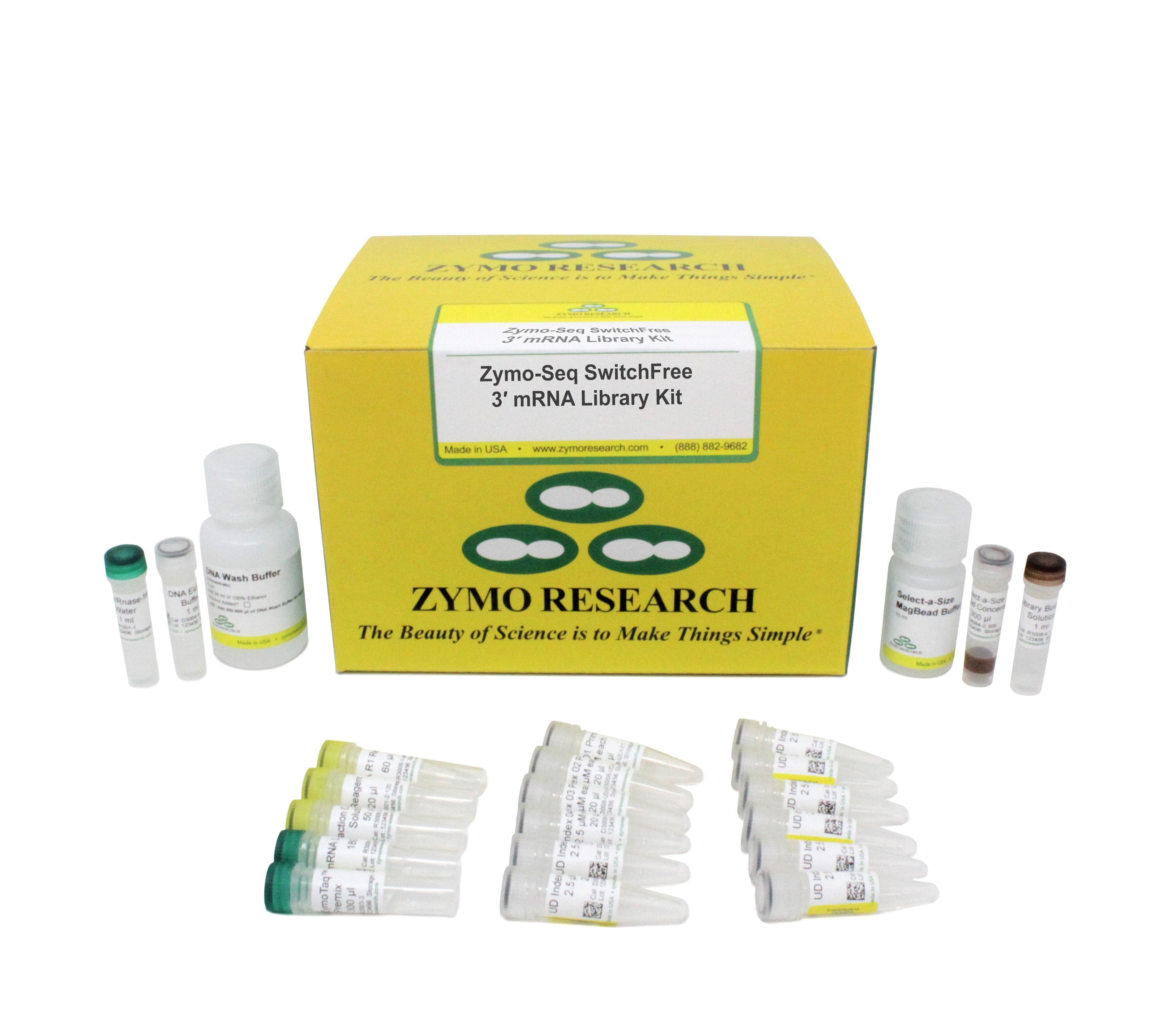
Showing 1 to 1 of 1 results
What Is RNA Sequencing?
RNA sequencing (RNA-seq) uses next-generation sequencing to profile the transcriptome -- the complete set of RNA molecules produced by a cell or tissue at a given time. Ribosomal RNA (rRNA) comprises over 90% of total cellular RNA and generates no useful transcript information in standard transcriptomics experiments; its removal is therefore the key step that differentiates RNA-seq library prep approaches. The two primary enrichment strategies are poly-A selection (oligo-dT capture of polyadenylated mRNA, compatible with high-quality RNA) and ribosomal RNA depletion (removal of rRNA using hybridization probes, antisense oligonucleotides, or probe-free enzymatic depletion, compatible with degraded, FFPE, or non-polyadenylated RNA). Stranded (directional) library preparation preserves the strand orientation of each transcript during cDNA synthesis, enabling disambiguation of overlapping sense/antisense transcripts and more accurate quantification of antisense lncRNAs and imprinted gene clusters. Choose your RNA-seq kit based on RNA input amount, sample quality (RIN or DV200), organism (model vs. non-model), whether non-coding RNA information is needed, and downstream analysis goals (quantification, isoform, de novo assembly).
What you will find:
-
SwitchFree™ 3′ mRNA Libraries: Cutting-edge kits such as the Zymo-Seq series that attach adapters directly to first-strand cDNA, shortening library prep duration to around 4 hours and minimizing manual reagent handling.
-
High-Resolution Quantification: Systems equipped with Unique Molecular Identifiers (UMIs) for precise deduplication, along with compatibility for just 10 ng of total RNA, enabling thorough high-throughput gene counting without prior mRNA enrichment.
How to Choose RNA-Seq Library Prep Kits
mRNA-seq vs. total RNA-seq
mRNA-seq (poly-A selection) starts with 25 ng-1 microgram of high-quality total RNA (RIN above 7 recommended) and produces libraries enriched for protein-coding polyadenylated transcripts, delivering higher read depth per expressed gene. It is the most commonly requested RNA-seq type for differential gene expression (DGE) studies of model organisms. Total RNA-seq (rRNA depletion) accepts 10 ng-1 microgram of total RNA, accommodates lower-quality RNA (RIN above 3, DV200 above 30%), and captures both coding and non-coding RNA, including lncRNA, eRNA, pre-mRNA, and mitochondrial RNA -- critical for FFPE tissues, bacteria, or non-model organisms without polyadenylated mRNAs.
rRNA depletion technology: probe-based vs. probe-free
Traditional rRNA depletion uses biotinylated antisense oligonucleotide probes to hybridize and magnetically deplete specific rRNA species. This approach requires species-specific probe sets (human/mouse/rat, plant, bacteria) and cannot efficiently deplete rRNA from non-model organisms or mixed samples. Zymo Research's RiboFree technology uses a probe-free enzymatic approach that depletes rRNA by using the input RNA as its own template for reverse transcription, generating cDNA from highly abundant sequences and enzymatically removing them -- making it universally compatible with RNA from any organism (human, animal, plant, bacteria, virus, environmental samples) without requiring species-specific probes.
Strand specificity
Stranded (directional) RNA-seq is now the standard for most applications because it preserves transcript orientation, allowing sense and antisense transcripts to be distinguished, improving mapping accuracy in regions of overlapping transcription, and enabling quantification of antisense lncRNAs. Most modern RNA-seq kits, including Zymo-Seq RiboFree, are strand-specific by default. Non-stranded (unstranded) protocols are used only in specialized contexts requiring older analysis pipelines or specific applications.
Low-input and single-cell RNA-seq
Low-input RNA-seq kits accept 1-100 ng of total RNA using template-switching reverse transcriptases that generate full-length cDNA from limited input. Ultra-low-input kits using SMART-Seq chemistry accept 10 pg-5 ng, suitable for flow-sorted cell populations or laser-capture microdissected tissue sections. Single-cell RNA-seq (scRNA-seq) using droplet microfluidics (10x Genomics Chromium) or plate-based methods captures transcriptomes from individual cells, generating library prep inputs of 0.1-10 pg per cell.
FFPE RNA-seq
FFPE-preserved tissues yield degraded RNA with low RIN values (often below 3). RNA-seq from FFPE requires rRNA depletion (poly-A selection is not effective on degraded RNA), FFPE-optimized reverse transcriptases that handle short, damaged templates, and input quality assessment by DV200 (percentage of RNA fragments above 200 nucleotides). Samples with DV200 above 30% are generally processable with rRNA depletion kits; below 30%, recovery and data quality decline substantially.
Specifications Context
RNA quality is assessed by RNA Integrity Number (RIN, scale 1-10 on Bioanalyzer; 10 is intact) or DV200 (percentage of fragments above 200 nucleotides; used when RIN is uninformative for degraded samples). The standard sequencing depth for differential gene expression mRNA-seq is 20-30 million paired-end reads per sample (150 bp x 2 on Illumina NovaSeq); total RNA-seq typically requires 25-50 million reads per sample due to residual rRNA reads even after depletion. Zymo-Seq RiboFree Total RNA Library Kit depletion efficiency reduces rRNA reads to below 5% of total reads across human, mouse, plant, bacterial, and mixed samples, validated across 150+ peer-reviewed studies cited on the product page. Direct RNA sequencing on Oxford Nanopore Technologies (without reverse transcription) has emerged as a research tool for detecting RNA base modifications (m6A, pseudouridine) and native poly-A tail lengths in addition to sequence, though library prep inputs require 10 micrograms or more of polyadenylated RNA.
Enhance your transcriptomic studies—reach out to the MBP team now for a quote on our expert RNA-seq library services.
FAQ