Bst DNA Polymerase and Enzymes for LAMP Amplification
Polymerases for LAMP and isothermal amplification provide strand-displacement activity that enables auto-cycling DNA synthesis at a constant temperature, with Bst DNA polymerase from Geobacillus stearothermophilus serving as the foundational enzyme system. Engineered variants such as Bst 2.0 and Bst 3.0 offer improved processivity and, in some formulations, enhanced reverse transcription capability for RT-LAMP applications. Lyo-ready (lyophilised) formats support ambient-temperature handling and simplified logistics for field-deployable workflows.
Academic researchers developing rapid detection assays benefit from MBP's range of standard and engineered Bst polymerase formats. Contact customerservice@mbpinc.net to request a quote today!
Polymerases
Showing 1 to 2 of 2 results
What Are LAMP Polymerases?
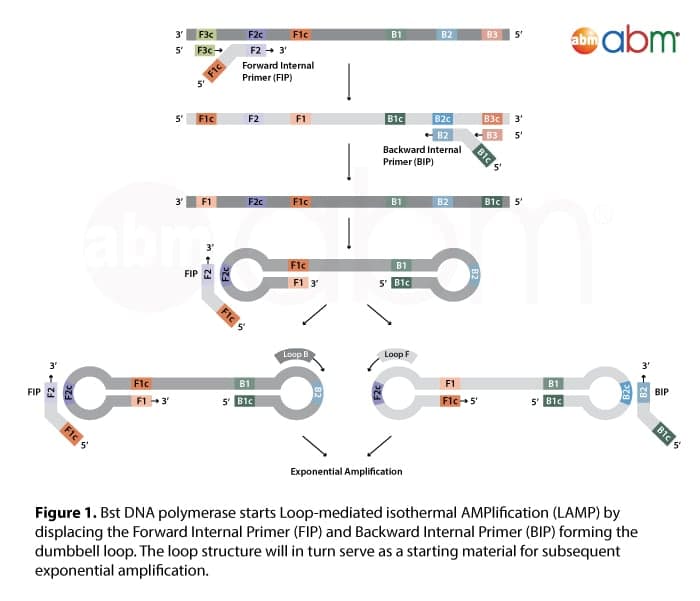
The defining enzyme of loop-mediated isothermal amplification is Bst DNA polymerase, isolated from Geobacillus stearothermophilus (formerly Bacillus stearothermophilus). Its high strand-displacement activity allows it to synthesise new DNA strands while displacing the existing complementary strand, without requiring thermal denaturation, the property that makes isothermal amplification possible. Choose standard Bst DNA polymerase for DNA-template LAMP; choose engineered Bst variants (Bst 2.0, Bst 3.0, or lyo-ready formats) for RT-LAMP applications requiring combined reverse transcriptase activity, faster reaction speed, or room-temperature-stable formats.
What you will find:
- Strong strand-displacement DNA synthesis using Bst DNA polymerase variants, enabling rapid isothermal amplification without thermal cycling.
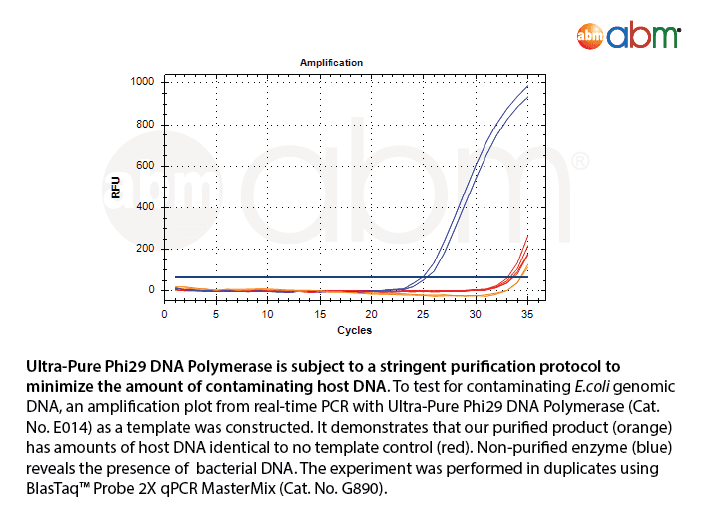
- High-efficiency Phi29 DNA polymerase systems supporting whole-genome amplification through processive strand displacement.
- Enzyme formats optimised for fast, constant-temperature nucleic acid amplification across LAMP and related isothermal methods.
How to Choose a LAMP Polymerase
Strand-Displacement Activity
Bst DNA polymerase's large fragment (Bst LF) provides the core strand-displacement activity that enables LAMP, operating at a temperature optimum near 65 °C -- this activity allows continuous synthesis and primer annealing on single-stranded regions generated during amplification, without thermal cycling.
Reverse Transcription Capability
Engineered variants such as Bst 3.0 may offer enhanced reverse transcription capability, enabling RT-LAMP workflows by supporting RNA-to-cDNA conversion within the same isothermal reaction environment.
Reaction Speed
Optimised Bst formulations can support rapid amplification in LAMP reactions, with performance depending on primer design, template quality, and reaction conditions.
Format: Liquid vs. Lyophilised
Lyo-ready (lyophilised) formats support room-temperature shipping and storage, relevant for field-deployable or point-of-need applications where cold-chain logistics are impractical. Standard liquid formulations require frozen storage but may offer cost advantages for laboratory-based use.
Pairing with Reverse Transcriptase
For RT-LAMP using polymerases without intrinsic RT activity, pairing with a reverse transcriptase whose temperature optimum overlaps with the Bst polymerase's working temperature (commonly 60-65 °C) helps maintain the isothermal format -- engineered high-thermostability reverse transcriptases are better suited to this than standard AMV or M-MLV enzymes with lower temperature optima.
Specifications Context
Bst DNA polymerase large fragment drives LAMP through strand-displacement activity at its temperature optimum near 65 °C; because LAMP uses this single-temperature synthesis instead of thermal denaturation, the enzyme's strand-displacement capability -- rather than thermostability across a wide cycling range as with Taq -- is the key performance attribute. When combining AMV or M-MLV reverse transcriptases (with lower native temperature optima) with Bst polymerase for RT-LAMP, the temperature mismatch can require a two-temperature protocol, undermining the isothermal format; this has driven engineering efforts producing polymerases such as Bst 3.0 with intrinsic reverse transcriptase activity functioning at the Bst temperature optimum. Comparative testing has shown lyo-ready Bst DNA polymerase formulations can provide significantly higher RT-LAMP reaction speed than some other commercially available Bst polymerases when tested with the same RNA targets and primer sets. LAMP polymerases are typically stored at −20 °C (liquid formats) or at room temperature (lyo-ready formats per product specification); lot-specific CoAs are available on request.
Contact the expert team at MBP today to find polymerases suited to your LAMP and isothermal amplification workflows.
FAQ