LAMP and Isothermal Amplification Reagents for Rapid Testing
LAMP (loop-mediated isothermal amplification) and other isothermal amplification reagents enable nucleic acid amplification at a constant temperature without thermal cycling, using strand-displacing DNA polymerases such as Bst DNA polymerase. RT-LAMP formats incorporate reverse transcription for RNA detection and support rapid nucleic acid screening in a simplified workflow.
Academic researchers and applied laboratories use isothermal amplification systems for fast, equipment-light detection workflows. Contact customerservice@mbpinc.net to request a quote today!
LAMP and Other Isothermal Amplification
Showing 1 to 2 of 2 results
What Is LAMP and Isothermal Amplification?
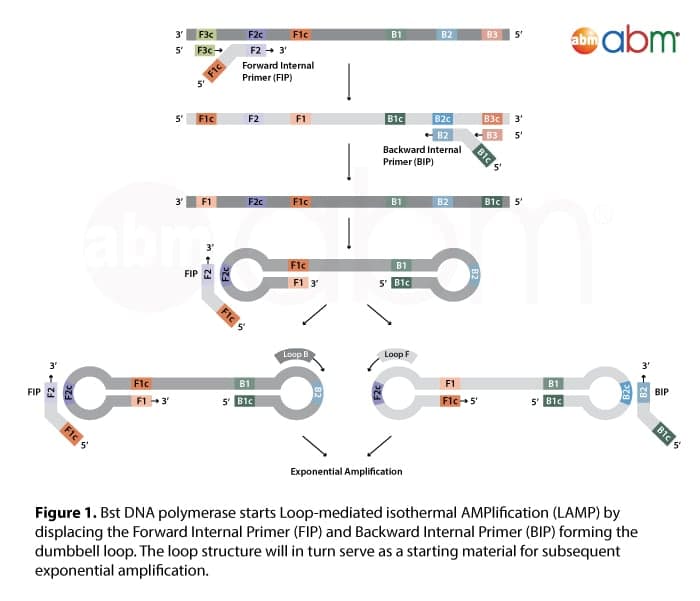
Loop-mediated isothermal amplification (LAMP), first reported by Notomi and colleagues in 2000, amplifies a target DNA sequence at a constant temperature - typically 60-65 °C- using a strand-displacing DNA polymerase, most commonly Bst DNA polymerase from Geobacillus stearothermophilus. Unlike PCR, LAMP requires no thermal cycler: amplification proceeds through auto-cycling strand-displacement synthesis, producing characteristic stem-loop DNA structures. Choose LAMP-based reagents for rapid (5-30 minute), simple, field-deployable, or point-of-need nucleic acid detection where thermal cycling equipment is unavailable, or speed is the priority; choose standard PCR when quantitative precision or compatibility with established laboratory infrastructure is more important.
What you will find:
- Strand-displacing DNA polymerases such as Bst DNA Polymerase and Phi29 DNA Polymerase enable isothermal amplification workflows without thermal cycling.
- Enzymes optimized for constant-temperature nucleic acid amplification across LAMP and related isothermal methods.
- Polymerase options supporting rapid DNA synthesis in simplified, heat-stable reaction formats for fast turnaround applications.
- Core reagents designed for streamlined setup in field diagnostics, pathogen detection, and research-based isothermal workflows.
How to Choose LAMP and Isothermal Amplification Reagents
DNA vs. RNA Targets
Standard LAMP amplifies DNA templates directly using Bst DNA polymerase. RT-LAMP (reverse transcription LAMP) incorporates a reverse transcriptase to first convert RNA targets to cDNA before LAMP amplification proceeds.
Reaction Temperature Compatibility
For RT-LAMP, reverse transcriptase and Bst polymerase ideally share a compatible temperature optimum, since LAMP's isothermal design is undermined if the reverse transcription step requires a different temperature than the amplification step - some specially evolved polymerases address this by combining strand-displacement and reverse transcriptase activities in one enzyme operating at a single temperature.
Primer Design Complexity
LAMP requires 4-6 specially designed primers per target - forward and backward inner primers (FIP/BIP), outer primers (F3/B3), and optional loop primers (FL/BL) - targeting 6-8 distinct regions of the sequence, increasing specificity but requiring more careful primer design than standard PCR's two-primer system.
Detection Method
LAMP results can be assessed by visual turbidity (from magnesium pyrophosphate byproduct), colorimetric pH-sensitive dyes, fluorescent intercalating dyes for real-time monitoring, or gel electrophoresis of the characteristic ladder-like amplicon pattern.
Application Fit
LAMP has been widely applied to the detection of viral, bacterial, and protozoan pathogens, including in environmental and field samples where standard PCR infrastructure is unavailable -- the technique's tolerance of crude sample matrices and simple readout make it well suited to rapid screening workflows.
Specifications Context
LAMP amplification can produce 10⁹-10¹⁰ copies of target DNA within 15-60 minutes through auto-cycling strand-displacement synthesis - at high target concentrations, the reaction can reach a detectable plateau in as little as 5-7 minutes. The Bst DNA polymerase large fragment (Bst LF) from Geobacillus stearothermophilus drives this process via strand-displacement activity at its temperature optimum near 65 °C, with continuous primer annealing enabled by the single-stranded regions generated during synthesis. When combining separate reverse transcriptases (AMV, M-MLV) with Bst polymerase for RT-LAMP, differing temperature optima between the two enzyme classes can complicate the isothermal format, which has driven development of engineered polymerases with combined strand-displacement and reverse transcriptase activity operating at a single temperature. LAMP and RT-LAMP reagents are typically stored at −20 °C; lot-specific CoAs are available on request.
Contact the expert team at MBP today and get optimized LAMP and other isothermal amplification reagents for your lab.
FAQ