Magnetic Bead Plant RNA Kits for 96-Well Throughput
Magnetic bead plant RNA extraction kits purify total RNA, including small RNAs ≥17 nt, from leaves, stems, roots, and seeds in a 96-well format for plant breeding screens, eQTL studies, and stress response RNA-seq programs. Paramagnetic silica-coated beads bind RNA during chaotropic lysis and magnetically separate from polyphenol and polysaccharide inhibitors during successive wash steps—no centrifugation is required for purification.
Compatible with KingFisher Flex, Tecan Fluent, and Hamilton STAR platforms. MBP supplies plant RNA magnetic bead kits to registered vendors at Howard Hughes Medical Institute, Vanderbilt University, and MD Anderson Cancer Center. Request a quote for high-throughput magnetic bead plant RNA extraction kits by contacting customerservice@mbpinc.net.
Mag Beads
Showing 1 to 1 of 1 results
What are Magnetic Bead Plant RNA Extraction Kits?
Magnetic bead plant RNA extraction kits purify total RNA from plant tissue -- leaves, stems, roots, seeds, and other plant organs -- using mechanical disruption in a specialized plant lysis buffer followed by binding of RNA to paramagnetic silica-coated beads, magnetic separation during successive wash steps to remove polyphenols, polysaccharides, and other plant-specific inhibitors, and elution in RNase-free water without centrifugation for the RNA purification phase. The 96-well format processes all samples simultaneously on liquid-handling robots (KingFisher Flex, Tecan Fluent, Hamilton STAR), enabling the scale needed for plant breeding programs, genome-wide association studies (GWAS) linked to expression, and abiotic stress response screens, processing hundreds of individual plant samples per day. Choose magnetic bead plant RNA extraction when processing more than 48 plant samples per session, when automation infrastructure is available, or when high-polysaccharide lysates cause consistent column clogging in spin-column formats.
What you will find:
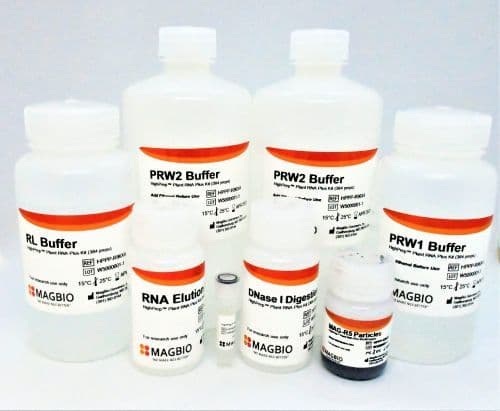
- Magbio HighPrep Plant RNA Plus Kit for rapid isolation of total RNA from complex plant tissues.
- Magnetic bead–based purification for efficient RNA recovery.
- Automation-ready workflow for high-throughput sample processing.
- Effective extraction from challenging plant sample types.
- High-quality total RNA suitable for downstream molecular biology applications.
How to Choose a Magnetic Bead Plant RNA Kit
Automation Platform and Script Availability
Confirm the kit manufacturer provides validated automation scripts for your instrument before purchase. Thermo Fisher MagMAX Plant RNA Isolation Kit provides KingFisher Flex and Apex scripts; Zymo Direct-zol-96 MagBead supports Tecan and Hamilton in addition to KingFisher. For other platforms, contact MBP's technical team to confirm script availability or the feasibility of in-house protocol adaptation.
CTAB vs. Guanidinium Lysis
Guanidinium-based lysis buffers are compatible with most magnetic bead RNA kits and are the default for standard plant species. For high-polyphenol species (Vitis, Pinus, Citrus) where guanidinium lysis produces brown, inhibitor-rich lysates, CTAB-based upstream lysis can be adapted for magnetic bead purification by adjusting the lysate-to-ethanol ratio before bead addition; confirm protocol compatibility with the specific kit before attempting CTAB lysis with magnetic bead formats.
Tissue Disruption Before Bead Extraction
Magnetic bead kits do not include mechanical disruption; plant tissue must be ground in liquid nitrogen to a fine powder or bead-beaten in lysis buffer before adding the lysate to the bead extraction plate. For 96-sample throughput, a 96-well bead mill system paired with a 96-deep-well plate is the most efficient tissue disruption setup for plant material at scale.
Small RNA Retention
Confirm the kit retains RNAs >=17 nt from plant tissue, including miRNAs, ta-siRNAs, and siRNAs. Silica bead formats generally retain the full RNA size spectrum; check the kit datasheet for the minimum RNA size retained.
Post-Extraction Quality Assessment
For large batch processing, run a representative subset (1 plate per 5 batches) on a Bioanalyzer RNA Nano chip to monitor RIN values over time. Declining RIN values across batches signal RNase contamination of reagents or incomplete tissue disruption that reduces RNA integrity before bead binding.
Specifications Context
Quality targets for magnetic bead plant RNA: A260/A280 >= 1.8, A260/A230 >= 1.5, RIN >= 7, and yield of 1-20 ug from 50 mg leaf tissue. For large-scale RNA-seq (>48 samples per run), RNA-seq library preparation kits validated for automated input (Zymo-Seq RiboFree Plant) are required downstream. High-throughput plant RNA-seq for quantitative trait loci (eQTL) studies and genomic selection in crop improvement programs at plant research institutes regularly processes 96-well batches of plant RNA, with magnetic bead extraction enabling the scale these programs require.
Contact the expert team at MBP Inc. to get optimized mag bead systems for high-throughput workflows.
FAQ