Spin-Column Insect RNA Kits with BashingBead Lysis
Spin-column insect RNA extraction kits purify total RNA, including small RNAs ≥17 nt, from whole mosquitoes, ticks, bees, lice, and Drosophila in approximately 10 minutes using ultra-high-density BashingBead lysis and a two-column Zymo-Spin architecture that removes gDNA on the first column and purifies RNA on the second. Single-insect yields reach up to 10 µg RNA in as little as 6 µl elution.
MBP carries Zymo Research Quick-RNA Tissue/Insect Microprep Kits used in vector surveillance, Drosophila immunity, and arbovirus detection workflows at Howard Hughes Medical Institute, Vanderbilt University, and MD Anderson Cancer Center. Request a quote today by contacting customerservice@mbpinc.net.
Spin-Column
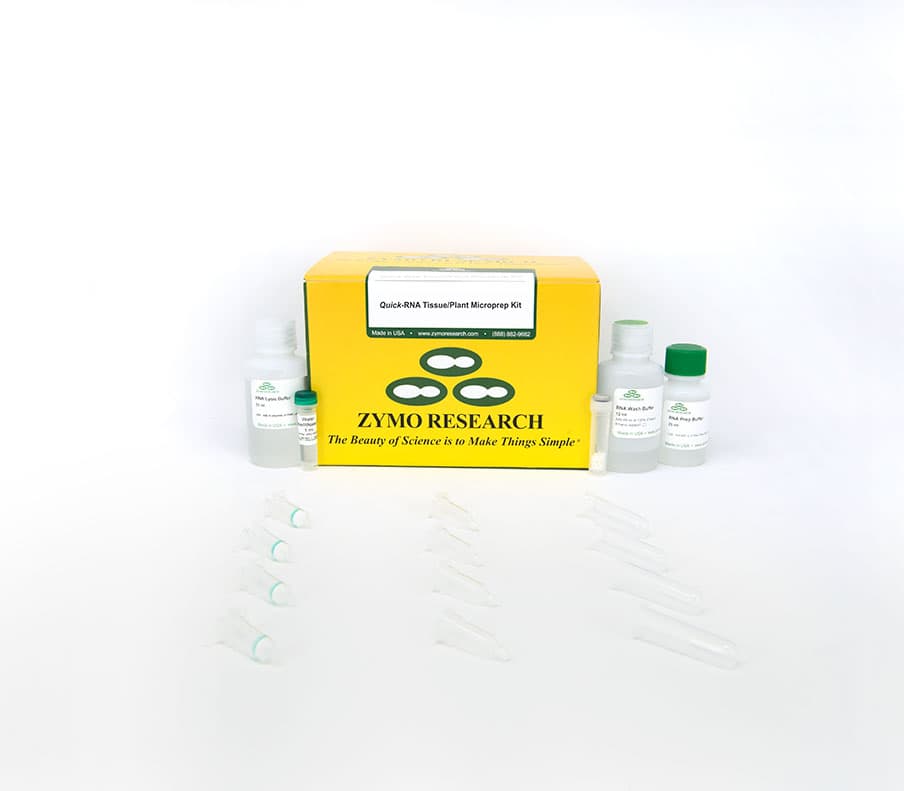
Showing 1 to 1 of 1 results
What are Spin-Column Insect RNA Extraction Kits?
Spin-column insect RNA extraction kits purify total RNA from whole arthropod specimens and insect tissue using ultra-high-density BashingBead mechanical homogenization in a chaotropic lysis buffer, followed by a two-column silica-membrane purification workflow in a standard microcentrifuge. The Zymo Quick-RNA Tissue/Insect Microprep Kit (R2030) uses a Zymo-Spin IIIC column to capture and discard genomic DNA in the flow-through, then a Zymo-Spin IC column to bind, wash, and elute total RNA, including small RNAs >=17 nt. The full protocol completes in approximately 10 minutes for batches of 1-12 specimens. Choose the spin-column insect RNA format for manual extraction of single insects to small batches, for field work using DNA/RNA Shield stabilization, and for studies requiring co-isolation of miRNA and siRNA from the same arthropod specimen.
What you will find:
- Quick-RNA™ Tissue/Insect MicroPrep Kit for rapid isolation of ultra-pure total RNA from tissue and insect samples.
- Ultra-clean spin-column technology designed to maximize RNA purity and recovery from small sample inputs.
- RNA extraction solutions optimized for challenging biological specimens, including insect tissues and dissected samples.
- High-quality total RNA preparation suitable for RT-PCR, qPCR, RNA sequencing, and gene expression analysis.
- Streamlined purification protocols that reduce processing time while maintaining RNA integrity
How to Choose a Spin-Column Insect RNA Kit
Microprep vs. Miniprep Format
The Microprep kit (Zymo R2030) processes specimens up to 10 mg and elutes in 6-25 ul, concentrating RNA for sensitive RT-qPCR from single small insects. The Miniprep format handles up to 30 mg of tissue - appropriate for dissected insect organs, larger arthropods, or small pools of 5-10 insects - and elutes in 25-100 ul for applications requiring higher total RNA mass.
Two-Column DNA Depletion vs. On-Column DNase
The two-column design (IIIC + IC column) in Zymo insect kits physically separates gDNA by binding capacity difference, eliminating a separate DNase incubation step. This is faster but less stringent than on-column DNase I treatment. For RNA-seq applications where any gDNA carryover introduces mapping artefacts, add an optional DNase I step; for RT-qPCR with intron-spanning primers, the two-column depletion alone is generally sufficient.
Bead Beating Instrument
A benchtop vortex (Vortex-Genie 2) with a horizontal microtube adapter provides validated lysis for the Zymo BashingBead Lysis Tubes at maximum speed for 5 minutes. A dedicated bead mill (e.g., Precellys, MP FastPrep) achieves more consistent disruption for hard-bodied arthropods such as hard ticks and beetles and is preferred when processing more than 24 specimens per session.
Specimen Stabilization Compatibility
Specimens in Zymo DNA/RNA Shield load directly into lysis tubes without additional washes or centrifugation steps. If specimens were field-collected in dry ice or liquid nitrogen, thaw at room temperature in lysis buffer and add to BashingBead tubes immediately - do not allow thawed specimens to sit at room temperature without lysis buffer, as RNase activity resumes rapidly on thawing.
Vector Surveillance Pooling
For arbovirus surveillance, pool up to 50 mosquitoes in the same lysis tube, cap tightly, and bead-beat at maximum speed for 10 minutes. Transfer 200-400 ul of clarified lysate (post-centrifugation) per column; multiple column reloads can process the remaining volume. Validate pool sensitivity with a spiked positive control before deploying in routine surveillance.
Specifications Context
Performance benchmarks for spin-column insect RNA: A260/A280 >= 1.8, A260/A230 >= 1.8, and RNA yield up to 10 ug from a single Aedes aegypti adult female. The Zymo Quick-RNA Tissue/Insect Microprep Kit is validated for RT-PCR, hybridization, microarray, and Next-Gen sequencing applications, and its two-column architecture is designed to deliver RNA free of PCR inhibitors - a critical requirement for arbovirus RT-qPCR assays where false-negative results from inhibitor carryover have direct public health implications. This kit is the primary insect RNA extraction format used in Drosophila immunity and mosquito vector competence research, with published protocols referencing BashingBead lysis in studies from institutions including Howard Hughes Medical Institute and Vanderbilt University.
MBP's specialist team can help match kit chemistry, format, and throughput to your sample type and downstream application. Contact the MBP team for personalized guidance.
FAQ