FFPE RNA Extraction Kits for Paraffin-Embedded Tissue
FFPE RNA extraction kits isolate total RNA, including small RNAs ≥17 nt, from formalin-fixed paraffin-embedded tissue sections and blocks using xylene-free deparaffinization, proteinase K digestion, heat-reversal of formaldehyde crosslinks, and Zymo-Spin silica-membrane purification.
MBP carries Zymo Research Quick-RNA FFPE Miniprep and Quick-DNA/RNA FFPE kits used in retrospective cancer transcriptomics at registered vendor institutions, including MD Anderson Cancer Center, Vanderbilt University, and Howard Hughes Medical Institute. Request a quote today by contacting customerservice@mbpinc.net.
FFPE
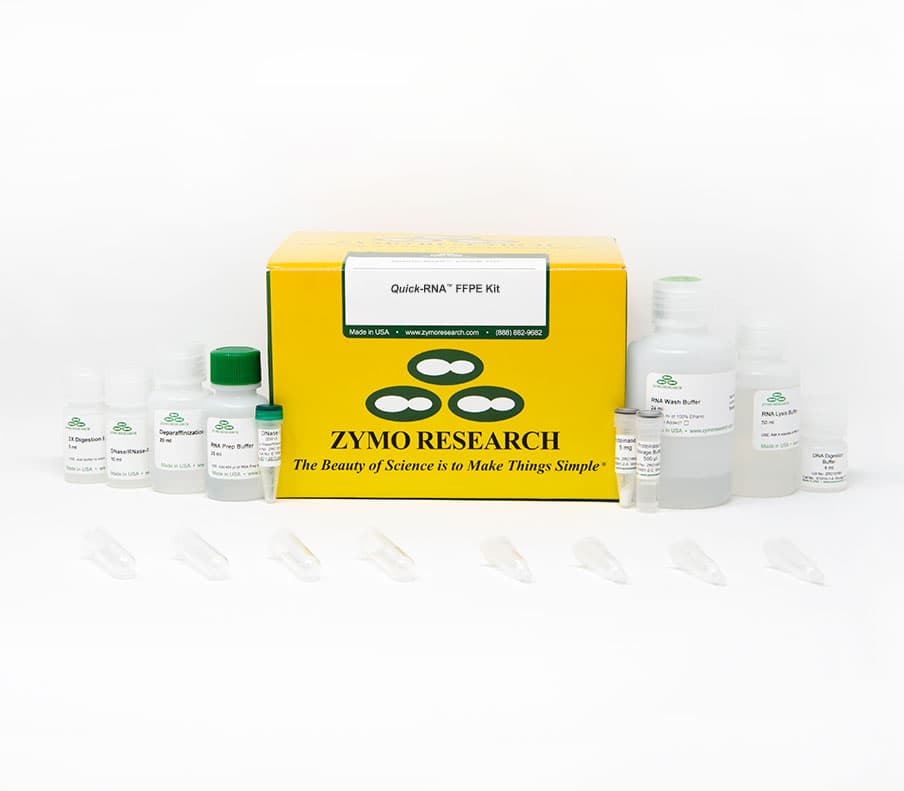
Showing 1 to 1 of 1 results
What are FFPE RNA Extraction Kits?
FFPE RNA extraction kits isolate total RNA from formalin-fixed paraffin-embedded tissue - the dominant archival format for surgical pathology specimens worldwide - using a multi-step protocol that removes paraffin, digests crosslinked proteins with proteinase K, applies heat to partially reverse formaldehyde-induced RNA crosslinks, and purifies RNA on a silica-membrane spin column. Formalin fixation crosslinks RNA to surrounding proteins through methylene bridges and fragments RNA to 100-300 bp; FFPE-specific kits are optimized for maximum recovery of this degraded, crosslinked RNA that standard tissue RNA kits cannot efficiently extract. Use an FFPE-specific kit whenever your starting material is a paraffin block or stained/unstained FFPE section - standard tissue RNA kits produce yields 5-20-fold lower from FFPE material than from fresh-frozen tissue.
What you will find:
- Quick-RNA™ FFPE MiniPrep for purification of high-quality total RNA from formalin-fixed, paraffin-embedded (FFPE) tissue samples.
- Solvent-free deparaffinization workflows that eliminate the need for hazardous xylene or other organic reagents.
- Specialized heat-decrosslinking chemistry designed to reverse formalin-induced crosslinks and improve RNA recovery.
- Spin-column purification technology that delivers clean RNA for reliable downstream molecular analysis.
- RNA extraction solutions optimized for archived tissue specimens used in biomarker, oncology, and gene expression research.
- High-quality RNA preparation suitable for RT-PCR, qPCR, RNA sequencing, and other transcriptomics applications.
How to Choose an FFPE RNA Extraction Kit
Xylene-Free vs. Xylene-Based Deparaffinization
The Zymo Research Quick-RNA FFPE Miniprep Kit uses a proprietary Deparaffinization Solution that dissolves paraffin without xylene, eliminating fume-hood requirements for the deparaffinization step. QIAGEN RNeasy FFPE and AllPrep DNA/RNA FFPE Kits specify xylene or heptane as the primary deparaffinization solvent; both provide xylene-free alternatives in the protocol. Xylene-free workflows are preferred in high-throughput pathology labs where fume-hood access is a bottleneck.
RNA-Only vs. DNA/RNA Co-Extraction
For paired DNA sequencing and RNA expression profiling from the same archived specimen, the Zymo Quick-DNA/RNA FFPE Miniprep Kit (R1009) and QIAGEN AllPrep DNA/RNA FFPE Kit co-extract both analytes from the same tissue section, conserving limited archival material. For RNA-only applications (RT-qPCR, RNA-seq, NanoString), the Quick-RNA FFPE Miniprep Kit provides a simpler one-column workflow optimized for maximum RNA yield.
Section Thickness and Surface Area
Thinner sections (5-10 um) provide better proteinase K penetration and more complete crosslink reversal than thick sections (20 um). Use 2-4 sections per extraction as a starting point; tissue type and cellularity affect yield - highly cellular tumour sections yield more RNA per mg than fibrous stromal tissue. The Zymo Quick-RNA FFPE kit specifies a maximum of four sections <=20 um with ~20 mm2 total surface area per extraction.
Amplicon Size for Downstream Assay
Before selecting a kit, confirm the expected RNA fragment size from your FFPE blocks. Blocks <=5 years old typically yield RNA assayable at 150-200 bp amplicons; blocks >10 years old may only reliably support amplicons of 60-100 bp. Select assays and library prep kits validated for fragmented FFPE RNA (e.g., Illumina TruSeq RNA Exome, Takara SMART-Seq FFPE).
DNase Treatment
Include on-column DNase I treatment for RT-qPCR and RNA-seq to remove gDNA contamination, which is particularly abundant in FFPE extracts because protein crosslinks trap gDNA in the same fraction as RNA. The Zymo Quick-RNA FFPE kit recommends optional on-column DNase I treatment; for sequencing applications, this step is mandatory.
Specifications Context
FFPE RNA quality expectations: RIN 1-4 for older blocks (>5 years), 3-6 for recent blocks (<3 years); A260/A280 >= 1.8. RNA yield from 10 mg FFPE tissue is typically 100 ng to 2 ug depending on tissue type, block age, and fixation conditions. For RNA-seq from FFPE, short insert library preparation protocols tolerating fragmented input (fragment size 100-300 bp) are required; Illumina TruSeq RNA Exome and Takara SMART-Seq v4 FFPE are validated for FFPE RNA-seq at major cancer research centers. FFPE biobank samples from surgical pathology archives at institutions including MD Anderson Cancer Center and Vanderbilt University are used extensively in retrospective cancer transcriptomics studies, making reliable FFPE RNA extraction a clinical research priority. The Zymo Quick-RNA FFPE Miniprep is cited in published FFPE workflows for its xylene-free chemistry and compatibility with both standard RT-PCR and next-generation sequencing library preparation.
MBP's specialist team can help match kit chemistry, format, and throughput to your sample type and downstream application. Contact the MBP team for personalized guidance.
FAQ