FFPE DNA/RNA Co-Extraction Kits for Archival Tissue
FFPE DNA/RNA co-extraction kits simultaneously isolate genomic DNA and total RNA from the same formalin-fixed paraffin-embedded tissue section using xylene-free deparaffinization, Proteinase K digestion, heat crosslink reversal, and Zymo-Spin column purification—delivering separate DNA and RNA fractions from a single undivided FFPE section. Co-extraction conserves limited archival material and ensures both analytes reflect the same tissue population for paired cancer multi-omics.
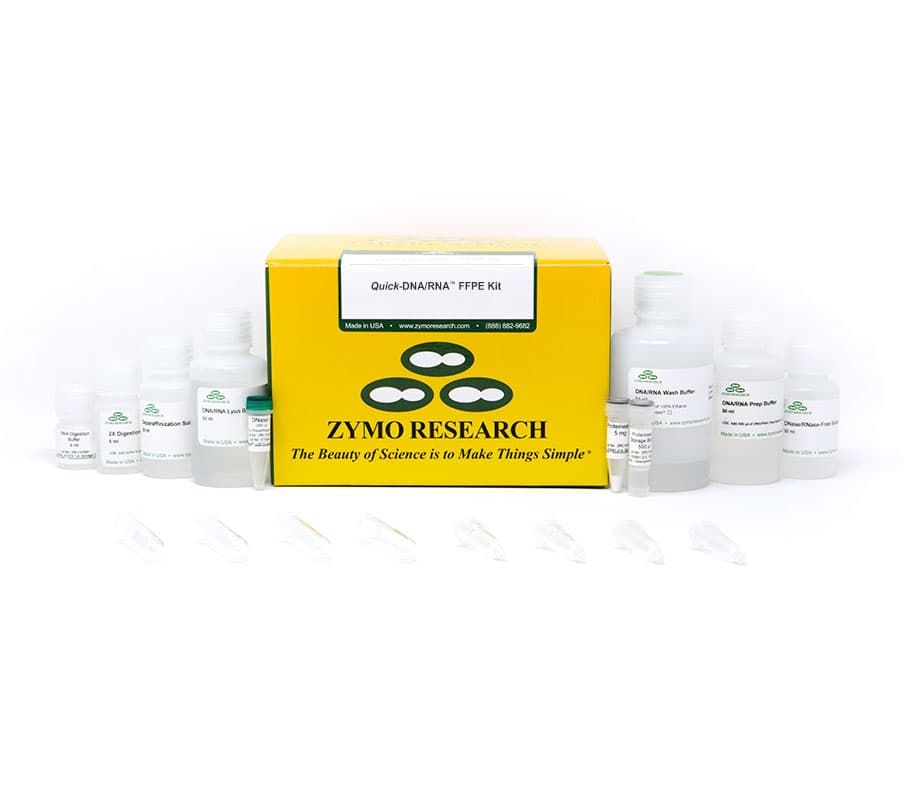
MBP carries Zymo Research Quick-DNA/RNA FFPE Miniprep Kits for registered vendors at Howard Hughes Medical Institute, Vanderbilt University, and MD Anderson Cancer Center. Request a quote for FFPE DNA/RNA co-extraction kits by contacting customerservice@mbpinc.net.
FFPE
Showing 1 to 1 of 1 results
What are FFPE DNA/RNA Co-Extraction Kits?
FFPE DNA/RNA co-extraction kits simultaneously isolate genomic DNA and total RNA -- including small RNAs >=17 nt from the same formalin-fixed paraffin-embedded tissue section using xylene-free deparaffinization, Proteinase K digestion, heat-mediated formaldehyde crosslink reversal, and Zymo-Spin column purification. Co-extraction from a single undivided FFPE section conserves precious archival material and ensures both DNA (for somatic mutation calling, CNV analysis, methylation profiling) and RNA (for expression profiling, fusion detection, nCounter panels) originate from identical tissue, eliminating the spatial heterogeneity introduced when different tissue sections or block portions are used for each analyte. Use an FFPE DNA/RNA co-extraction kit whenever archival tissue is limited, as in needle biopsy cores, small surgical biopsies, or rare tumour specimens, or when integrated multi-omic analysis (paired WES + RNA-seq, or mutation + expression correlation) is required from the same pathological specimen.
What you will find:
-
Quick-DNA/RNA™ FFPE MiniPreps: Efficient systems designed to extract high-quality total nucleic acids with reduced sequence bias, tailored for subsequent qPCR and NGS library preparation.
-
Decross-linking Agents: Nuclease-free solutions formulated to effectively liberate nucleic acids from protein complexes, ensuring transfection-grade purity for delicate bioinformatics workflows.
How to Choose an FFPE DNA/RNA Co-Extraction Kit
Xylene-Free vs. Xylene-Based Deparaffinization
Zymo Research Quick-DNA/RNA FFPE Miniprep Kit uses a proprietary Deparaffinization Solution that removes paraffin without xylene, making it safer for labs without fume hoods and eliminating toxic waste disposal requirements.
Tissue Section vs. Tissue Block Curling
For formalin-fixed paraffin-embedded sections on slides, cut and scrape sections directly into the Deparaffinization Solution tube - 2-4 sections of 5-10 um thickness is the standard starting point. For tissue blocks, cut 10-20 um sections with a microtome into a 1.5 ml tube. Avoid over-cutting; excessive paraffin volume from thick sections delays deparaffinization and reduces proteinase K efficiency, leading to lower DNA and RNA yields.
DNA and RNA Fraction Separation
The Zymo Quick-DNA/RNA FFPE Miniprep Kit delivers non-crosslinked DNA and DNA-free total RNA in separate fractions, making it suitable for downstream molecular analyses from the same FFPE sample.
Amplicon Size for Downstream Assays
RNA isolated from FFPE tissue is typically fragmented because of formalin fixation. For RT-qPCR, primer pairs producing amplicons of approximately 70–150 bp generally provide the most reliable amplification. The purified RNA from the Quick-DNA/RNA™ FFPE MiniPrep is suitable for downstream applications including RT-PCR, next-generation sequencing (NGS), microarray analysis, and hybridization, provided library preparation and assay workflows are compatible with fragmented FFPE-derived nucleic acids.
Block Age Assessment
Request pathology records for fixation time and block age before extraction. For blocks >10 years old, perform a diagnostic RT-qPCR on a short amplicon (60-80 bp) reference gene in the RNA fraction before committing to full RNA-seq library preparation. RNA from blocks with Ct >35 for abundant reference genes (ACTB, GAPDH) at short amplicons typically fails RNA-seq quality thresholds.
Specifications Context
The Zymo Quick-DNA/RNA™ FFPE Miniprep Kit delivers non-crosslinked DNA and DNA-free total RNA (including small RNAs ≥17 nt) from FFPE tissue using a xylene-free deparaffinization workflow. The purified nucleic acids are suitable for downstream applications including PCR, RT-PCR, next-generation sequencing (NGS), hybridization, and other molecular analyses compatible with FFPE-derived samples. Because formalin fixation fragments nucleic acids, downstream assays are generally designed with short amplicons (approximately 60–150 bp for RNA and 100–300 bp for DNA) to improve amplification efficiency. Co-isolation of DNA and RNA from the same FFPE specimen supports integrated genomic and transcriptomic analyses while preserving limited archival tissue.
For FFPE kit selection, bulk pricing on Zymo Quick-DNA/RNA FFPE Miniprep kits, or protocol guidance for aged or low-cellularity archival blocks, contact the MBP team.
FAQ