Environmental & Microbial DNA/RNA Co-Extraction Kits
Environmental/microbial DNA/RNA co-extraction kits simultaneously purify genomic DNA and total RNA from soil, sediment, water, biofilm, fecal samples, and environmental swabs using bead-beating lysis for unbiased microbial community disruption and PCR inhibitor removal for humic acids and polyphenols. Separating DNA and RNA fractions from one undivided sample enables paired 16S/shotgun metagenomics and metatranscriptomics.
MBP carries Zymo Research ZymoBIOMICS DNA/RNA Miniprep and MagBead kits validated on the 8-species Microbial Community Standard, for registered vendors at Howard Hughes Medical Institute, Vanderbilt University, and MD Anderson Cancer Center. Request a quote by contacting customerservice@mbpinc.net.
Environmental/Microbial
Showing 1 to 3 of 3 results
What are Environmental/Microbial DNA/RNA Co-Extraction Kits?
Environmental/microbial DNA/RNA co-extraction kits simultaneously purify genomic DNA and total RNA from complex natural matrices - soil, sediment, water, biofilm, fecal samples, plant material, and environmental swabs - using bead-beating mechanical lysis that unbiasedly disrupts all microbial cell types in mixed communities (Gram-positive bacteria, Gram-negative bacteria, fungi, protozoa), combined with PCR inhibitor removal steps that address the humic acids, polyphenols, and polysaccharides co-extracted from environmental matrices. Both analytes elute in separate fractions from the same undivided sample, enabling paired metagenomic 16S/ITS amplicon sequencing and metagenomic shotgun sequencing (DNA fraction) with metatranscriptomic mRNA-seq (RNA fraction) from a single extraction. Use an environmental/microbial co-extraction kit when your sample is soil, water, biofilm, sediment, or a complex fecal matrix, and you need both the community composition DNA data and the metabolically active gene expression RNA data from the same physical sample.
What you will find:
-
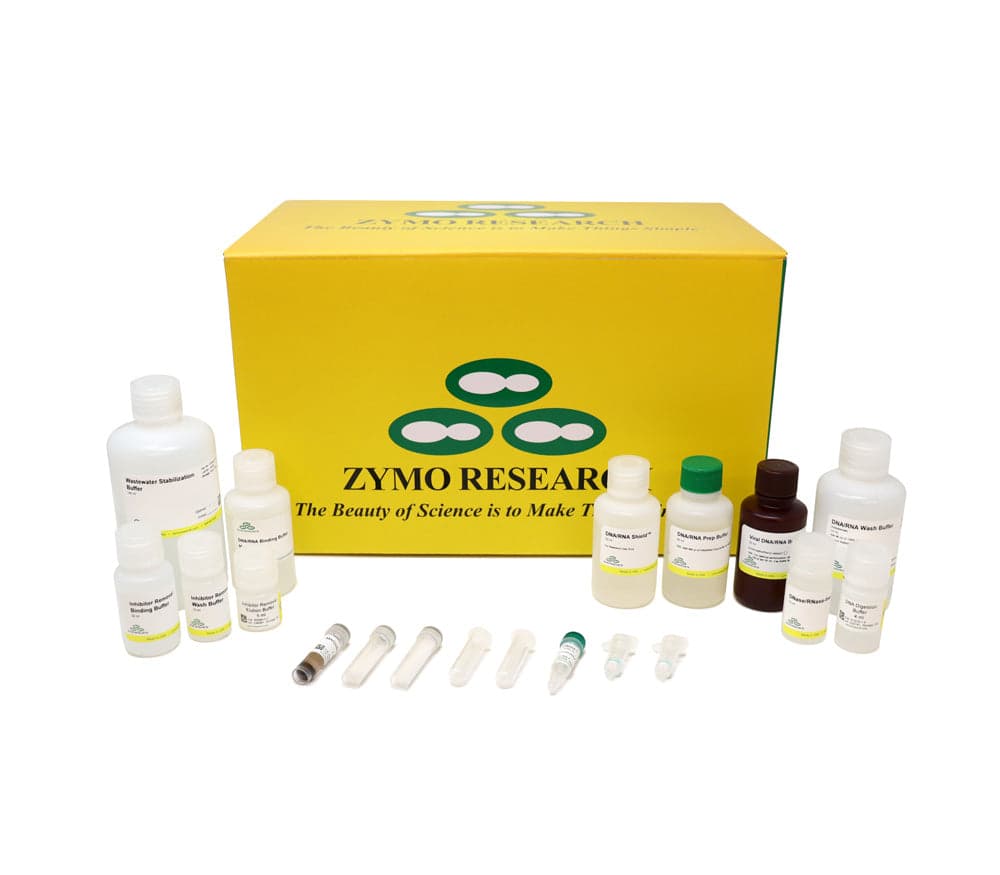
Quick-DNA/RNA™ Water Kit: Designed to isolate low-biomass microbial signatures from water samples, guaranteeing nuclease-free and transfection-quality purity.
-
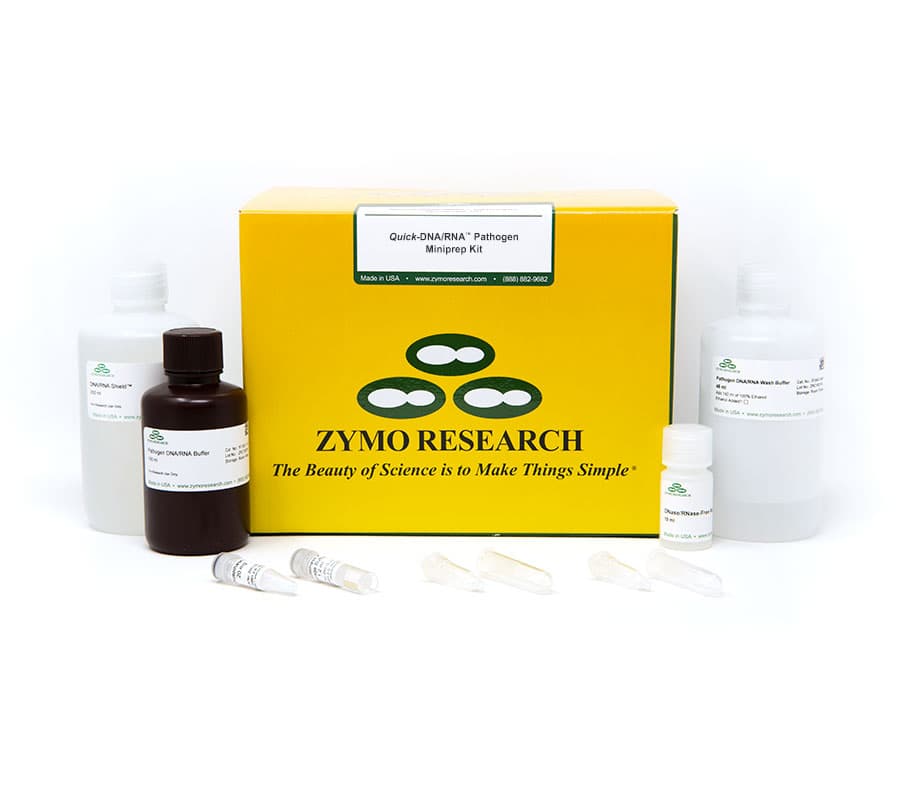
Quick-DNA/RNA™ Pathogen MiniPrep: Designed for fast, high-yield extraction of viral and bacterial pathogens from clinical and environmental samples.
-
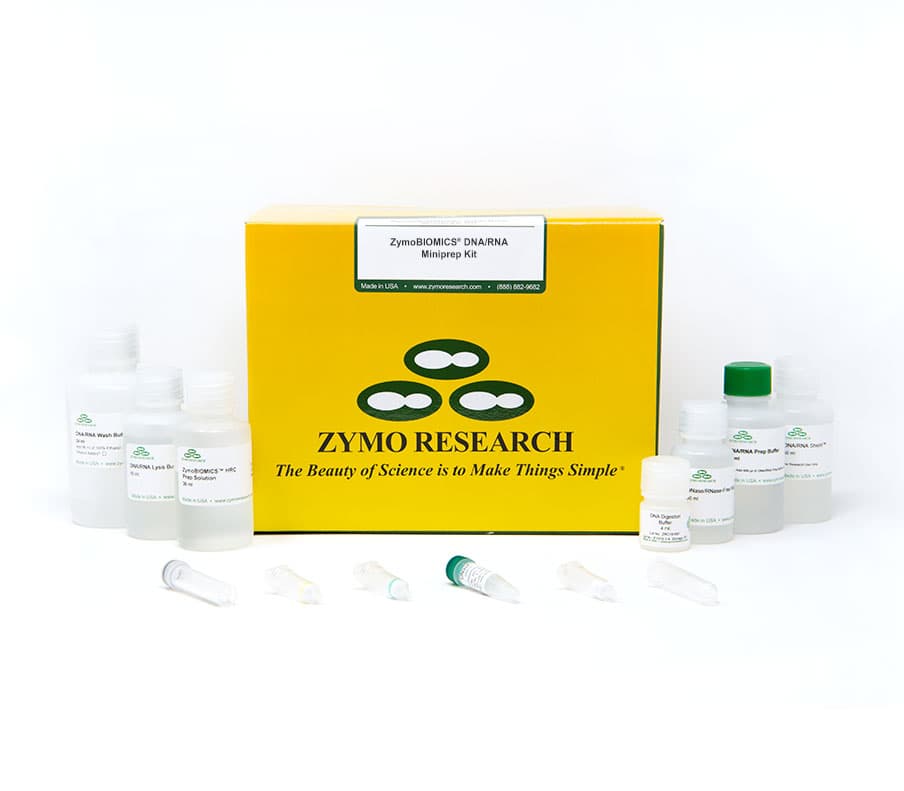
ZymoBIOMICS™ DNA/RNA Mini Kit: A reproducibility-validated system employing ultra-high-density BashingBeads™ for impartial lysis and comprehensive community analysis.
How to Choose an Environmental/Microbial DNA/RNA Co-Extraction Kit
Inhibitor Load: Soil Type and Matrix
High-organic-matter soils (peat, forest soils, tropical soils) carry the highest humic acid inhibitor loads. ZymoBIOMICS DNA/RNA kits incorporate OneStep PCR Inhibitor Removal Technology in the wash steps; for heavily inhibited matrices, reduce input to 50-100 mg and verify A260/A230 >= 1.5 on first test extractions. For very high inhibitor soils, the QIAGEN AllPrep DNA/RNA Mini Kit downstream of bead-beating and phenol-phase separation (Okazaki et al. 2023 protocol) achieves higher DNA fragment size (>10-15 kb) for long-read metagenomics.
Spin-Column vs. Magnetic Bead Format
ZymoBIOMICS DNA/RNA Miniprep Kit (spin-column) processes 1-24 samples in a microcentrifuge and delivers separate DNA and RNA fractions by column-switching. ZymoBIOMICS MagBead DNA/RNA processes 96 samples per run on KingFisher Flex, Accuris IsoPure, and AllSheng AutoPure. Choose spin-column for small-batch environmental studies; choose magnetic bead for large cohort microbiome surveys, biobank processing, and studies requiring >48 samples per session.
Separate Fractions vs. Total Nucleic Acid
ZymoBIOMICS DNA/RNA Miniprep Kit delivers separate DNA and RNA fractions by column-switching design -- the preferred format for parallel 16S amplicon sequencing (DNA) and metatranscriptomics (RNA) requiring analyte-specific library preparation workflows. ZymoBIOMICS MagBead DNA/RNA delivers a combined total nucleic acid fraction; post-extraction enzymatic depletion (DNase I for RNA fraction, RNase A for DNA fraction) separates analytes from the combined eluate.
RNA Stability and Sample Collection
Environmental RNA degrades within seconds to minutes at room temperature without stabilization. Immediately add DNA/RNA Shield to collected soil or fecal samples in the field to inactivate RNases and preserve RNA integrity at ambient temperature for up to 30 days. For aquatic environmental samples, filter immediately onto Sterivex membranes and add DNA/RNA Shield directly to the filter for stabilization during transport.
rRNA Depletion for Metatranscriptomics
Plan for pan-microbial rRNA depletion as a mandatory step between co-extraction and metatranscriptomic library preparation. Residual co-extracted inhibitors from environmental samples can impair enzymatic depletion reactions; an RNA cleanup step with Zymo RNA Clean & Concentrator-5 between extraction and depletion is often needed for soil RNA with A260/A230 below 1.8.
Specifications Context
Target benchmarks for environmental/microbial co-extractions: DNA A260/A280 >= 1.8, DNA fragment size >= 15 kb (for long-read metagenomics) or >= 1 kb (for 16S amplicon); RNA A260/A280 >= 1.8, A260/A230 >= 1.5, RIN >= 6 from DNA/RNA Shield-stabilized samples. A 2023 published method achieved DNA peak size >10-15 kb and RIN >6 from lake bacterioplankton using bead beating and phenol-phase separation combined with AllPrep column purification, in approximately 3 hours for 6-8 samples. Paired metagenomic and metatranscriptomic analysis of soil, gut, and aquatic microbial communities is a major focus of environmental and microbiome research, with ZymoBIOMICS kits cited in NIH-funded studies at institutions including Howard Hughes Medical Institute and Vanderbilt University.
For kit selection guidance, bulk pricing, and protocol optimization for specific environmental matrices, including high-humic soils, aquatic filters, and fecal samples, contact the MBP team.
FAQ