Product Filters

Magnetic Bead Genomic DNA Kits for Plant Tissue


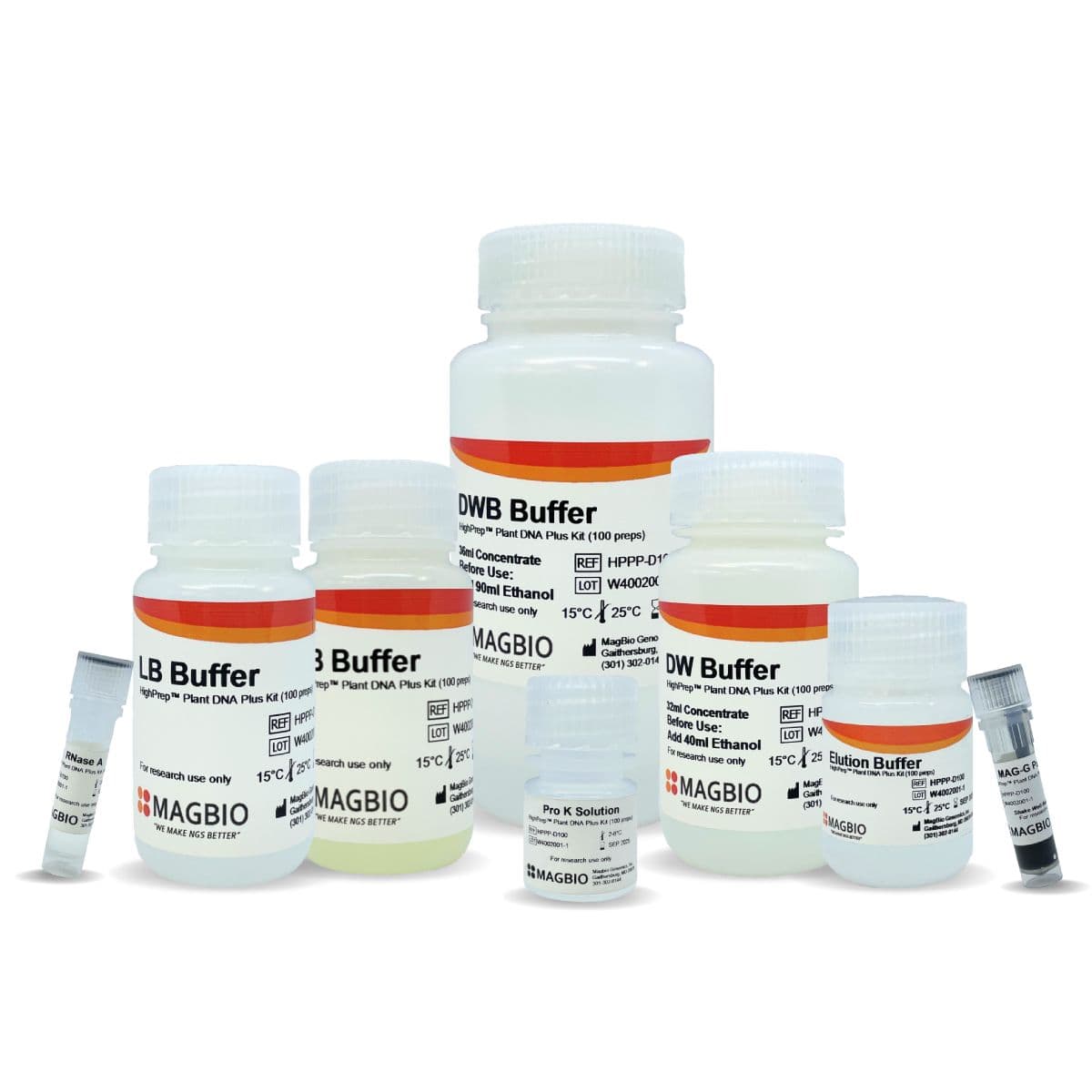
Magnetic bead genomic DNA kits for plant tissue bind DNA released by a lysis buffer to paramagnetic beads, then wash and elute using a magnetic separator without centrifugation, columns, or a vacuum manifold. The bead-based approach helps remove polysaccharides, phenolic compounds, and enzyme inhibitors that commonly interfere with plant DNA purification workflows. 

Lab managers building automated genotyping or marker-assisted breeding pipelines can scale this format on common liquid handling workstations, and MBP's specialist team can help match bead chemistry to your automation platform. Request a quote today by contacting customerservice@mbpinc.net 

Mag Beads
Per Page:
Sort By:
no products Image
No Products Found
Back to home

What are Magnetic Bead Genomic DNA Kits for Plant Tissue?


A magnetic bead genomic DNA kit for plant tissue uses paramagnetic beads to bind genomic DNA released from lysed plant cells, while a magnetic separator holds the beads in place during wash and elution steps. This approach eliminates the need for centrifugation, vacuum manifolds, and silica columns that can become problematic when processing polysaccharide-rich plant lysates. Related workflows include automated magnetic particle processing, SPRI-based DNA purification, and downstream PCR, qPCR, genotyping, and sequencing applications. Choose magnetic bead kits for plant genomic DNA when working with difficult plant tissues or when building an automated extraction workflow.


What You Will Find


  • Automated plant genomic DNA isolation using silica-coated magnetic beads for high-throughput extraction workflows.
  • High-binding plant magnetic particles designed to maximize DNA recovery from a wide range of plant specimens.
  • Paramagnetic bead cleanup reagents for post-extraction removal of polyphenols and other contaminants.
  • Plant DNA extraction reagents compatible with automated liquid handling systems and magnetic particle processors.


How to Choose a Magnetic Bead Plant Genomic DNA Kit


Sample Input and Throughput

Magnetic bead plant DNA kits commonly process up to 96 samples of approximately 50 mg fresh tissue or 15 mg dried tissue per sample in under one hour. Confirm that your typical sample input falls within the recommended range to achieve consistent DNA yield and purity.

Clogging-Prone Tissue Types

Fibrous plant tissues and samples rich in polysaccharides can challenge traditional column-based extraction methods. Magnetic bead chemistry binds DNA directly in solution, reducing issues associated with clogged filters and inconsistent flow rates.

Manual Versus Automated Processing

Magnetic bead kits can be processed manually using a magnetic stand or integrated into automated magnetic particle processors for higher throughput. Laboratories already using automated extraction systems should verify compatibility with existing instruments and plate formats.

Standard Versus High-Molecular-Weight DNA

Some magnetic bead kits are optimized for high-molecular-weight DNA suitable for long-read sequencing and genome assembly applications, while standard formats are designed for PCR, qPCR, and routine genotyping workflows.


Specifications Context


The key specifications that distinguish magnetic bead plant DNA kits are processing speed, automation compatibility, resistance to clogging from plant debris, and DNA fragment size output. Many workflows can process up to 96 samples in under one hour without centrifugation or vacuum filtration, making them attractive for high-throughput laboratories. Laboratories working with fibrous, polysaccharide-rich, or otherwise challenging plant tissues often evaluate magnetic bead chemistry when column-based methods prove inefficient. The format is also widely adopted in automated workflows due to its compatibility with liquid handling systems and magnetic particle processors. 


Contact the specialist team for guidance on magnetic bead chemistry selection, automation platform compatibility, and workflow optimization.

FAQ

Magnetic bead plant genomic DNA kits commonly process up to 96 samples of approximately 50 milligrams of fresh tissue or 15 milligrams of dried tissue per sample, often completed in under one hour for the full batch. This throughput is comparable to or faster than 96-well silica plate kits. Confirm your typical tissue mass per sample fits this range for consistent yield.
Fibrous plant tissue that is not fully lysed during disruption and homogenization is a common cause of filter or vacuum manifold clogging in silica-based plant DNA kits. Magnetic bead chemistry avoids this because beads bind DNA directly in the lysate without passing the sample through a filter or membrane. If your species or tissue type has historically caused column clogging, magnetic bead chemistry addresses that specific failure point.
Yes - magnetic bead plant genomic DNA kits can be processed manually using a magnetic stand, typically completed within about 50 minutes to under an hour for a batch of samples. The same chemistry can also be scaled to automated magnetic particle processors for higher throughput. Manual processing is a reasonable starting point before committing to automation equipment.
Magnetic bead plant genomic DNA kits remove polysaccharides, phenolic compounds, and enzyme inhibitors without organic extractions, producing DNA suitable for qPCR and next-generation sequencing. High-molecular-weight magnetic bead kits report A260/A280 ratios around 1.8, with A260/A230 ratios commonly in the 1.5 to 2.5 range. Standard magnetic bead kits not marketed as HMW typically produce yields comparable to CTAB-based extraction methods.
Some magnetic bead plant genomic DNA kits use Solid Phase Reversible Immobilization (SPRI) chemistry specifically for high molecular weight DNA, with reported fragment sizes in the 50 to 200 kilobase range, suited to long-read sequencing, linked-read genome assembly, and optical mapping. Standard magnetic bead kits not marketed as HMW typically produce DNA in ranges comparable to CTAB or silica-based extraction. Confirm fragment size specifications match your sequencing platform's requirements before ordering.
Magnetic bead plant genomic DNA kits are generally adaptable to common laboratory automation platforms and magnetic particle processors, since the closed-system bead workflow avoids the sample transfers between wells that complicate automating silica plate or vacuum manifold protocols. Static-pin separators or magnetic separators integrated into robotic workstations can both be used depending on the kit. Confirm your specific liquid handler is supported before purchasing for an automated pipeline.
DNA from magnetic bead plant genomic DNA kits is generally suitable for PCR-based marker analysis and genotyping, with the closed-system bead format reducing cross-contamination risk across a 96-well batch compared to open-well filtration methods. This makes magnetic bead chemistry a reasonable choice for breeding programs processing many individuals or accessions per run. Standard kit chemistry covers most genotyping needs without requiring HMW-specific formulations.
MBP supplies magnetic bead plant genomic DNA extraction kits, including standard and high-molecular-weight options, to academic and breeding programs across the United States and Canada, with a US office in Houston, Texas. As a registered vendor for institutions including Howard Hughes Medical Institute, Vanderbilt University, and MD Anderson Cancer Center, MBP supports bulk and automation-scale purchase-order quantities. Contact the specialist team for guidance on bead chemistry and liquid handler compatibility.
We provide the highest quality of products and anytime customer service.
Featured Categories
    online payment
    online payment
    fast delivery
    fast delivery
    technical support
    technical support
    24/7 support
    24/7 support
    copy right
    2026 All Right Reserved