DNA/PCR Sequencing Cleanup Reagents for NGS Library Amplification
DNA/PCR sequencing cleanup reagents purify PCR-amplified NGS libraries—indexed Illumina libraries, amplicon sequencing products (16S, ITS, gene panels), and long-range PCR products—removing primers, dNTPs, polymerase, betaine, DMSO, and PCR buffer salts using SPRI beads. MBP supplies cleanup reagents to registered vendors at Howard Hughes Medical Institute, Vanderbilt University, and MD Anderson Cancer Center.
Request a quote for DNA and PCR sequencing cleanup reagents designed for amplicon sequencing, indexed library purification, primer removal, and NGS library amplification workflows by contacting customerservice@mbpinc.net.
DNA/PCR
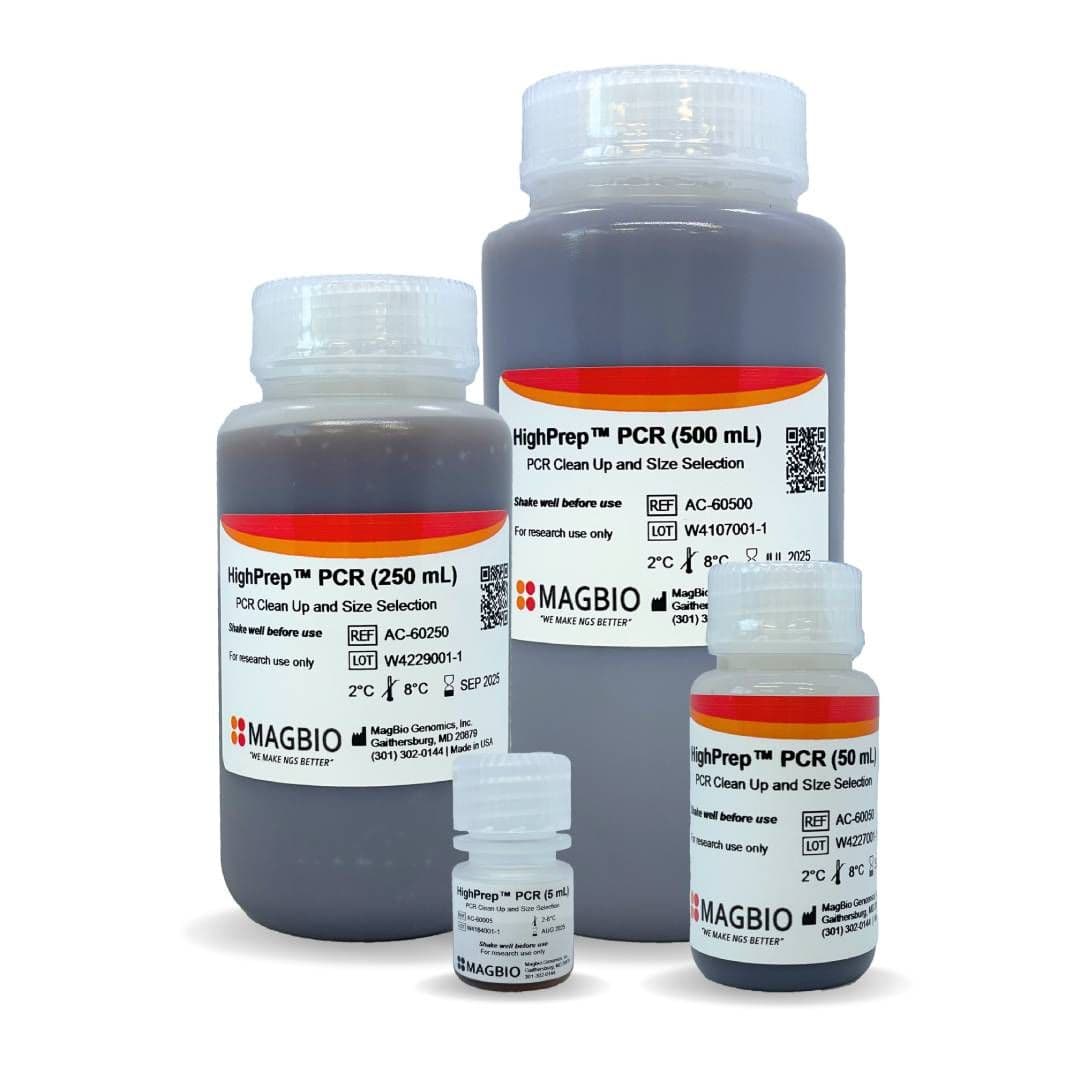
Showing 1 to 1 of 1 results
What is DNA/PCR Sequencing Cleanup?
DNA/PCR sequencing cleanup purifies PCR-amplified NGS library products - indexed Illumina libraries after amplification, amplicon sequencing PCR products (16S rRNA, ITS, targeted gene panels), and long-range PCR products for long-read sequencing - removing residual PCR primers, dNTPs, thermostable polymerase, betaine, DMSO, BSA, and PCR buffer salts that inhibit sequencing cluster generation, flow cell loading, and library quantification. Perform SPRI bead cleanup after every PCR amplification step in library preparation - residual primers generate non-informative sequencing reads, betaine carryover inhibits cluster generation chemistry, and thermostable polymerase coats flow cell surfaces, reducing cluster density and data yield.
What you will find
- Magbio HighPrep™ PCR: A highly flexible, bead-based reagent that simplifies post-PCR cleanup and dual-sided size selection, fitting seamlessly into your high-throughput automated platforms.
- HighPrep™ PCR PB Kit: Specifically optimized for the rigorous demands of Pacific Biosciences (PacBio) workflows, this kit ensures you recover the long-read fragments your research depends on.
- Selective Contaminant Depletion: Our buffers are engineered to remove salts and polymerases without the stress of centrifugation, delivering transfection-grade purity in every sample.
How to Choose a DNA/PCR Sequencing Cleanup Reagent
Bead Ratio for Target Amplicon Size
The bead-to-sample ratio determines the minimum fragment size retained. At 0.8x: retains >=300 bp; removes primers and adapter dimers; best for amplicons >=300 bp (16S V3-V4, ITS2). At 0.9x: retains >=200 bp; removes primers and adapter dimers; standard for indexed library amplicons. At 1.0x: retains >=150 bp; removes primers; useful for short-insert libraries (100-200 bp). At 1.8x: retains >=100 bp; maximum primer removal; over-cleaning for library amplicons. Always calibrate the bead ratio using a test library at your target amplicon size before processing study samples; empirical calibration is required because bead lot performance and PEG concentrations vary.
Double-Side SPRI After PCR
For amplicon libraries where the PCR product range is wide (multiple bands) or where large amplification artifacts must be removed alongside primers, double-sided SPRI after PCR selects the target amplicon precisely: the first step removes amplification artifacts above the target size; the second step retains the target amplicon and discards primers and primer dimers.
Bead-Based vs. Spin Column After PCR
AMPure XP beads are preferred for high-throughput 96-well plate PCR cleanup in amplicon sequencing workflows where 96-384 individual PCR amplicons must be cleaned before pooling. Spin columns (Zymo DNA Clean & Concentrator-5) are used for small-batch amplicon cleanup when concentrated eluate in 6-30 µl is needed before capillary electrophoresis or other downstream analysis.
Betaine and DMSO Removal
If your PCR protocol includes betaine (1-2 M) or DMSO (1-5%), confirm complete removal by checking that the post-cleanup DNA solution is free of unusual viscosity (indicating residual betaine). At the standard bead ratio, betaine and DMSO are completely removed during the 2x 80% ethanol wash steps. If betaine or DMSO carryover is suspected (reduced sequencing cluster density), add 200 µl ethanol wash before elution.
Amplicon Sequencing Pool Cleanup
After individually cleaning and quantifying each amplicon library by Qubit HS, pool at equimolar ratios before the final SPRI cleanup of the pool. Final pool cleanup at 0.9x removes any residual primer from individual library cleanup steps and normalizes the final pool for sequencing loading.
Specifications Context
HighPrep™ PCR uses SPRI magnetic bead technology for post-PCR cleanup and DNA size selection. Adjustable bead-to-sample ratios enable efficient removal of primers, primer dimers, adapter dimers, nucleotides, enzymes, and buffer components while selectively retaining target DNA fragments. Standard ratios support PCR product cleanup, while dual-sided selections provide precise library size distribution for NGS workflows. HighPrep™ PCR PB Kit is optimized for PacBio sequencing, maximizing recovery of long DNA fragments while depleting smaller contaminants. The centrifugation-free workflow supports both manual and automated processing and is compatible with Illumina, ONT, and PacBio library preparation.
Ready to refine your library? The MBP team is here to help—contact us today for a personalized quote on our PCR size selection reagents.
FAQ