Product Filters

DNA Sequencing Cleanup Reagents for NGS Library Preparation


DNA sequencing cleanup reagents purify genomic DNA libraries at every enzymatic step—after end-repair, adapter ligation, and PCR amplification—removing adapter dimers, enzymes, primers, and unincorporated nucleotides using SPRI beads or spin columns. MBP supplies these reagents to registered vendors at Howard Hughes Medical Institute, Vanderbilt University, and MD Anderson Cancer Center. 

Request a quote for DNA sequencing cleanup reagents optimized for genomic DNA library preparation, adapter ligation cleanup, PCR cleanup, and NGS workflow quality control by contacting customerservice@mbpinc.net.

DNA
Per Page:
Sort By:
no products Image
No Products Found
Back to home

What are DNA Sequencing Cleanup Reagents?


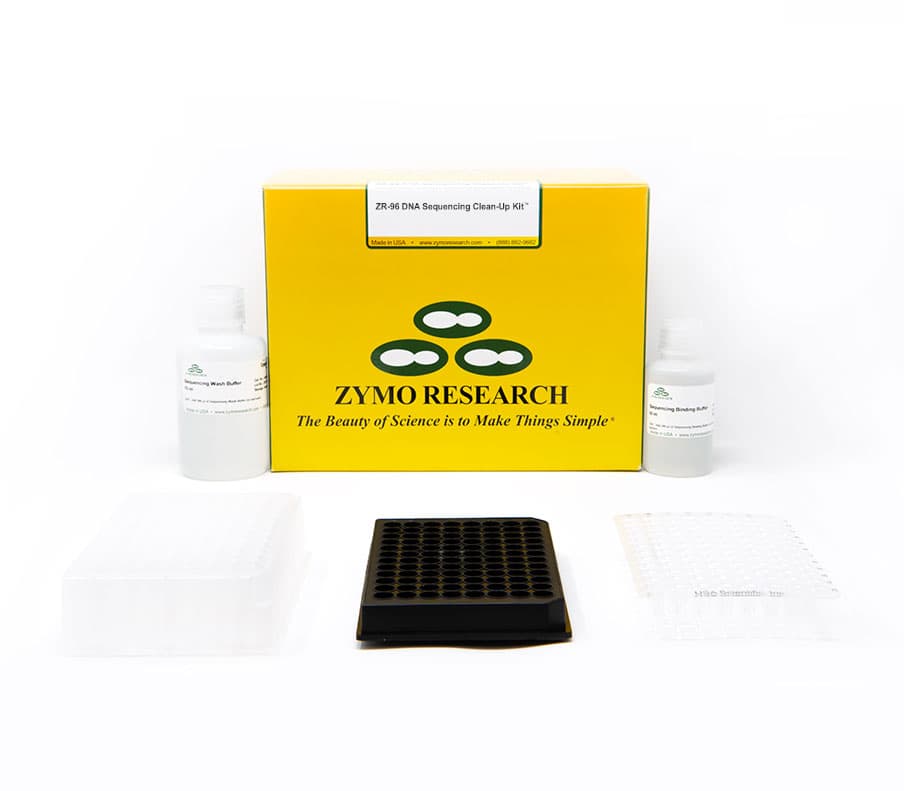
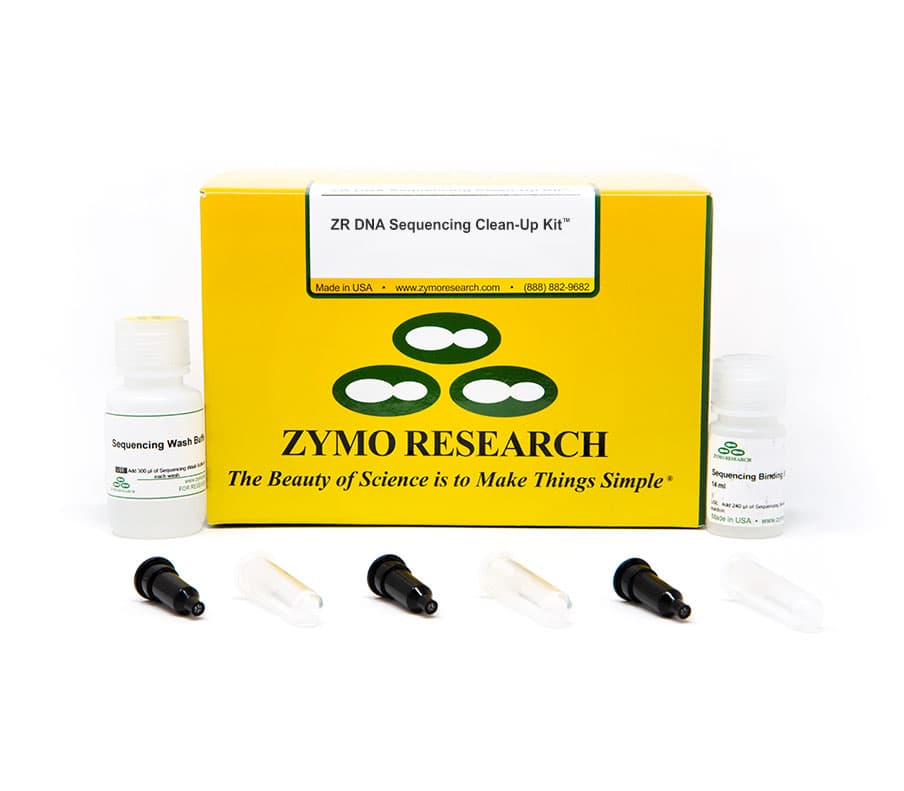
DNA sequencing cleanup reagents purify double-stranded DNA at every enzymatic step in genomic library preparation workflows - after end-repair/A-tailing, after adapter ligation (to remove adapter dimers), and after PCR amplification of indexed libraries - removing primers, dNTPs, adapter dimers, buffer salts, and enzymes that inhibit downstream sequencing steps. Adapter dimer removal is the most critical cleanup step: dimers formed during ligation efficiently cluster on Illumina flow cells and produce non-informative reads that reduce effective genome coverage and waste sequencing cost. The Zymo ZR DNA Sequencing Clean-up Kit (D4050) and ZR-96 DNA Sequencing Clean-up Kit (D4052) use Zymo-Spin silica-membrane column technology to remove dye terminators, unincorporated dNTPs, salts, enzymes, and short oligonucleotides from sequencing reactions in under 10 minutes, eluting purified DNA ready for capillary electrophoresis or downstream NGS steps. Perform cleanup after every adapter ligation step in Illumina library preparation - skipping this step and proceeding to amplification will amplify adapter dimers exponentially, and the resulting library cannot be rescued by cleanup after PCR.


What you will find:

  • ZR DNA Sequencing Clean-up Kit™: A rapid-velocity spin-column system designed to isolate ultra-pure templates without the risk of ethanol carryover or inhibitory salt precipitation.

  • ZR-96 DNA Sequencing Clean-up Kit: A high-throughput 96-well platform optimized for automated liquid handlers, delivering reproducibility-tested results across massive genomic cohorts.


How to Choose a DNA Sequencing Cleanup Reagent


Individual Tube vs. 96-Well Plate Format

The Zymo ZR DNA Sequencing Clean-up Kit (D4050) processes individual reactions in a standard microcentrifuge - the right format for low-volume sequencing labs running 1-24 reactions per session. The ZR-96 DNA Sequencing Clean-up Kit (D4052) processes 96 samples simultaneously using a 96-well spin plate with a centrifuge, reducing per-sample hands-on time for high-throughput sequencing workflows. Choose the 96-well format when running 48 or more sequencing reactions per session.

Dye Terminator Removal

Both ZR kits are validated for removal of BigDye Terminator v3.1 and equivalent fluorescent dideoxy terminator chemistries - the most common source of dye blob artefacts in Sanger electropherograms. The silica-membrane column binds sequencing extension products while unincorporated terminators, dNTPs, salts, and short oligonucleotides pass through in the wash steps, producing clean sequencing product ready for capillary injection.

Elution Volume

For Sanger sequencing, elute in the minimum recommended volume (6-10 ul) to maximize sequencing signal per injection. For NGS post-ligation cleanup where DNA concentration must be quantified by Qubit HS before library pooling, elute in 20-25 ul to ensure sufficient volume for quantification and downstream steps. Avoid over-eluting in large volumes that dilute the cleaned product below Qubit HS detection limits.

Post-Cleanup QC

For Sanger cleanup: confirm a clean electropherogram from base 30 onward with no dye blob artefacts and read length exceeding 700-800 bases. For NGS library cleanup: confirm with Bioanalyzer or TapeStation that the correct peak insert size is present, no adapter dimer peak is visible at 120-130 bp, and library concentration is >=1 ng/ul for Qubit HS detection. A visible adapter dimer peak after cleanup signals insufficient wash steps, an overloaded column, or excessively high adapter concentration during ligation.

Throughput Scaling

For programs processing more than 96 reactions per day, run multiple ZR-96 plates sequentially on the same centrifuge. The ZR spin-column formats are optimized for manual and semi-automated workflows.


Specifications Context


The Zymo ZR DNA Sequencing Clean-up Kit (D4050) and ZR-96 DNA Sequencing Clean-up Kit (D4052) use Zymo-Spin column technology to remove dye terminators, dNTPs, salts, enzymes, and unincorporated primers from sequencing reactions, delivering cleaned product ready for capillary electrophoresis or NGS loading. Both kits are validated for BigDye Terminator v3.1 and produce clean electropherograms with read lengths exceeding 800 bases when input cycle-sequencing reactions are prepared under standard conditions. Column-based sequencing cleanup is the standard method for individual and plate-scale Sanger sequencing verification, clone confirmation, and plasmid sequencing at academic molecular biology laboratories at institutions including Howard Hughes Medical Institute, Vanderbilt University, and MD Anderson Cancer Center.


Purify your pathway to discovery—reach out to our technical team today to secure a quote for your DNA cleanup reagents.

FAQ

DNA sequencing cleanup reagents purify double-stranded DNA at steps in genomic DNA library preparation workflows - including after end-repair/A-tailing, after adapter ligation, and after PCR amplification of indexed libraries - removing enzymes, salts, unincorporated nucleotides, dye terminators, and adapter dimers using silica-column-based or SPRI bead-based methods. MBP stocks the Zymo ZR DNA Sequencing Clean-up Kit (D4050) for individual reactions and the ZR-96 DNA Sequencing Clean-up Kit (D4052) for 96-well plate throughput, both using Zymo-Spin column technology validated for BigDye Terminator v3.1 cleanup and NGS library intermediate purification. Cleanup at each step is critical to prevent carryover inhibitors from reducing the efficiency of downstream enzymatic steps and to remove adapter dimers that consume sequencing reads.
Spin columns (Zymo ZR DNA Sequencing Clean-up Kit D4050, ZR-96 D4052) are the format stocked by MBP and are appropriate for: Sanger dye terminator removal before capillary electrophoresis; NGS library intermediate cleanup for manual batches of 1-96 samples; and workflows where concentrated elution in 6-25 ul is needed. SPRI bead-based reagents (such as AMPure XP from Beckman Coulter, not stocked by MBP) are used in fully automated 96-well liquid-handling pipelines where centrifugation is not available and bead-to-sample ratio adjustment for size selection is required. Choose the ZR spin-column format for manual and semi-automated sequencing cleanup; contact the MBP team for guidance if a fully automated SPRI workflow is needed.
Standard AMPure XP library cleanup for Illumina short-read sequencing uses a 1.8x bead-to-sample ratio (180 ul AMPure XP per 100 ul sample). At 1.8x, all DNA fragments >=100 bp are retained on the beads; fragments shorter than 100 bp (including primer dimers, free adapters, and adapter dimers) remain in the supernatant and are discarded. After magnetic separation, two washes with 80% ethanol remove residual salt and PEG before elution in water or TE buffer. Note: AMPure XP is manufactured by Beckman Coulter and is not stocked by MBP; for spin-column-based post-ligation cleanup, MBP supplies the Zymo ZR DNA Sequencing Clean-up Kit (D4050) and ZR-96 (D4052).
Adapter dimers form when the two adapter oligonucleotides ligate directly to each other without an insert fragment - a side reaction during the ligation step of NGS library preparation. Adapter dimers (typically 120-130 bp total length including two adapter sequences) efficiently cluster on Illumina flow cells and are sequenced, producing reads of adapters only (no genomic insert), wasting sequencing capacity and reducing effective genome coverage per run. At typical adapter ligation concentrations, 5-30% of ligation products can be dimers; cleanup with a spin-column kit (Zymo ZR DNA Sequencing Clean-up Kit D4050 or ZR-96 D4052) or SPRI bead cleanup removes them along with unligated adapters before sequencing.
Yes. The Zymo ZR-96 DNA Sequencing Clean-up Kit (D4052) is designed for simultaneous processing of 96 sequencing reactions in a 96-well spin plate format using a standard 96-well plate centrifuge. The protocol uses multichannel pipettes for buffer addition and processes all 96 wells in a single centrifuge run, making it suitable for high-throughput Sanger sequencing labs and NGS library cleanup workflows. For fully automated SPRI bead-based cleanup on liquid-handling robots (Biomek, Tecan, Hamilton), bead-based systems such as AMPure XP (Beckman Coulter, not stocked by MBP) are the standard; the ZR-96 is optimized for semi-automated centrifuge-based plate workflows.
The Zymo ZR DNA Sequencing Clean-up Kit (D4050) and ZR-96 (D4052) are validated for standard cycle-sequencing reaction inputs (10-20 ul reaction volume typical for BigDye Terminator v3.1). For NGS library intermediate cleanup, ensure the input library concentration is at least 2-5 ng/ul before column cleanup to maintain concentration above the minimum for Qubit HS detection (>=0.5 ng/ul) after elution. For very low-input libraries (10-100 pg total), use low-DNA-binding tubes throughout the workflow and elute in the minimum volume (6-10 ul) to maintain library concentration above quantification thresholds.
Double-sided SPRI size selection is used when both adapter dimers (below ~150 bp) and over-sized fragments (above ~700 bp) must be removed to produce a library with a tight size distribution centered at the target insert size (e.g., 200-500 bp). Step 1 at 0.6x bead ratio (left-side selection): large fragments bind beads (discard beads); collect supernatant containing target and small fragments. Step 2: at 0.8x beads added to the supernatant (right-side selection): target fragments bind beads; small fragments and dimers remain in supernatant (discard); elute beads to recover the size-selected library. Double-side SPRI requires AMPure XP or SPRIselect beads (Beckman Coulter, not stocked by MBP); the Zymo ZR spin-column kits (D4050, D4052) stocked by MBP perform standard cleanup without size fractionation.
After cleanup with the Zymo ZR DNA Sequencing Clean-up Kit (D4050) or ZR-96 (D4052), assess quality by: (1) Qubit dsDNA HS Assay for accurate concentration measurement at <=10 ng/ul; (2) Agilent Bioanalyzer DNA 1000 chip or Agilent TapeStation D1000 ScreenTape for fragment size distribution - confirm peak insert size at the expected library fragment size, no visible adapter dimer peak at 120-130 bp, and no high-molecular-weight artifact bands; (3) qPCR-based library quantification (KAPA Library Quantification Kit) for absolute molarity before cluster generation. Libraries with visible adapter dimer contamination after cleanup require an additional cleanup step before sequencing.
We provide the highest quality of products and anytime customer service.
Featured Categories
    online payment
    online payment
    fast delivery
    fast delivery
    technical support
    technical support
    24/7 support
    24/7 support
    copy right
    2026 All Right Reserved