Post-Stain Reagents for Accurate Gel Visualization and Analysis
Post-Stain covers gel staining reagents applied by soaking a completed gel in staining solution after electrophoresis has finished, as opposed to incorporating stain into the gel before casting. Post-staining avoids any effect of the stain on DNA migration during electrophoresis, making it the preferred approach when fragment size accuracy matters, or when a stain such as GelRed offers greater sensitivity in post-staining than pre-casting. For protein gels, Coomassie and silver stains are the most common post-staining methods. Academic and core laboratories can benefit from guidance when selecting post-staining reagents and protocols for optimal sensitivity, accuracy, and compatibility with downstream analysis.
Explore available post-stain reagents or request a quotation by contacting customerservice@mbpinc.net. Our team can help identify the appropriate staining method and workflow for your nucleic acid or protein gel electrophoresis applications.
Post-Stain
Showing 1 to 1 of 1 results
What is post-staining?
Post-staining is the process of soaking a completed agarose or polyacrylamide gel in a staining solution after electrophoresis to detect separated nucleic acid or protein bands, in contrast to pre-staining, which incorporates a stain into the gel before casting. Since no stain is present in the gel matrix during the run, post-staining eliminates any potential effect of the stain on DNA migration, making it the preferred method when accurate fragment sizing is most important. For nucleic acids, GelRed post-stain is frequently recommended for its superior sensitivity; for proteins, Coomassie Brilliant Blue and silver stain are the standard post-staining methods.
What you will find:
-
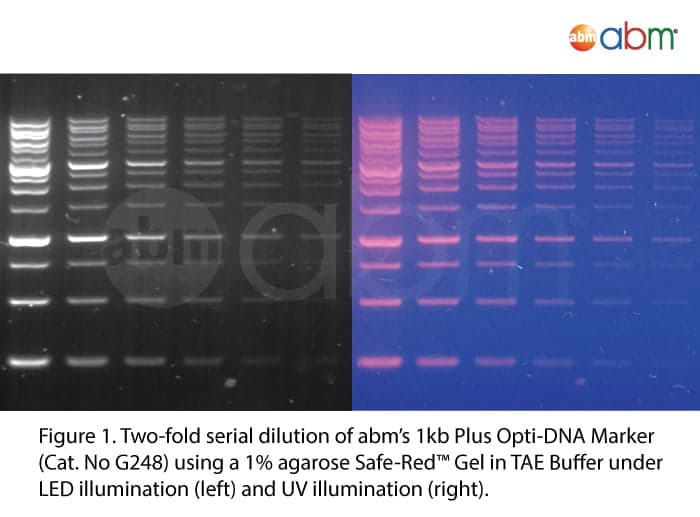
Safe-Red Gel post-stain: used post-electrophoresis for sensitive DNA visualization
How to use post-staining reagents
Soak the gel in stain solution for 20–30 minutes after electrophoresis
For most nucleic acid post-staining applications, submerging the gel in staining solution and placing it on a rocking platform for approximately 20–30 minutes gives adequate dye intercalation and band visualization without over-background staining.
Use water or dilute buffer as the soaking solvent for GelRed post-staining
GelRed post-staining is typically performed by soaking the gel in a diluted GelRed solution in water or dilute buffer for 20–30 minutes, which achieves high-sensitivity band detection without a separate destaining step, since gel background fades adequately during the staining soak.
Follow post-staining with a brief destaining step for cleaner backgrounds if needed
Some post-staining protocols, particularly for ethidium bromide post-staining, recommend a brief rinse or soak in water or buffer after staining to reduce background fluorescence for cleaner band visualization, though GelRed post-staining often does not require a separate destaining step.
For Coomassie staining of protein gels, follow fixation with a full destaining step
Coomassie Brilliant Blue post-staining of SDS-PAGE protein gels requires a fixation step to immobilize proteins in the gel, followed by staining, and then an extensive destaining step to wash Coomassie from the gel background while leaving stain in the protein bands, since the unstained background is blue and must be removed for bands to be visible.
Reuse post-stain solutions to reduce reagent cost
GelRed and other post-staining solutions can often be reused multiple times before their staining efficiency declines noticeably, and storing used stain solution appropriately and reusing it for subsequent gels reduces reagent cost per gel significantly, particularly for labs running large numbers of gels.
Specifications context
GelRed post-staining is recommended over GelRed pre-casting when accurate DNA fragment sizing is needed, since GelRed's larger molecular size can cause abnormal migration when pre-incorporated into the gel matrix. When both high sensitivity and accurate sizing are required, post-staining with GelRed is the recommended approach, with the stain solution reusable to reduce costs. As of 2026, GelRed and SYBR Green/Gold post-staining remain the highest-sensitivity fluorescent options for nucleic acid work, and in-house comparison studies consistently report GelRed showing greater sensitivity than ethidium bromide.
Contact the helpful team at Molecular Biology Products Inc. (MBP) to find a reliable post-stain solution for your lab.
FAQ