Product Filters

Plant Tissue Culture Reagents for Micropropagation and Plant Regeneration


Plant tissue culture reagents support the in vitro propagation, regeneration, and research of plants through sterile culture techniques including micropropagation, callus induction, and somatic embryogenesis. The tissue culture media sub-category covers basal salt formulations and stage-specific media including basal and multiplication formulations. Academic researchers and propagation labs cloning or regenerating plant species can use MBP's specialist team to confirm media and hormone choices for a specific species and micropropagation stage.

Explore available plant tissue culture reagents or request a quotation by contacting customerservice@mbpinc.net. Our team can help identify the appropriate basal media, growth regulators, and stage-specific formulations for your plant regeneration workflow.

Plant Tissue Culture

Per Page:
Sort By:
Schenk & Hildebrandt Modified Basal Medium w/ Sucrose, w/o Vitamins
List Price:
USD553.00
Online Price:
USD395.00
Your Price:
Schenk & Hildebrandt Modified Basal Medium w/ Vitamins & Sucrose
List Price:
USD553.00
Online Price:
USD395.00
Your Price:
Schenk & Hildebrandt Vitamin Powder (100x)
List Price:
USD553.00
Online Price:
USD395.00
Your Price:
Sodium Bicarbonate
List Price:
USD34.99 - USD69.99
Online Price:
USD24.99 - USD49.99
Your Price:
Sodium Chloride (NaCl)
List Price:
USD20.99 - USD195.99
Online Price:
USD14.99 - USD139.99
Your Price:
Sodium Hydroxide – Pellets
List Price:
USD46.19 - USD139.99
Online Price:
USD32.99 - USD99.99
Your Price:
Sodium Phosphate Dibasic Anhydrous
List Price:
USD40.59 - USD111.99
Online Price:
USD28.99 - USD79.99
Your Price:
Sodium Phosphate Monobasic Monohydrate
List Price:
USD20.99 - USD526.39
Online Price:
USD14.99 - USD375.99
Your Price:
Sodium Sulfate Anhydrous
List Price:
USD16.79 - USD316.39
Online Price:
USD11.99 - USD225.99
Your Price:
Sucrose ACS Grade
List Price:
USD27.99 - USD839.99
Online Price:
USD19.99 - USD599.99
Your Price:
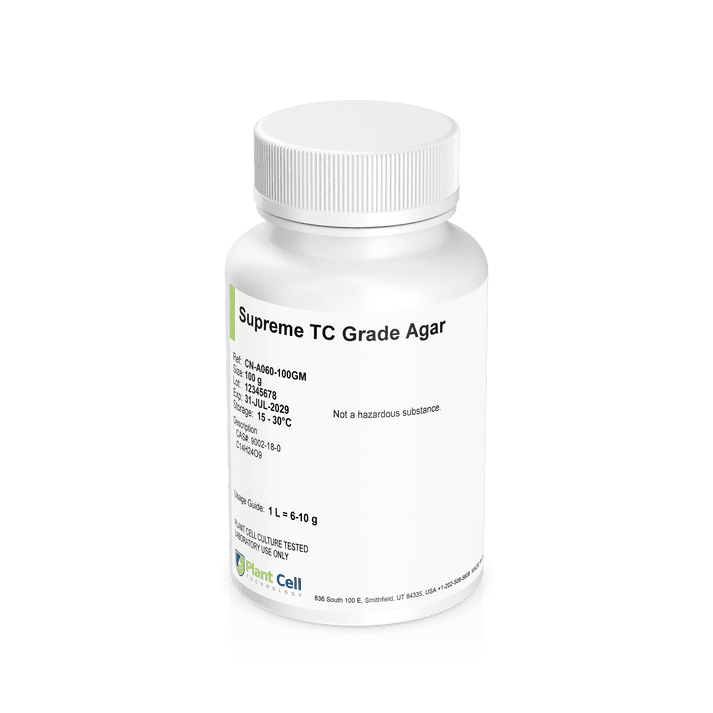
Supreme TC Grade Agar
List Price:
USD27.99 - USD650.99
Online Price:
USD19.99 - USD464.99
Your Price:
TC Gel Proprietary Blend
List Price:
USD88.19 - USD6,999.99
Online Price:
USD62.99 - USD4,999.99
Your Price:

Showing 181 to 192 of 208 results

What is plant tissue culture?


Plant tissue culture is the technique of growing plant cells, tissues, explants, or organs in vitro on sterile nutrient media to achieve propagation, regeneration, or research outcomes, encompassing micropropagation (clonal multiplication), callus culture (undifferentiated cell mass growth), and somatic embryogenesis (embryo induction from somatic cells). The tissue culture media sub-category provides the basal salt formulations and stage-specific media that underlie these techniques. Related entities include explant sterilization and disinfestation, axillary and adventitious shoot proliferation, the auxin-to-cytokinin developmental ratio, and virus-indexed/disease-free clonal propagation.


What you will discover:


  • Supplements & Additives: Pure plant growth regulators, auxins, cytokinins, vitamins, and sterile gelling agents adjusted to direct accurate cellular differentiation and ensure optimal structural support.

  • Tissue Culture Media: Widely relied upon, consistently formulated macro- and micronutrient basal mixes designed to offer a stable physiological base for various plant species in vitro.


How to choose plant tissue culture reagents


Species-specific basal medium needs

While Murashige and Skoog medium serves a broad range of species effectively, some plants (woody species, certain orchids, and others) perform better on alternative basal formulations such as Woody Plant Medium, B5, or White's medium; reviewing published protocols for the specific target species before defaulting to standard MS medium can improve success rates.

Micropropagation stage alignment

Selecting media and growth regulator concentrations that match the specific micropropagation stage (establishment, multiplication, rooting) is critical, since using a multiplication-stage hormone ratio during the rooting stage (or vice versa) will not produce the intended developmental outcome.

Explant type and sterilization considerations

The choice of explant (meristem, leaf, stem tip, or other tissue) affects both the sterilization protocol needed before culture initiation and the media formulation likely to succeed; meristem-derived explants are commonly used for virus-indexed, disease-free clonal propagation of crops prone to viral infection.

Callus-mediated vs. direct shoot regeneration

Callus-mediated shoot multiplication can produce large numbers of plants but carries a documented risk of genetic variation (somaclonal variation) in regenerated plants, while direct multiplication from axillary or adventitious shoots without an intervening callus stage generally produces more genetically uniform clones; the choice depends on whether genetic fidelity or multiplication rate is the priority.


Specifications context


Plant tissue culture media are characterized by basal salt formulation type, macro/micronutrient concentrations, and included organic supplements (vitamins, amino acids, sucrose), with plant growth regulator concentrations specified in micromolar or mg/L units appropriate to the targeted developmental stage. Multiplication rate, a key efficiency metric in micropropagation, describes the increase in shoot number achieved per subculture cycle, commonly reported over a 4-week cycle period. 

This sub-category sits within MBP's tissue culture catalog and contains tissue culture media, covering basal and multiplication formulations. MBP's specialist team can help confirm basal medium and growth regulator selection for a specific plant species and propagation stage before order placement.

Contact an MBP representative now to obtain a personalized bulk quote for your lab or nursery.

FAQ

Micropropagation is the clonal multiplication of plants through tissue culture, typically progressing through staged shoot proliferation and rooting to produce genetically uniform plantlets, while callus culture involves growing an undifferentiated, unorganized mass of plant cells that can sometimes serve as a starting material for shoot regeneration. Callus-mediated regeneration carries a documented risk of genetic variation compared to direct shoot multiplication.
While Murashige and Skoog medium serves a broad range of species effectively, some plants, including certain woody species and orchids, perform better on alternative basal formulations such as Woody Plant Medium, B5, or White's medium, which differ in nutrient salt concentrations and composition. Reviewing published protocols for the specific target species helps determine whether an alternative basal medium would improve culture success.
The choice of explant, such as a meristem, leaf, or stem tip, affects both the sterilization protocol needed before culture initiation and the likelihood of successful establishment on a given media formulation. Meristem-derived explants are commonly used for virus-indexed, disease-free clonal propagation of crops prone to viral infection, such as potato, sugarcane, and cassava.
Somaclonal variation refers to genetic variation that can arise in plants regenerated through callus-mediated tissue culture, reflecting unintended mutations or epigenetic changes accumulated during the undifferentiated callus growth phase. This is a key consideration when genetic fidelity to the parent plant is important, favoring direct shoot multiplication methods that avoid an intervening callus stage.
Multiplication rate describes the increase in shoot number achieved per subculture cycle during the multiplication stage of micropropagation, commonly reported over a defined cycle period such as 4 weeks. A higher multiplication rate indicates more efficient shoot proliferation, which is a key performance metric for commercial-scale micropropagation operations.
Plant explants are commonly sterilized using a combination of detergent and dilute bleach, with alcohol or fungicide treatment used for more difficult-to-sterilize material. Proper explant sterilization is critical to establishing a contamination-free culture, since bacterial or fungal contamination can quickly overtake a tissue culture vessel.
Plant tissue culture, including callus culture and shoot regeneration, is commonly used to regenerate whole plants from genetically engineered cells following plant transformation, allowing traits such as herbicide resistance or improved nutrition to be propagated into complete plants. The specific tissue culture protocol used often depends on the plant species and transformation method employed.
Micropropagation stage timing varies by species, but establishment commonly takes 2-3 months, multiplication proceeds in 4-8 week subculture cycles, and in vitro rooting takes approximately 4 weeks, followed by 4-8 weeks of acclimatization before plants move to nursery production. These timeframes are general guidelines and specific protocols should be consulted for a given species.
Plant tissue culture media based on Murashige and Skoog salts and vitamins, sometimes modified or supplemented, are used in published cannabis micropropagation protocols, alongside alternative basal formulations such as Driver and Kuniyaki Walnut (DKW) media in some published methods. Confirm the specific basal formulation and growth regulator requirements documented for the target cannabis cultivar before selecting media.
We provide the highest quality of products and anytime customer service.
Featured Categories
    online payment
    online payment
    fast delivery
    fast delivery
    technical support
    technical support
    24/7 support
    24/7 support
    copy right
    2026 All Right Reserved