Basal Media for Plant Tissue Culture
Basal media are classical salt formulations supplying the macronutrients, micronutrients, and vitamins needed for general plant cell metabolism, serving as the nutritional foundation for nearly all plant tissue culture protocols. Murashige and Skoog (MS) medium is the most widely used basal formulation, supplemented as needed with sucrose, agar, and growth regulators, with alternative formulations such as B5, White’s, and Woody Plant Medium available for species not optimized for MS salts. MBP's specialist team can confirm formulation and format for a specific species.
Explore available basal media or request a quotation by contacting customerservice@mbpinc.net. Our team can help identify the appropriate basal salt formulation and culture format for your plant tissue culture system.
Basal Media
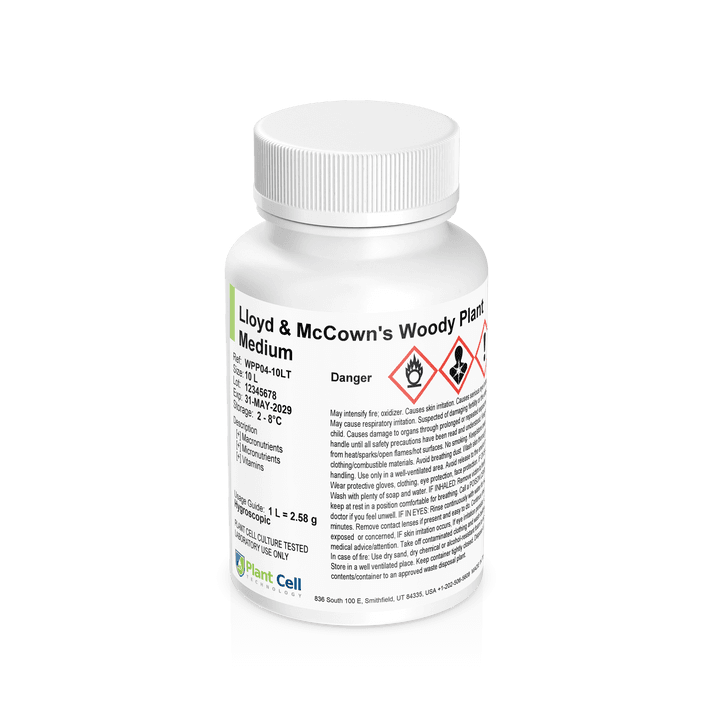
Showing 1 to 2 of 2 results
What is basal media in plant tissue culture?
Basal media are standardized mineral salt and vitamin formulations developed to support general plant cell growth and metabolism in vitro, with Murashige and Skoog (MS) medium, developed in 1962, the most widely used formulation across academic and commercial plant tissue culture. Other classical basal formulations, including B5 (Gamborg), White's, Linsmaier and Skoog (LS), Schenk and Hildebrandt (SH), and Woody Plant Medium, were developed for specific plant types or applications where MS salts are not optimal. Related entities include macro/micronutrient salt composition, organic supplements (vitamins, glycine), pH adjustment and autoclaving, and sucrose concentration notation (e.g., MS0 for no sucrose, MS20 for 20 g/L sucrose).
What you will find:
-
Standardized Core Formulations: Universally trusted mineral combinations that provide the exact ionic balances required to sustain healthy primary culture lines in vitro.
-
Core Vitamin Complexes: Concentrated organic groups prepared to protect tissue samples from oxidative stress and support fundamental enzymatic pathways during early inoculation.
-
Modifier-Free Starting Bases: Pure, chemically defined matrices designed to serve as neutral blanks for custom laboratory modifications and precise developmental tracking.
How to choose basal media products
MS medium vs. alternative basal formulations
Murashige and Skoog medium, with relatively high salt concentrations, performs well across an extensive range of monocotyledon and dicotyledon species, but some woody species, orchids, and other specific plant types are documented to perform better on alternative formulations such as Woody Plant Medium, B5, or White's medium; checking published precedent for the target species before defaulting to MS is recommended.
Basal salts only vs. complete formulation with vitamins
Some products supply only the basal salt mixture (macronutrients and micronutrients), requiring separate addition of vitamins, glycine, and other organics, while complete formulations bundle salts and vitamins together, and some further include sucrose or other components for a more turnkey formulation; confirm which components are included to avoid missing a required element of a published protocol.
Macronutrient vs. micronutrient component products
For labs needing to formulate custom media or modify a classical recipe, basal media are also available as separate macronutrient and micronutrient solutions or mixtures, allowing more granular control over the final nutrient composition than a single complete basal salt product.
\Sucrose concentration notation
Basal medium products are sometimes designated by sucrose content using a number suffix convention (e.g., MS0 indicating no sucrose, MS20 indicating 20 g/L sucrose); confirm whether sucrose is included in a specific product or needs to be added separately according to the target protocol.
Specifications context
Basal media powders are formulated to defined concentrations, commonly 4.3–4.4 g/L for standard MS formulations, with modifications (such as MS with added glycine, Modification 9-type formulations) available for specific application needs like micropropagation and somatic embryogenesis. Final media pH is typically adjusted to approximately 5.7–5.8 before autoclaving, and agar (commonly 8–15 g/L) is added before autoclaving for solid media preparation.
This sub-category is part of MBP's tissue culture media catalog alongside multiplication media, which builds on a basal formulation with stage-specific hormone supplementation. MBP's specialist team can help confirm basal formulation and component completeness for a specific plant species and protocol before order placement.
Reach out to the MBP technical support team today to order the core basal media solutions needed for your facility.
FAQ



