Cre-Inducible DIO Lentiviral Vectors for Research
MBP Inc. supplies Cre-inducible DIO (Double-floxed Inverted Open reading frame) for conditional, cell-type-specific gene expression. These constructs activate transgene expression only in cells that express Cre recombinase — making them essential tools for circuit-specific optogenetics, neuroscience, and in vivo conditional gene expression studies in Cre-driver transgenic animal lines across the USA and Canada.
MBP supplies Cre-inducible (DIO) vector platforms from ABM for regulated expression systems across diverse experimental workflows. Contact customerservice@mbpinc.net today to request a quote.
Cre-Inducible Gene Expression (DIO) Vectors
Showing 1 to 3 of 3 results
What Are Cre-Inducible DIO Lentiviral Vectors?
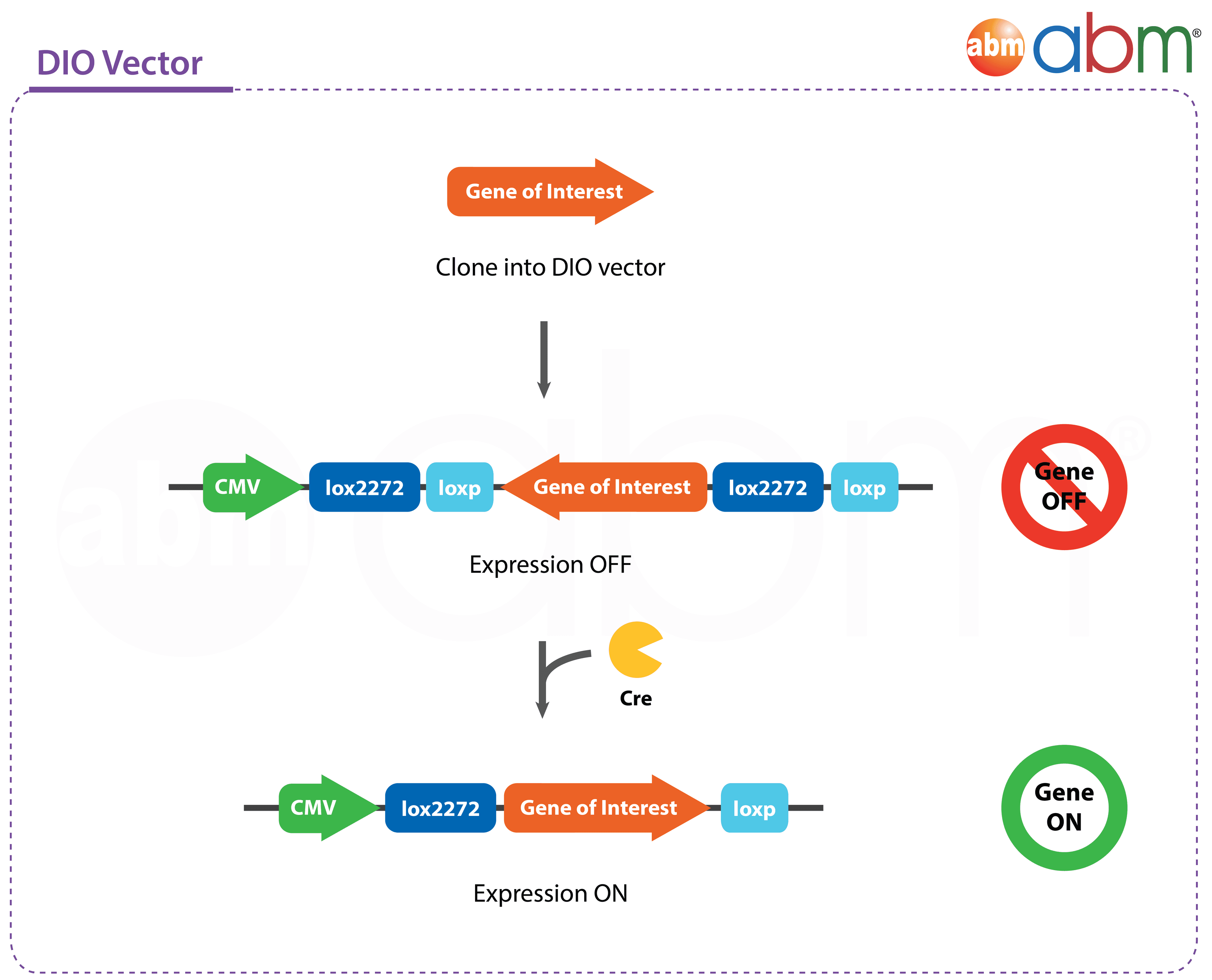
Conditional gene expression systems restrict transgene activation to defined cell populations — indispensable when whole-tissue expression would confound experimental interpretation or produce toxicity. DIO (Double-floxed Inverted Open reading frame) architectures place the gene of interest in an inverted, non-coding orientation until Cre recombinase flips it into the correct sense orientation for transcription. Conditional expression studies require precise genetic control. Choose a DIO vector compatible with your experimental model.
What you will find:
- Lenti-CMV-DIO-copGFP-SV40-Puro Vectors: Feature copGFP fluorescent tracking and a puromycin resistance marker for the selection of stable cells.
- Blank DIO-SV40-copGFP Vectors: Feature a copGFP reporter designed for cell-specific gene insertion and expression.
- Lenti-CMV-DIO-Blank-SV40-Puro Vectors: Feature an empty DIO expression plasmid with SV40-driven puromycin resistance for reliable experimental normalization.
How to Choose a DIO Lentiviral Vector
Insert Size
AAV DIO vectors are limited to expression cassettes of approximately 4.2 kb. Lentiviral DIO vectors support cassettes up to ~10 kb, enabling delivery of large genes — including full-length membrane receptors, ion channels, and fluorescent fusion constructs — that cannot fit in an AAV genome.
Cre Delivery Method
Cre can be delivered by co-injection of a Cre-expressing lentiviral or AAV vector, stereotactic injection of DIO LV into a transgenic Cre-driver mouse line, or plasmid co-transfection of Cre in cell culture experiments.
Permanence of Activation
Once Cre flips the ORF into sense orientation, one site from each loxP pair is excised, leaving heterotypic lox sites that cannot undergo further Cre-mediated recombination — the transgene is permanently locked ON and heritably expressed in daughter cells.
Validation Before In Vivo Use
Co-transfection of the DIO vector with a Cre expression plasmid in HEK293T cells confirms efficient Cre-mediated inversion and expected transgene expression. Transfecting the DIO vector alone confirms the absence of leaky expression.
Reporter and Application Format
DIO lentiviral vectors are available with GFP, mCherry, YFP, and other fluorescent reporters — as the primary transgene or fused via a 2A self-cleaving peptide for simultaneous labelling and functional expression. Optogenetic actuators (ChR2, eNpHR, Arch) and chemogenetic tools (DREADDs) are common applications.
Specifications Context
DIO (Double-floxed Inverted Orientation) lentiviral vectors enable Cre-dependent gene expression using recombination-based activation of inverted transgene cassettes. These systems are commonly used in conditional expression workflows involving fluorescent reporters, selectable markers, and controlled gene expression models. A known technical consideration is baseline leakiness before Cre recombination, which can vary depending on vector design and experimental conditions. MBP’s DIO lentiviral vector offerings include blank, GFP, and selection-marker formats designed to support a range of Cre-dependent experimental setups. Product availability reflects MBP’s catalogue as of mid-2026.
Contact the expert team at MBP to get a reliable Cre-inducible gene expression (DIO) vector for your lab.
FAQ



