Adenoviral CRISPR/Cas9 Negative Control Constructs for Labs
MBP Inc. supplies adenoviral CRISPR/Cas9 control constructs — including scrambled (non-targeting) sgRNA adenoviruses for spCas9 — for establishing experimental baselines in adenoviral gene editing workflows. These control vectors provide CRISPR system components without targeting specific mammalian genes, enabling proper interpretation of genome editing outcomes in research applications across the USA and Canada.
Explore MBP's adenoviral CRISPR/Cas9 control products for genome-editing research. Request a quote for current availability by contacting customerservice@mbpinc.net
CRISPR/Cas9 Controls
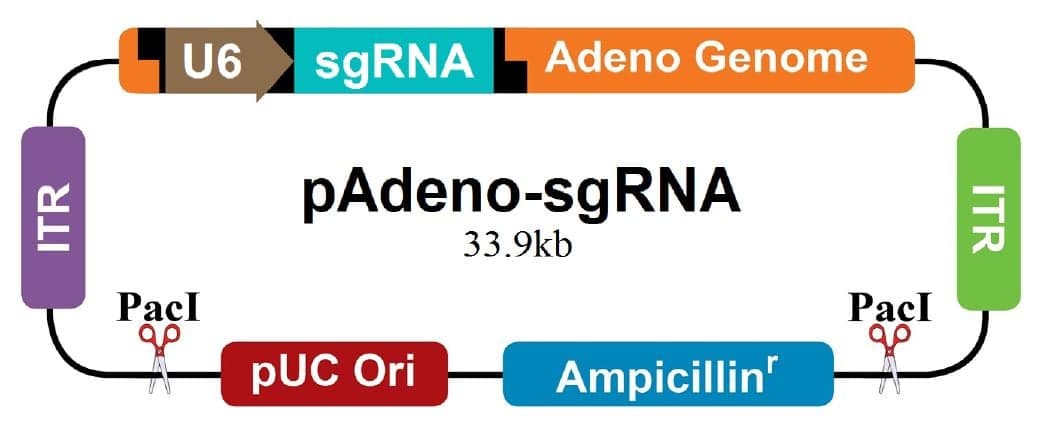
Showing 1 to 1 of 1 results
What Are Adenoviral CRISPR/Cas9 Negative Controls?
Adenoviral delivery of CRISPR/Cas9 components combines the immune stimulation of adenoviral capsid delivery with the cellular stress of Cas9 expression — making matched negative controls even more critical than in lentiviral CRISPR work, where vector-related immune activation is comparatively lower. Genome-editing studies benefit from appropriate validation controls. Select a CRISPR/Cas9 control construct for your adenoviral workflow.
What you will find:
-
Scrambled sgRNA CRISPR Adenoviruses: for spCas9-driven gene editing studies. It includes high-titer control viruses carrying non-targeting RNA as a guide.
How to Choose Adenoviral CRISPR/Cas9 Controls
Component Matching
A valid control should use the same adenoviral Cas9 expression construct as experimental groups and express a non-targeting sgRNA, isolating editing-specific phenotypes from adenoviral delivery and Cas9 expression effects.
Non-Targeting sgRNA Validation
As with lentiviral CRISPR controls, non-targeting sgRNAs should be bioinformatically verified to have minimal homology to any genomic PAM-adjacent target site, avoiding unintended cutting.
Cas9-Inclusive vs. sgRNA-Only Controls
A non-targeting sgRNA + Cas9 construct controls for the full CRISPR system; a non-targeting sgRNA without Cas9 isolates the contribution of sgRNA delivery alone — both formats are useful depending on the experimental question.
Combined Immune Response Considerations
Because adenoviral capsid delivery and Cas9 expression each independently activate cellular stress responses, the negative control must deliver identical components (minus the targeting guide) to separate editing-specific effects from these combined non-specific responses.
Scrambled sgRNA Caution
As with other CRISPR delivery formats, scrambled (rather than non-targeting) sgRNA sequences are not recommended, since randomly rearranged guides may inadvertently target unintended genomic sites.
Specifications Context
Adenoviral delivery of CRISPR/Cas9 is widely used in pre-clinical gene editing studies where high-efficiency delivery is required in both dividing and non-dividing cells, making appropriate controls essential for interpretation due to vector-associated and Cas9-induced cellular responses. Non-targeting (scrambled) sgRNA adenoviral controls, including formats with Cas9 where applicable, are available from established manufacturers, including ABM (Applied Biological Materials). All adenoviral CRISPR work requires institutional biosafety committee (IBC) approval prior to use, and approval timelines should be considered early in project planning, as review may take several weeks depending on institutional processes. Product availability reflects MBP’s catalogue as of mid-2026.
Contact the expert team at MBP today and get advanced adenoviral CRISPR controls for your lab today.
FAQ



