Ligation-Independent Cloning (LIC) Kits for Seamless DNA Assembly
Ligation-independent cloning (LIC) kits enable directional assembly of one or more PCR fragments into a linearized vector without requiring restriction enzyme digestion or a separate ligation reaction, using complementary overhangs generated by exonuclease treatment or homologous end sequences. They are supplied as complete kits including vector, enzyme mix, and competent cells or as standalone enzyme/buffer systems. Academic researchers building multi-fragment expression constructs, including for lentiviral vector modification, can use MBP's specialist team to confirm kit compatibility with existing vector backbones.
Explore available LIC kits or request a quotation by contacting customerservice@mbpinc.net. Our team can help confirm compatibility with your vector backbone, insert design, and multi-fragment cloning strategy.
Ligation Independent Cloning Kits
Showing 1 to 1 of 1 results
What are ligation independent cloning kits?
Ligation independent cloning (LIC) kits enable assembly of PCR-amplified DNA fragments into a linearized vector through complementary single-stranded overhangs, generated either by exonuclease treatment of vector and insert ends or by PCR primers carrying homology arms, bypassing the need for restriction enzyme digestion and T4 DNA ligase. Related entities include seamless cloning methods (Gibson Assembly-type approaches), directional cloning, multi-fragment assembly, homology arm design, and downstream transformation into competent cells.
What you will find:
-
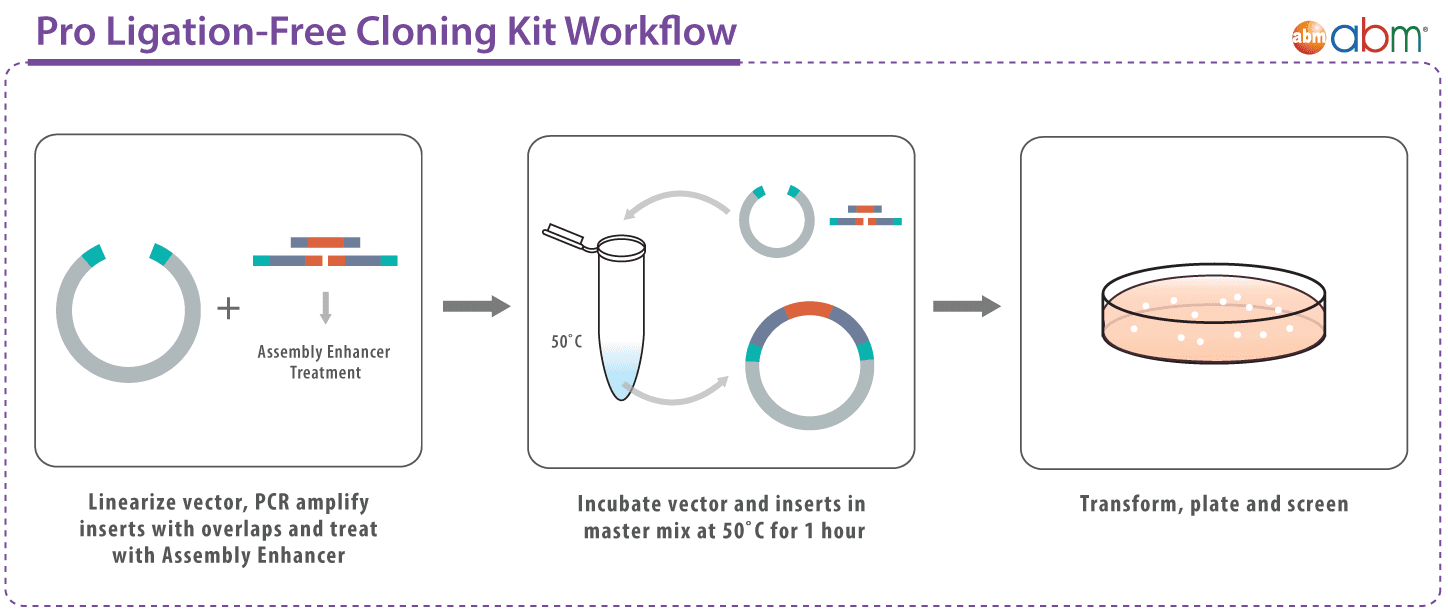
Pro Ligation-Free Cloning Kit: Ligase-independent, comprehensive, all-in-one system for smooth and rapid DNA assembly.
How to choose ligation independent cloning kits
Single-fragment vs. multi-fragment assembly
Some LIC kits are optimized for inserting a single PCR fragment into a vector at a defined site, while others support simultaneous assembly of multiple fragments (often up to 4–5) into a single linearized vector in one reaction; choose based on the complexity of the construct being built.
Homology arm length and primer design
LIC and seamless assembly methods require PCR primers with homology arms (typically 15–25 base pairs) overlapping the vector or adjacent fragment ends; primer design tools provided with some kits can help ensure compatible overlap lengths and melting temperatures across all fragment junctions.
Compatibility with existing vector backbones
Confirm the LIC kit's enzyme system is compatible with the vector backbone already in use, particularly for specialized vectors such as lentiviral transfer plasmids, since some seamless assembly chemistries have sequence requirements at the junction sites.
Kit completeness (enzyme-only vs. full kit with competent cells)
Standalone enzyme/buffer kits assume the lab already has compatible competent cells for transformation, while full kits bundle competent cells (and sometimes a control vector/insert pair) for initial validation of the assembly chemistry before applying it to a novel construct.
Specifications context
LIC and seamless assembly kits report cloning efficiency as the percentage of correct-assembly colonies among total transformants, with well-optimized reactions commonly exceeding 80–90% correct assembly for 2–3 fragment reactions. Reaction setup typically takes 15 minutes to 1 hour at a defined temperature (often room temperature or 50°C depending on the chemistry) before transformation.
This sub-category is part of MBP's cloning catalog alongside transformation kits and competent cells, needed to propagate the assembled construct, and chemicals/reagents for general cloning consumables. Labs building custom immortalization vectors can also review MBP's cell immortalization catalog. MBP's specialist team can help confirm assembly chemistry compatibility with a specific vector backbone before order placement.
Contact the expert team at MBP today to get high-integrity ligation-independent cloning kits for your lab.
FAQ