TERT Overexpression Viruses for Cellular Immortalization and Senescence Bypass
TERT overexpression viruses are recombinant lentiviral particles that deliver human telomerase reverse transcriptase (hTERT) under a constitutive promoter to extend telomeres and bypass replicative senescence in primary cells. They are supplied with antibiotic or fluorescent-antibiotic fusion selection markers under CMV or EF1-alpha promoters. Academic researchers immortalizing fibroblasts or other primary cell types while preserving near-normal phenotype can use MBP's specialist team to confirm titer and marker selection before ordering.
Explore available TERT overexpression viral reagents or request a quotation by contacting customerservice@mbpinc.net. Our team can help confirm viral titer, promoter design, and selection marker compatibility for your immortalization workflow.
TERT Overexpression Viruses







Showing 1 to 8 of 8 results
What are TERT overexpression viruses?
TERT overexpression viruses are recombinant lentiviral (or in some cases retroviral) particles carrying the human telomerase reverse transcriptase (hTERT) gene under a constitutive promoter, designed to extend telomere length and bypass replicative senescence in primary cells. Related entities include telomere maintenance, replicative senescence, population doubling limits, EF1-alpha and CMV promoters, and antibiotic/fluorescent selection markers (puromycin, hygromycin, GFP-Puro).
What you will find:
- Adeno-hTERT Antisense used in cancer research for inhibition of telomerase activity
- Lenti-hTERT Virus (High Titer) used as a standard tool for efficient immortalization of primary cells
- Lenti-EF1a-hTERT Virus uses the EF1a promoter for reliable, long-term expression.
- Adeno-hTERT is used in transient TERT expression for high-efficiency adenoviral delivery
- Lenti-hTERT is used as a streamlined vector for specialized genetic engineering.
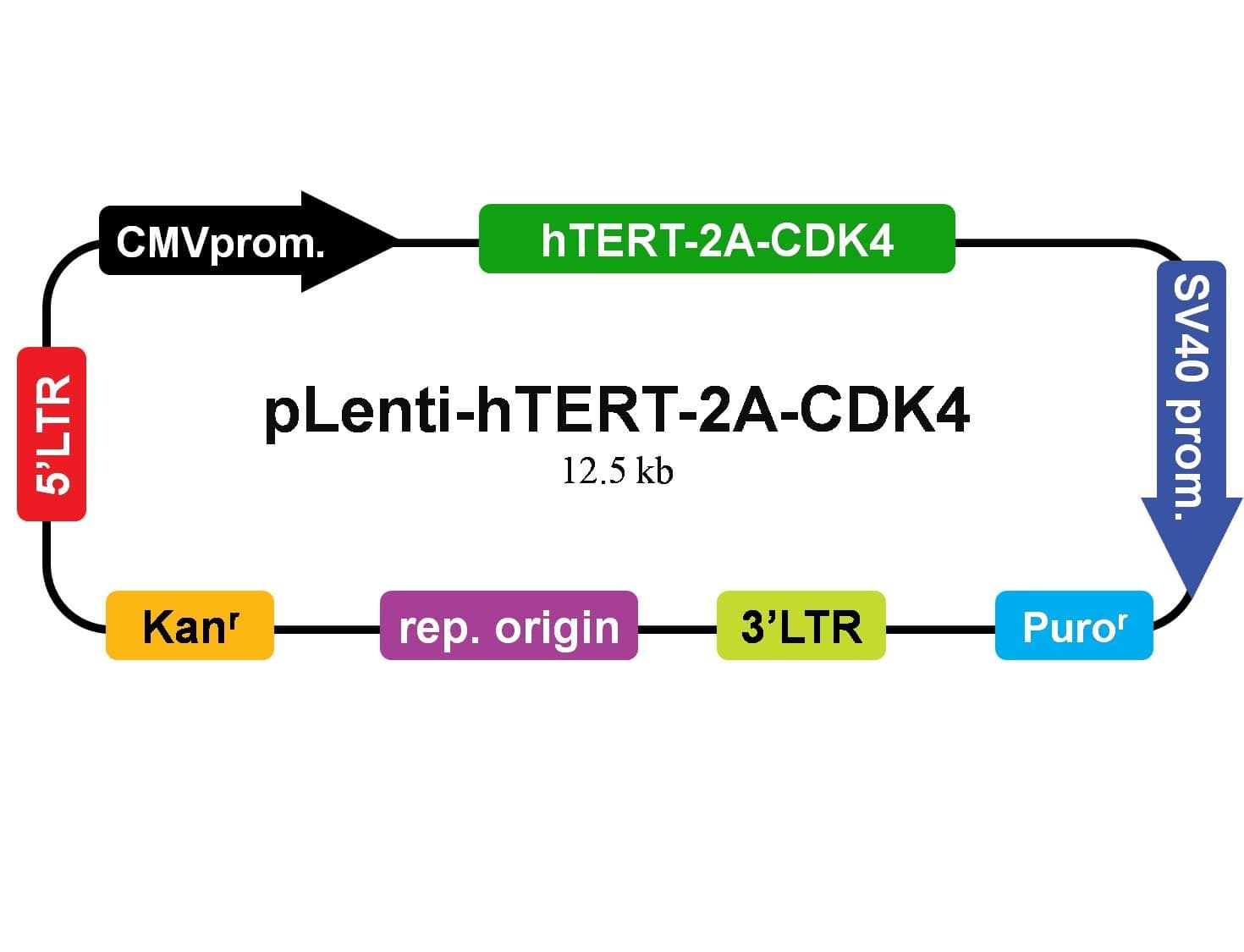
- Lenti-hTERT-2A-CDK4 Virus co-expression for complex cell types like myogenic cells.
- Lenti-EF1a-hTERT-Hygro Virus for precise metabolic selection featuring hygromycin resistance
- Lenti-hTERT-Neo Virus for stable generation of cell lines, includes neomycin/G418 resistance
How to choose TERT overexpression virus products
Promoter selection
EF1-alpha promoter constructs are often preferred for primary cells where CMV promoter silencing over extended culture is a concern, though CMV-driven constructs offer strong initial expression; the choice may depend on the expected culture duration and cell type-specific promoter activity.
Selection marker type
Antibiotic resistance markers (puromycin, hygromycin, neomycin/G418, blasticidin) allow selection of stably transduced populations by drug treatment, while fluorescent-antibiotic fusion markers (e.g., GFP-Puro) additionally allow visual confirmation of expression and flow sorting; confirm the target cell line's existing markers don't conflict.
Titer and transduction efficiency
hTERT lentivirus is typically supplied at titers around 1x10^8 TU/mL; transduction efficiency depends on the target cell type's susceptibility to lentiviral infection, and some difficult-to-transduce primary cells may require optimization of multiplicity of infection (MOI) or use of transduction enhancers.
Species considerations
hTERT is human-specific; for non-human primary cells, confirm whether a species-matched TERT ortholog is available or whether SV40 large T antigen (with broader documented cross-species activity) is a more appropriate alternative for the target species.
Specifications context
TERT overexpression lentivirus is typically supplied at approximately 1x10^8 TU/mL in small-volume vials (e.g., 25 microliters per vial), shipped on dry ice and stored at -80°C, with constructs validated by full-length sequencing and confirmed free of mycoplasma and common contaminants. Stable transduction and selection typically take 1-2 weeks before characterization, with full confirmation of telomere extension and extended proliferative capacity assessed over subsequent passages. As of 2026, hTERT lentivirus remains a standard tool for generating immortalized cell lines that retain much of the original primary cell's phenotype, distinguishing it from the more transformation-prone SV40 large T antigen approach.
This sub-category sits within MBP's cell immortalization catalog alongside SV40T antigen overexpression viruses and additional immortalization agents. Labs building custom expression constructs can also review MBP's cloning reagents for vector and competent cell options. MBP's specialist team can help confirm promoter and selection marker choices for a specific primary cell type before order placement.
Browse our collection and contact the expert team at MBP today to find premium-quality TERT viral vectors for your lab.
FAQ