Transfection Reagents for DNA, RNA, siRNA, and CRISPR Delivery into Cultured Cells
Transfection reagents introduce DNA, mRNA, siRNA, and CRISPR/Cas9 components into cultured cells via chemical (cationic lipids/lipofection, PEI, calcium phosphate), physical (electroporation), or viral (transduction with polybrene/DEAE-dextran enhancement) methods. Reagent choice depends on nucleic acid type, cell type, and whether transient or stable expression is the goal — primary and stem cells often require empirical testing across chemistries. Electroporation targets 40–80% survival with 1–5 µg DNA per 10⁷ cells. MBP ships to labs across the United States, Canada, and internationally with PO and Quick Order at mbpinc.net.
Explore available transfection reagents or request a quotation by contacting customerservice@mbpinc.net. Our team can help identify the optimal delivery method for your cell type, nucleic acid cargo, and expression requirements.
Transfection Reagents

Showing 1 to 3 of 3 results
What are transfection reagents?
Transfection reagents enable the delivery of exogenous nucleic acids — plasmid DNA, mRNA, siRNA/shRNA, and CRISPR/Cas9 ribonucleoprotein or plasmid components — into cultured cells for applications spanning gene expression studies, gene silencing, CRISPR-based gene editing, recombinant protein production, and stable cell line development. Delivery methods fall into three categories: chemical methods (cationic lipid/lipofection reagents, polymeric agents like polyethyleneimine/PEI, and calcium phosphate co-precipitation), physical methods (electroporation and biolistic particle delivery), and viral methods (transduction via lentiviral, adenoviral, or AAV vectors, the only category where "transduction" is the technically correct term). Each category includes multiple specific reagents with different optimal nucleic acid types, cell type compatibility, and transient-versus-stable expression outcomes.
What you will find:
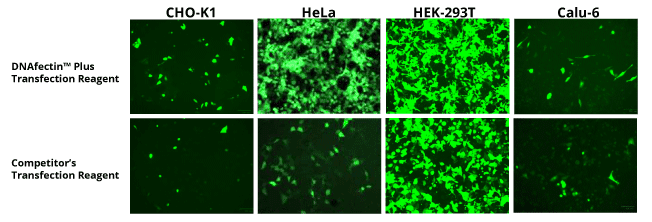
- DNAfectin™ Plus Transfection Reagent: innovative lipid-based reagent for rapid transfection in common adherent cell lines; fewer handling steps, and works in complete growth media
- Susfectin™ Transfection Reagent: polymer-based reagents formulated for suspension cultures, providing highly efficient nucleic acid delivery
- Transfection Reagent: designed for faster and more reliable concentration of lentiviral particles from cell culture supernatant
How to choose transfection reagents
Chemical: lipofection
Cationic lipid (lipofection) reagents form positively charged complexes with nucleic acids that interact with the negatively charged cell membrane, enabling entry primarily via endocytosis. Examples include DOTMA-based formulations and product lines such as Lipofectamine and X-tremeGENE, suitable for a diverse range of cell lines with DNA, small RNA, and CRISPR/Cas9 components. Lipid transfections adapt well to cost-effective and high-throughput formats but are generally cell-type-specific in optimal performance — a reagent validated on one line may need re-optimization for another.
Chemical: PEI and calcium phosphate
Polyethyleneimine (PEI) is a polymeric transfection agent that, like cationic lipids, forms complexes with DNA for cell membrane interaction — commonly used for high-yield transient transfection in suspension cultures for recombinant protein production. Calcium phosphate co-precipitation is a long-established method (Graham & van der Eb, 1973) that remains highly efficient for a wide range of cell types and molecules, suitable for both transient and stable transfection, though the process can be harsher on sensitive cell lines, leading to increased cell death in some cases.
Physical: electroporation
Electroporation exposes cells to electrical pulses that create temporary membrane pores, allowing direct entry of DNA, RNA, and other molecules — an easy, non-chemical technique yielding high efficiency across diverse cell types. Optimization centers on three parameters: pulse voltage, pulse width, and pulse number, with the goal of maintaining 40-80% cell survival. Electroporation requires roughly five-fold more cells and DNA than calcium phosphate methods, typically 1-5 µg DNA per 10⁷ cells, with good linear correlation between DNA amount and uptake.
Viral transduction enhancers
For viral transduction (lentiviral, adenoviral, AAV), polybrene and DEAE-dextran are polycations that minimize electrostatic repulsion between negatively charged viral particles and cell membranes, enhancing transduction efficiency. FBS has been shown to yield better transduction efficiency than bovine calf serum in some transduction protocols — a media-composition detail relevant to viral workflows specifically.
Selecting reagent for nucleic acid type
Some reagents are specifically optimized for plasmid DNA (Effectene, TransIT-X2), while others (Lipofectamine RNAiMAX) are designed for small oligonucleotides like siRNA. Co-transfection of multiple nucleic acid types may require protocols and ratios validated specifically for that combination rather than direct extrapolation from single-nucleic-acid optimization.
Pre-transfection cell preparation
Regardless of method, cells should be at least 90% viable and have recovered at least 24 hours post-subculture before transfection. Cell density must avoid both contact inhibition (too high, reducing uptake) and insufficient cell-cell contact (too low, reducing growth) — both extremes reduce efficiency.
Specifications context
Electroporation optimization targets 40-80% post-pulse cell survival across a parameter space of pulse voltage, width, and number, with typical DNA loading of 1-5 µg per 10⁷ cells showing linear uptake correlation within that range. Calcium phosphate transfection (Graham & van der Eb, 1973) remains a foundational method still in active use for both transient and stable transfection across many cell types. As of 2026, lipid-based reagents remain the default first choice for adherent cell line transfection due to ease of use, with electroporation and viral transduction reserved for hard-to-transfect primary/stem cells and applications requiring stable genomic integration respectively.
Contact the expert team at MBP and find premium transfection reagents for your lab today.
FAQ