
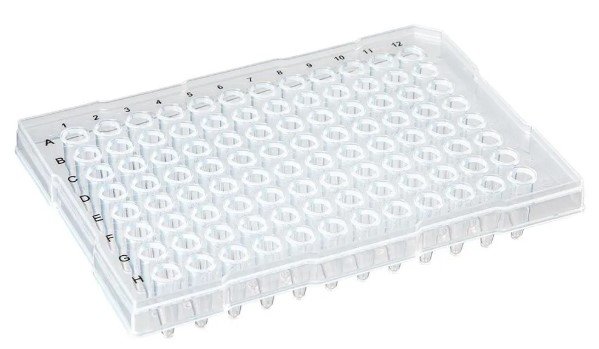
Microplates, or microtiter plates, are rectangular plates with multiple small wells, primarily used in tests like ELISA and PCR. The standard 96-well plate is essential for sample collection, compound preparation, and high-throughput screening. These plates are labeled for easy reference, feature an orientation notch, and are made from polypropylene or polystyrene.
They come in sterile and non-sterile options with round or flat-bottom wells. The plate color can impact fluorescence and signals, so ensure compatibility with your equipment. Some plates are also designed for specific devices.
Explore this blog to discover more about 96-well PCR plates and their applications.
96-Well PCR Plates
Advancements in polymerase chain reaction (PCR) have greatly improved the technique, thanks to the efforts of research organizations and foundations worldwide. While much of the focus has been on refining components like samples, DNA primers, template DNA, and thermocyclers, the impact of low-quality plastics on the consistency of PCR procedures is often overlooked.
To address this, companies have invested significantly in developing high-quality PCR consumables. These efforts have led to PCR plates in frosted, white, and clear designs, specifically crafted to be compatible with leading thermocyclers and PCR protocols, ensuring researchers achieve optimal results.
Types Of 96-Well PCR Plates
Explore the various types of 96-well PCR plates:
- Non-Skirted
- Semi-Skirted
Non-skirted PCR Plates
Non-skirted PCR plates, known for their lightweight and flexible design, lack extended edges or skirts, making them easy to handle and ideal for standard PCR applications that don't require automation. While highly versatile, they may be less stable in high-throughput systems and are more prone to warping under high temperatures.
These plates feature clear well bottoms for enhanced visibility and are available in various colors with clearly marked alphanumeric labels. Compatible with standard multichannel pipettes, non-skirted PCR plates offer convenience and practicality for routine laboratory use.
Features
- No extended skirt or edge for added flexibility.
- Lightweight and highly maneuverable.
- Ideal for manual applications.
- Less stable and prone to warping under high temperatures.
Applications
- 96-well non-skirted PCR plates are an excellent choice for smaller labs and routine PCR experiments that don't require automation.
- Their cost-effectiveness and flexibility make them ideal for educational settings, such as schools, where managing fewer samples is the priority.
Advantages of Non-Skirted Plates:
- These lightweight and user-friendly pipettes are ideal for manual pipetting and are compatible with various thermal cyclers.
- Their affordability makes them a budget-friendly option for labs.
- Designed for standard PCR applications that don’t require automation, they are easy to store and stack, saving valuable lab space.
- These pipettes are especially suited for smaller labs or educational institutions where flexibility is a priority.
Semi-skirted PCR Plates
Semi-skirted PCR plates are designed with a partial edge, or “skirt,” that surrounds the sides while leaving the base exposed. This unique design provides enhanced stability comparable to fully skirted plates, yet retains a lighter and more flexible structure. These features make 96-well semi-skirted PCR plates ideal for both automated systems and manual pipetting workflows.
Striking a perfect balance between the rigidity of skirted plates and the adaptability of non-skirted ones, semi-skirted PCR plates are a versatile choice for a wide range of laboratory applications.
Features
- Features a partial skirt along the sides.
- Combines stability with added flexibility.
- Compatible with both manual and automated workflows.
- Lighter than fully skirted PCR plates.
Applications:
- Semi-skirted plates are an excellent choice for laboratories that combine manual pipetting with some automation.
- They are ideal for moderate-throughput settings where stability is important, but full automation is not necessary.
Advantages of Semi-Skirted Plates:
- These 96-well semi-skirted PCR plates offer a great balance of stability and flexibility, making them ideal for various laboratory tasks.
- They work efficiently with both manual pipetting and some automated systems.
- Lighter and easier to handle than fully skirted plates, they provide a cost-effective alternative while maintaining essential stability.
- With ample space for labeling and barcoding, these plates facilitate sample tracking.
- Perfect for medium-throughput applications, they are versatile and reliable in various lab settings.
Here’s a refined comparison table of skirted vs. non-skirted PCR plates:
| Feature | Non-Skirted PCR Plates | Semi-Skirted PCR Plates |
| Skirt Design | No extended skirt or edge. | Partial skirt around the sides. |
| Flexibility | Lightweight and flexible, easy to handle. | Good balance between stability and flexibility. |
| Stability | Less stable, and can warp at high temperatures. | More stable than non-skirted, but less than fully skirted. |
| Best For | Manual use in smaller labs or standard PCR. | Both manual pipetting and some automated use. |
| Automation Compatibility | Not suitable for high-throughput or fully automated systems. | Suitable for moderate throughput and some automated systems. |
| Well Bottom Visibility | Clear for easy visibility. | Clear for easy visibility. |
| Application | Ideal for labs with low throughput and limited automation. | Ideal for labs needing moderate throughput with some automation. |
| Cost | More affordable. | More cost-effective than fully skirted plates. |
| Space Efficiency | It can be easily stacked and stored. | It can be stacked but offers more stability. |
| Versatility | Best for standard PCR applications. | Suitable for medium-throughput applications. |
| Labeling/Barcoding | Less space for labeling. | Ample space for labeling and barcoding. |
| Applications in Education | Great for schools or low-budget labs. | It is good for labs with moderate automation needs. |
This table will ensure clarity and highlight the key differences and advantages of each type of PCR plate. Moreover, you can purchase semi-skirted or non-skirted PCR plates from MBP Inc.
Final Thoughts
Choosing the right PCR plate depends on your lab's needs and throughput. Non-skirted plates are lightweight and cost-effective, ideal for smaller labs and manual use. Semi-skirted plates offer stability and flexibility, suitable for moderate-throughput applications and both manual and automated use. Understanding these differences helps labs select the optimal plate type for consistent, reliable PCR results.


