Forced Air Convection Drying Ovens for Research and QC Labs
Forced air convection drying ovens use an internal fan to circulate heated air throughout the chamber, providing more uniform temperatures and faster drying than gravity convection ovens for laboratory applications including glassware and labware drying, specimen dehydration, material heating, and curing.
MBP supplies forced air convection drying ovens for research, QC, and institutional laboratories across the United States, Canada, and internationally, with US order processing in Houston, Texas. MBP is a registered vendor for Howard Hughes Medical Institute, Vanderbilt University, and MD Anderson Cancer Center. Request a quote by contacting customerservice@mbpinc.net.
Forced Drying Ovens
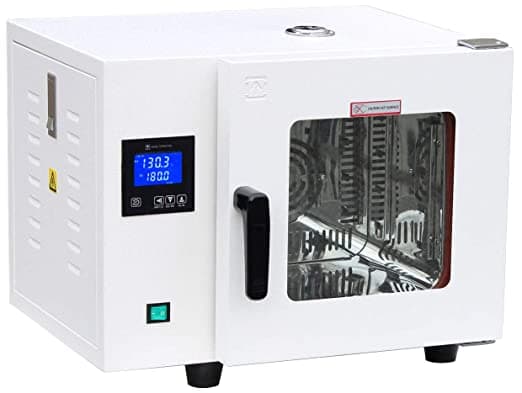
Showing 1 to 1 of 1 results
What Are Forced Air Convection Drying Ovens?
Forced air convection drying ovens use a motorized fan (internal blower) to circulate heated air throughout the insulated chamber at high velocity, distributing heat more rapidly and uniformly than natural (gravity) convection, where heated air rises and cooler air falls without mechanical mixing, creating vertical temperature gradients of 5-15 degrees C between shelf levels. In a forced air oven, the fan draws air across the heating elements and pushes it back through the chamber via a rear air duct or perforated back wall, reducing temperature variation to plus or minus 1-5 degrees C across the full chamber volume. This improved uniformity is critical for reproducible drying and curing results when multiple sample trays are loaded simultaneously on different shelves. Forced air ovens are sometimes called mechanical convection ovens to distinguish them from gravity convection (natural convection) models. Choose forced air ovens when temperature uniformity across multiple shelves, fast door-recovery, and high sample throughput are needed; choose gravity convection only for lightweight powder samples that would be disturbed by airflow.
What You Will Find:
- Digital Forced Air Drying Ovens: Bench-top forced air ovens designed to provide uniform heated-air circulation for laboratory drying, heating, and conditioning applications.
- Digital Temperature Control: Micro-computer-controlled temperature regulation for improved precision, accuracy, and temperature uniformity during routine laboratory workflows.
- Memory & Alarm Functions: Built-in memory restores previous operating settings after a power interruption, while programmable alarms notify users when the chamber temperature falls outside the set range.
- Multiple Chamber Sizes: Forced air drying ovens available in a range of capacities to accommodate different laboratory sample volumes and workspace requirements.
How to Choose a Forced Air Drying Oven
Temperature range and maximum temperature
Standard forced air laboratory ovens cover ambient plus 10 degrees C to 250-300 degrees C for the majority of laboratory drying, sterilization, and curing applications. Models such as the Labtron LFDO-A18 specify RT plus 10 to 300 degrees C with a 225 L chamber and back-heating forced convection. The BEING BOF series covers ambient plus 10 to 300 degrees C with a 4.3-inch touchscreen controller. Choose a model whose continuous working temperature is at least 20-30 degrees C above your most demanding protocol temperature to ensure stable operation without pushing the oven to its rated maximum.
Airflow design and temperature uniformity
Forced air ovens use different airflow architectures: rear-wall plenum (air pushed forward from a heated back panel) is most common and provides horizontal air circulation across all shelves; side-wall injection creates cross-flow; top-mounted fans push air downward. Oven manufacturers specify temperature uniformity at maximum temperature (e.g., plus or minus 2 degrees C at 150 degrees C) and temperature fluctuation at setpoint (e.g., plus or minus 1 degree C). Request both specifications when comparing models. Optimal shelf loading leaves 25-30% of the shelf area unoccupied to permit air flow between samples.
Chamber volume and shelf configuration
Benchtop forced air ovens range from 0.9 cu. ft. (25 L) for BINDER FDS056 to 3.7 cu. ft. (105 L) for BINDER FDS115 to 13.8 cu. ft. for SHEL LAB SMO14HP-2. Adjustable perforated stainless steel shelves (2-6 shelves per model, depending on size) allow flexible sample height configurations. Maximum load per shelf (typically 10-30 kg for standard models) must not be exceeded to prevent shelf deflection and door-close interference. The 225 L Labtron LFDO-A18 is a mid-to-large benchtop unit suitable for glassware drying and batch specimen dehydration.
Controller and programmable features
Basic forced air ovens use single-setpoint digital PID controllers. Advanced models feature programmable multi-segment controllers: the BEING BOF supports presetting 8 periods and 8 steps (64 total program combinations) for temperature, time, and fan speed simultaneously. Programmable control is used for cure cycles with specific ramp rates, controlled aging protocols, and standardized drying procedures requiring documented temperature-time profiles. USB data export and RS-232 interfaces for LIMS integration are available on GLP-grade models.
Fan speed control
Fan speed adjustment is available on advanced forced air ovens: reducing fan speed to minimum settings mimics gravity convection conditions for drying lightweight powders or fine particulates that would be disturbed by full fan velocity. The BEING BOF specifies simultaneous programming of temperature, time, and fan speed, enabling protocol optimization for mixed sample types processed in the same run.
Specifications Context
Forced air convection ovens achieve temperature recovery after a 30-second door-open event in 3-8 minutes at 150 degrees C, compared to 15-30 minutes for gravity convection ovens of equivalent volume, because the fan immediately recirculates warm air throughout the chamber. Standard drying of wet laboratory glassware (after washing and rinsing with deionized water) uses 80-100 degrees C in a forced air oven for 20-30 minutes; higher temperatures risk thermal shock to borosilicate glass at rapid heating rates. Dry heat sterilization of heat-stable instruments and non-aqueous oils uses 160-180 degrees C for 1-2 hours in a forced air oven; this also inactivates bacterial endotoxin (lipopolysaccharide) at temperatures above 170 degrees C, which steam sterilization cannot achieve. Forced air laboratory ovens with touchscreen 4.3-inch displays, 64-step programmable profiles, variable fan speed control, over-temperature and over-current protection, and CE certification are the standard specification for new research and pharmaceutical laboratory installations.
To discuss product availability or get selection guidance, contact the MBP team.
FAQ