Multi-Position Hotplate Stirrers for Parallel Sample Processing
Multi-position hotplate stirrers are laboratory instruments that simultaneously heat and stir four to fifteen individual sample positions on a single unit, enabling parallel reactions, dissolution testing, QC batch processing, and comparative assays under identical or independently controlled conditions. Each position drives a PTFE stir bar in its vessel via an individual magnetic drive; ceramic-coated top plates provide chemical resistance and even heat distribution from ambient to 120 degrees C or higher across all positions.
MBP provides quote-based procurement and purchase order support for multi-position hotplate stirrers for US and Canadian research and QC laboratories. Request a quote for multi-position hotplate stirrers for parallel sample processing, batch testing, and laboratory workflows by contacting customerservice@mbpinc.net.
Multi-Position Hotplate Stirrers
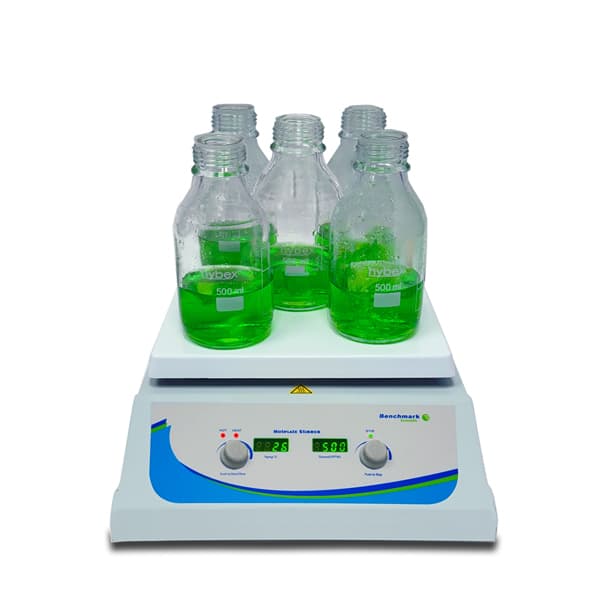
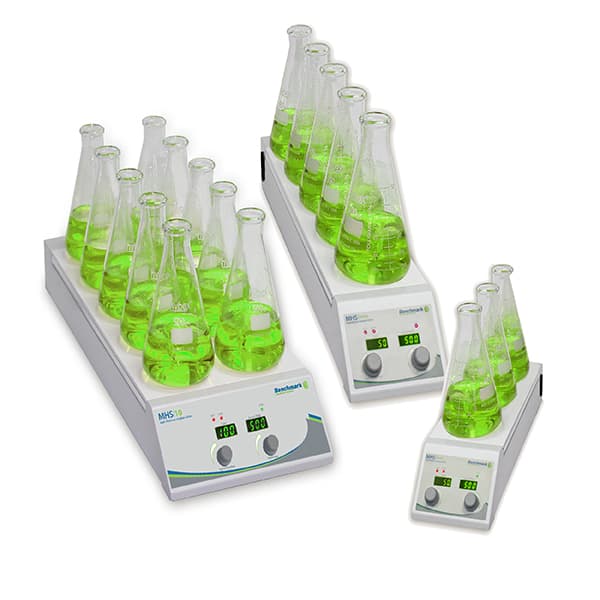
Showing 1 to 2 of 2 results
What Are Multi-Position Hotplate Stirrers?
Multi-position hotplate stirrers are magnetic hotplate stirrer units with 4, 5, 6, 8, 10, or 15 individual stirring positions arranged on a single heated work surface, each position driving its own PTFE stir bar independently. Each position supports a vessel (typically up to 400 mL to 1 L per position), and most models allow each position to be operated at the same shared speed and temperature setting or, on advanced models with independent position control, at individually programmed conditions. Multi-position units eliminate the throughput bottleneck of single-position stirrers in labs that routinely run parallel reactions, QC batches, dissolution testing, media preparation, or student laboratory exercises. Ceramic-coated top plates on most models resist chemical spills and provide even heat distribution across all positions. Models with brushless DC motors, LCDs, independent per-position speed and temperature control, built-in timers (1 to 999 minutes), and Pt100 external probe inputs for liquid temperature control are commercially available. Choose a multi-position hotplate stirrer when you regularly run the same protocol on 4 or more samples simultaneously; it improves consistency by running all samples in the same run rather than sequentially.
What You Will Find:
-
5-position hotplate stirrers let you heat and mix multiple containers at once, perfect for synchronized testing.
-
Multi-functional stirring units feature durable top plates that ensure uniform heat across every single position.
-
High-capacity multi-stirrers provide the powerful torque needed to keep several solutions moving smoothly for hours.
-
Space-saving designs help declutter your workstation by replacing multiple individual units with one sleek machine.
How to Choose a Multi-Position Hotplate Stirrer
Number of positions
Configuration options run from 4 positions (common for parallel reactions in small labs) to 6, 8, 10, and 15 positions for high-throughput QC or dissolution testing. Confirm total bench footprint: a 10-position unit is significantly larger than a 4-position unit, and the instrument must fit within available bench space while leaving adequate clearance for vessel handling.
Independent vs. shared control
Entry-level multi-position units share a single speed and temperature control across all positions, which suits workflows where all samples run under identical conditions. Advanced models allow each position to be set to an independent speed and temperature, enabling gradient experiments or multi-protocol batch runs on a single unit. For dissolution testing and QC protocols that require documented identical conditions across all vessels, shared control with a single setpoint is preferable for simplicity and traceability.
Temperature range and uniformity
Most multi-position hotplate stirrers cover ambient to 120 degrees C (suitable for most aqueous biological and chemical workflows) or up to 300 degrees C on specialty high-temperature models. Temperature uniformity across all positions is more critical than in single-position units because inter-position temperature gradients directly affect data consistency in parallel runs. Ceramic-coated plates improve uniformity compared to stainless steel across wider multi-position surfaces.
Speed range and stirring volume
Speed ranges from 300 rpm to 1500 rpm, covering the majority of multi-position mixing applications. Confirm the maximum volume per position (typically 400 mL to 1 L) and whether a PTFE stir bar appropriate for the vessel size is included or must be purchased separately.
Timer and safety features
Built-in timers (1 to 999 minutes with an infinite mode) are a practical feature for dissolution testing and timed reaction protocols. Over-temperature protection and dry-run prevention (heat-warning LED or alarm) protect reagents and equipment during unattended operation. Closed top-plate designs that protect internal mechanisms from spills improve longevity in busy QC and teaching environments.
Specifications Context
Stir bar size matters on multi-position units: use the largest stir bar that fits the vessel without contacting the sides, as a bar that is too small at a shared speed setting may not mix effectively in larger vessels. Ceramic-coated top plates resist most laboratory acids and bases but should not be used with HF or strong oxidizers that attack ceramic surfaces. For pharmaceutical dissolution testing under USP standards, confirm that the unit meets the temperature uniformity and speed accuracy requirements of the applicable compendial method before specifying it as a dissolution apparatus substitute.
Ready to multiply your results? Explore our multi-position hotplate stirrer range and reach out to the MBP team for a friendly quote today.
FAQ