Presses for Sample Compaction, Pellet Preparation, and Analytical Workflows
Presses covers laboratory presses used to apply controlled mechanical pressure for sample preparation, including KBr pellet presses for FTIR and IR spectroscopy disc preparation, hydraulic presses for XRF powder pellet compaction, heated presses for polymer film and laminate preparation, and general-purpose compaction presses for analytical sample preparation. As a Sub Category 1 under Sample Processing alongside Pumps, Ball Mills & Mixing, and Homogenizer, this section covers pressing equipment and its dies and accessories. Academic and core laboratories can benefit from guidance when selecting press types, pressure ranges, and die configurations for their specific sample preparation requirements.
Preparing pellets, films, or compacted samples for analysis? Contact customerservice@mbpinc.net to discuss your application and receive recommendations on suitable presses, dies, and accessories for your workflow.
Presses
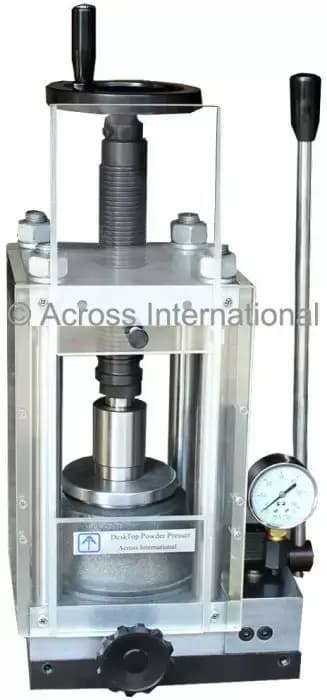
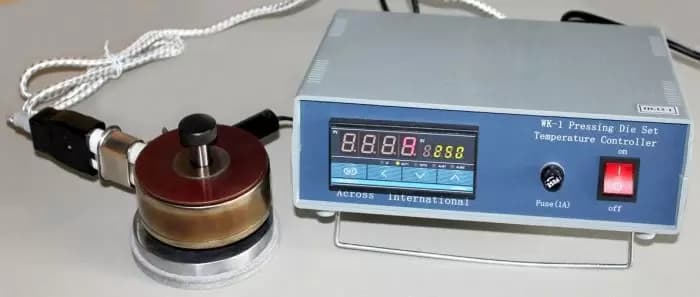



Showing 1 to 8 of 8 results
What are laboratory presses?
Laboratory presses are instruments that apply controlled mechanical force to compress a sample or material between a die set or press platens, producing a compact disc, pellet, or formed sheet of defined shape and density. In analytical chemistry, the most common laboratory press application is preparing KBr pellets for FTIR and near-IR spectroscopy — where an analyte mixed with dried KBr powder is pressed under approximately 5–10 tons of pressure to form a transparent disc through which the infrared beam passes — and pressed powder pellets for X-ray fluorescence (XRF) elemental analysis. Heated presses add temperature control for polymer processing applications.
What you will find:
-
High-pressure hydraulic laboratory presses
-
Manual laboratory presses
-
Compact benchtop laboratory press systems
-
Heated platen laboratory presses for material shaping
-
Automatic and programmed laboratory presses
-
Laboratory pellet presses for spectroscopy
-
Large floor-mounted laboratory presses
-
Die sets and laboratory pressing equipment
How to choose a laboratory press
Choose a pellet press for FTIR KBr disc and IR spectroscopy preparation
A dedicated KBr pellet press applies the controlled force needed to form transparent KBr discs for FTIR spectroscopy, typically 8–10 tons for 13 mm dies, in a compact and safe format. Many KBr pellet presses include an integrated die or are supplied with 13 mm die sets appropriate for standard FTIR beam paths.
Choose a hydraulic press for XRF and higher-force compaction applications
Hydraulic laboratory presses provide higher and more precisely controlled force than manual screw presses, typically ranging from 5 to 40 tons, appropriate for XRF powder pellet preparation where consistent compaction pressure is needed for reproducible pellet density and surface finish. Hydraulic presses also suit compaction testing and material science applications.
Match die diameter to the instrument's sample holder requirements
Die diameters for pellet presses are standardized to match common analytical instrument sample holder dimensions: 13 mm for most FTIR instruments, 25 mm, 32 mm, and 40 mm for XRF instruments depending on the spectrometer model. Confirm the required pellet diameter for your analytical instrument before selecting a die set.
Consider an evacuable die for FTIR pellets requiring air-free discs
Evacuable die sets allow the die to be connected to a vacuum pump during pressing to remove air and moisture from the KBr mixture before and during pressing, producing clearer, more homogeneous pellets with reduced background interference from trapped atmospheric moisture.
Evaluate the press force range against the compaction force your application requires
FTIR KBr pellets typically require 5–10 tons of force; XRF pellets may require 15–40 tons for dense, crack-free surfaces. The press's maximum force capacity and whether its force gauge or indicator provides readable pressure control determine whether consistent, reproducible pellets can be produced.
Specifications context
The 13 mm die format for FTIR KBr pellets is the most widely used standard globally, matching the standard beam aperture of most Fourier-transform infrared spectrometers, while 25 mm, 32 mm, and 40 mm pellets are used in different XRF instrument models with correspondingly sized sample cups. As of 2026, hydraulic laboratory presses with digital force gauges for precise compaction control continue to be adopted in analytical chemistry labs over older screw-press designs that provide less reproducible force.
Contact the professionals at Molecular Biology Products Inc. (MBP) to obtain a quote on the appropriate laboratory press solution for your laboratory.
FAQ