Stainless Steel Reactors for High-Pressure Lab Synthesis
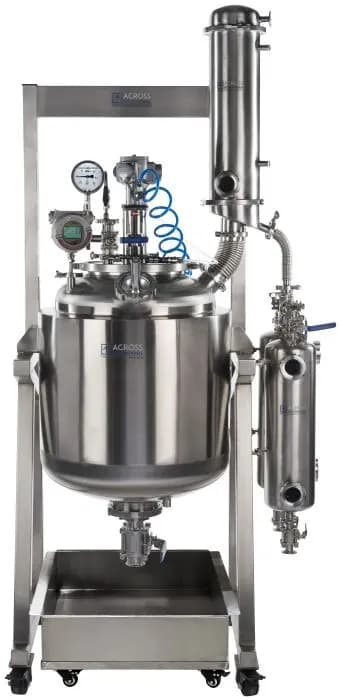
Stainless steel jacketed reactors are pressure-rated reaction vessels constructed from 316L stainless steel, designed for chemical synthesis, polymerization, extraction, and process development workflows that require higher operating pressure, elevated temperatures beyond 200 degrees C, or mechanical durability beyond what borosilicate glass provides. These reactors are used in pharmaceutical manufacturing, botanical extraction, aerospace, semiconductor, and materials research applications.
MBP provides purchase order procurement and specialist support for research institutions across the USA and Canada. Request a quote by contacting customerservice@mbpinc.net.
Stainless Steel Reactors
Showing 1 to 1 of 1 results
What Are Stainless Steel Reactors?
Stainless steel jacketed reactors are single- or double-walled pressure vessels in which the inner chamber contains the reaction mixture and the outer jacket circulates a heat-transfer fluid to control the reaction temperature. Unlike borosilicate glass reactors, stainless steel vessels can withstand positive operating pressures (3 to 10 bar and above, depending on design), elevated temperatures (to 300 degrees C or higher), and mechanical stress from abrasive reagents, high-speed mixing, or large batch weights. Grade 316L stainless steel provides excellent corrosion resistance to a wide range of aqueous and organic media. Common applications include high-pressure hydrogenation and reduction reactions, polymerization under inert atmosphere, botanical and cannabis extraction under pressure, pharmaceutical active ingredient synthesis requiring autoclave conditions, materials research (sol-gel synthesis, hydrothermal reactions), and pilot-plant scale-up where glass durability is insufficient for the batch size or operating conditions. Specify stainless steel over glass when the reaction requires pressure above 1 bar, an operating temperature above 200 degrees C, an abrasive reagent mix, or production-scale batch sizes, where the risk of glass breakage is unacceptable.
What You Will Find:
-
Elite 316L-Grade Fabrication: High-quality dual-jacketed containers made from surgical-grade stainless steel for optimal corrosion resistance and durability in demanding chemical settings.
-
Turnkey Packages on a Large Scale: Configurations of 100L and 200L are designed specifically, pre-integrated with powerful pumps and thermal circulators for instant industrial applications.
-
Precision-Focused Processes: Specialized configurations for Decarboxylation, Winterization, and Crystallization, guaranteeing that each valve and controller is fine-tuned for particular molecular changes.
-
Robust Vacuum Integrity: Durable seals and sturdy ports engineered to sustain deep vacuum levels despite high-torque agitation and elevated temperature cycles.
How to Choose a Stainless Steel Reactor
Pressure rating and design standard
Pressure rating is the primary selection criterion for stainless steel reactors. Bench-scale reactors for laboratory use are typically rated to 3 to 10 bar. High-pressure autoclaves reach 100 bar or above for extreme-condition chemistry (hydrothermal synthesis, supercritical fluid reactions). Specify the maximum operating pressure of your reaction with a safety factor of at least 2x, and confirm that the reactor's design standard (ASME, PED, or equivalent) matches institutional requirements for pressure vessel operation.
Volume and scale
Stainless steel reactors for lab and pilot use cover 1 L to 200 L. For production-scale operations, vessels of 500 L to several thousand liters are engineered to order. Choose the vessel size that accommodates 50 to 70% fill for the reaction mixture plus any headspace for off-gas and reflux. For scale-up studies, start with a lab reactor and specify the same diameter-to-height ratio and jacket configuration to maintain heat transfer and mixing equivalence when moving to larger vessels.
Grade: 316L vs. 304 vs. Hastelloy
316L stainless steel (low carbon, 2 to 3% molybdenum) provides superior corrosion resistance to chlorides and acidic media compared to 304 stainless. For strongly corrosive applications (concentrated acids, halide-containing reagents, or high-temperature corrosive processes), Hastelloy C-276 or titanium-lined vessels are specified. Confirm material compatibility with a corrosion resistance chart for the specific reagents used before specifying the grade.
Jacket type and heat transfer
Single jackets are standard for lab-scale stainless reactors, adequate for moderate temperature control of most synthesis and extraction workflows. For larger-scale processes with higher heat loads (exothermic polymerizations, large-volume extraction), half-pipe or ring-baffle jackets provide significantly higher heat transfer coefficients. For reactions requiring rapid temperature cycling (crystallization, precipitation), high-flow jackets with turbulence promoters shorten cycle times.
Agitation system
Overhead stirrers with explosion-proof motors (ATEX or ETL-rated) are standard for stainless steel reactors used with flammable solvents. Impeller selection follows the same criteria as for glass reactors: propeller or pitched-blade turbine for low-viscosity liquids; anchor or helical ribbon for high-viscosity media. Stainless steel impellers and shafts are standard; Hastelloy or PTFE-coated impellers are available for highly corrosive media.
Specifications Context
Material certification (mill certificate for 316L stainless, confirming composition and mechanical properties) should accompany any pressure vessel for regulated or industrial workflows. Confirm the reactor's design standard and third-party inspection certification before use in GMP-adjacent or regulated environments. Surface finish (electropolished interior surfaces, Ra less than 0.5 micrometers) is specified in pharmaceutical and bioprocess applications to reduce contamination risk and ease cleaning. For extraction applications using solvents such as CO2, ethanol, or hydrocarbons, confirm that all seals (PTFE, PEEK, or Viton) are rated for the solvent at operating temperature and pressure.
Prepared to elevate your production to the next tier? Discover our selection of 316L stainless steel reactors and contact the MBP team for a quote now.
FAQ