Rotary Evaporators for Solvent Removal and Recovery
Rotary evaporators (rotovap) are laboratory instruments that remove volatile solvents from samples by rotating a flask in a heated water or oil bath under vacuum, creating a continuously renewed thin film of liquid that evaporates rapidly at temperatures well below the solvent's atmospheric boiling point. They are the standard instruments for solvent removal after organic synthesis, natural product extraction, and pharmaceutical concentration.
MBP provides purchase order procurement and direct specialist support for rotary evaporators for research institutions across the USA and Canada. Request a quote for rotary evaporators for solvent removal, solvent recovery, and sample concentration workflows by contacting customerservice@mbpinc.net.
Rotary Evaporators
Showing 1 to 4 of 4 results
What Are Rotary Evaporators?
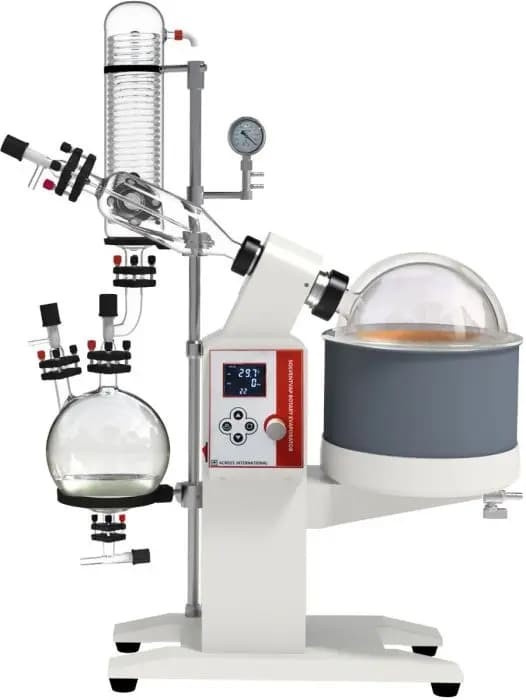
A rotary evaporator (commonly called a rotovap or rotavapor) is a laboratory instrument that removes solvent from a liquid sample through evaporation under reduced pressure. A round-bottom flask containing the sample is immersed partially in a heated bath and rotated, continuously coating the inner surface with a thin film of liquid. This thin film dramatically increases the evaporation surface area while the rotation prevents localized overheating. Vacuum applied through the system lowers the boiling point of the solvent by 30 to 80 degrees C compared to atmospheric pressure, allowing gentle removal without degrading heat-sensitive target compounds. Solvent vapors travel through a vapor duct to a condenser, where they are cooled and collected as condensate for recovery or disposal. The concentrated or dried sample remains in the evaporation flask. Common solvents removed include ethanol, methanol, ethyl acetate, dichloromethane, hexane, acetone, and toluene. A rotary evaporator is the right instrument when you need to remove a volatile solvent from a dissolved or extracted compound on a 1-L to 50 L batch scale; it is faster, gentler, and more solvent-efficient than open evaporation or distillation.
What You Will Find:
- Motorized Lift Rotary Evaporators: Ai SolventVap rotary evaporators with motorized lift for efficient solvent evaporation and recovery.
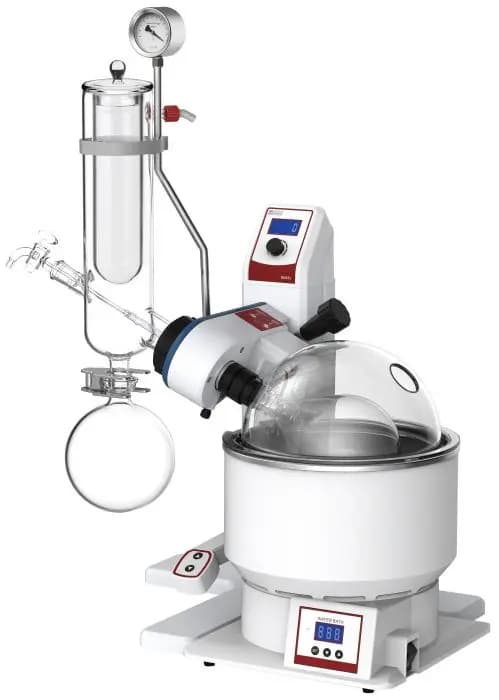
- Rotary Evaporators with Cold Trap: Ai SolventVap systems featuring an electric lift and cold trap condenser to improve solvent collection and vacuum performance.
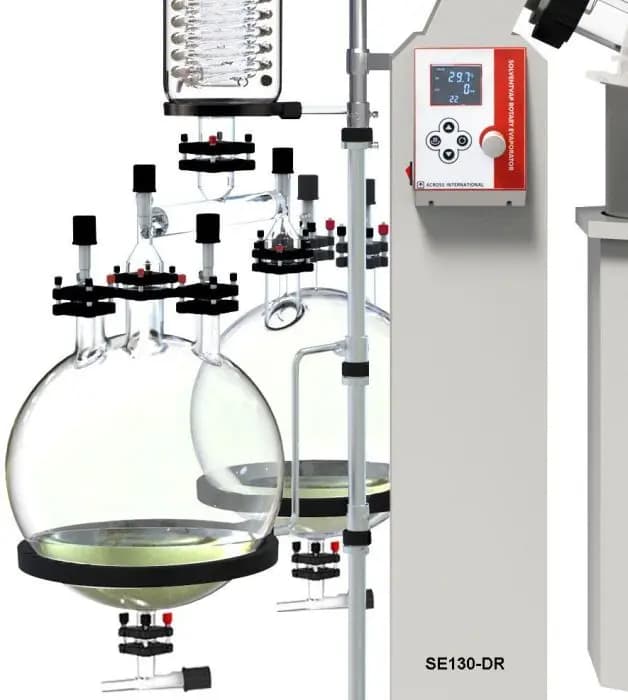
- Dual Receiving Flask Kits: Optional dual receiving flask assemblies for uninterrupted solvent collection during rotary evaporation workflows.
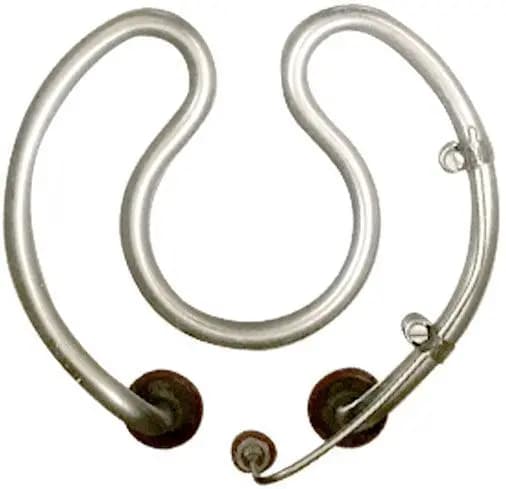
- Replacement Heating Elements: Heating elements designed for compatible Ai SolventVap rotary evaporators to maintain reliable heating performance.
How to Choose a Rotary Evaporator
Flask size
Flask size is the primary sizing decision. For standard research synthesis and extraction labs, 2 L to 5 L systems handle most batch sizes. Choose a flask that accommodates 50 to 70% of your typical batch volume; overfilling causes bumping and carryover into the condensate. Larger 10 L, 20 L, and 50 L rotary evaporators are used for scale-up and extraction pilot runs. Confirm that the heating bath is sized appropriately for the chosen flask; a 20 L flask in a 5 L bath will not heat efficiently.
Condenser configuration
Vertical (coil-type) condensers provide high condensation surface area and are effective for high-boiling or slowly condensing solvents. Inclined (diagonal) condensers are the traditional rotovap configuration, providing good condensate flow to the receiver and compatibility with high-throughput solvent removal. Dry ice or cold-water condensers are used for low-boiling, highly volatile solvents (diethyl ether, pentane) requiring condenser temperatures well below 0 degrees C. Match condenser type and coolant temperature to the solvent being evaporated.
Vacuum control
Manual vacuum control (needle valve) is adequate for routine single-solvent applications. Automated vacuum controllers with digital setpoint and feedback control maintain a stable vacuum at the evaporation setpoint, preventing bumping and enabling programmed ramp-down vacuum protocols for multi-solvent samples. For regulated environments or high-throughput labs, automated vacuum control reduces solvent loss and operator attention time.
Water bath temperature range
Standard water baths reach 95 degrees C and are adequate for aqueous, alcoholic, and most organic solvent removal at moderate vacuum. For high-boiling solvents (DMSO: bp 189 degrees C; DMF: bp 153 degrees C), oil baths reaching 180 degrees C and a deeper vacuum (1 to 5 mbar with a rotary vane pump) are required. Confirm bath compatibility with the heat transfer fluid: water for temperatures to 95 degrees C; food-grade or synthetic oil for higher temperatures.
Cold trap requirement
A cold trap between the rotary evaporator and the vacuum pump is not optional; it is essential. Without a cold trap, solvent vapors contaminate pump oil, raising ultimate pressure and shortening pump life. A cold trap cooled to -20 degrees C to -40 degrees C (using a mechanical chiller) captures the vast majority of solvent vapor for the most common solvents. For highly volatile solvents (diethyl ether, pentane), a dry-ice trap at -78 degrees C may be required.
Specifications Context
Evaporation rate is commonly specified in L/h for ethanol at a standard bath temperature and vacuum; use this as a relative performance indicator, not as an absolute rate for other solvents. Evaporation rates for dichloromethane, acetone, and ethyl acetate differ from those of ethanol at the same vacuum and temperature. Confirm that the drive motor seal (the rotating joint between the flask and the vapor duct) is rated for the full vacuum range of your pump. Worn drive seals are the most common cause of vacuum loss in rotary evaporators in regular use; replacement seals are available and should be kept in stock.
Ready to upgrade your solvent recovery? Explore our full range of rotary evaporators and reach out to the MBP team for a friendly quote today.
FAQ