Short Path Distillation for High-Purity Molecular Separation
Short path distillation systems - also called molecular distillation units - purify heat-sensitive, high-boiling compounds under high vacuum conditions, allowing vapor molecules to travel directly from the evaporation surface to the condenser with minimal thermal exposure. This process reduces effective boiling temperatures and supports the purification of cannabinoids, terpenes, vitamins, fatty acids, pharmaceutical intermediates, and essential oils.
MBP provides purchase order procurement and specialist support for short-path distillation systems for US and Canadian research laboratories. Request a quote for short path distillation systems for high-purity molecular separation and purification workflows by contacting customerservice@mbpinc.net.
Short Path Distillation



Showing 1 to 5 of 5 results
What Is Short Path Distillation?
Short path distillation (SPD), also called molecular distillation, is a batch thermal separation technique in which the evaporation surface and the internal condenser are positioned only centimeters apart within the same apparatus; the condenser is placed inside the distillation body rather than at the end of a vapor tube. Operating under high vacuum (0.001 to 1 mbar), the mean free path of vapor molecules becomes longer than the evaporation-to-condenser distance, enabling molecules to travel directly from the liquid surface to the condenser without collisions with other gas-phase molecules. This molecular flow regime eliminates the need to heat the sample to its atmospheric boiling point; effective separation temperatures are 100 to 200 degrees C below atmospheric boiling points. Residence time on the heated surface is short (seconds to a few minutes), further reducing thermal degradation. Short path distillation is the preferred purification technique for cannabinoids (THC, CBD), tocopherols, beta-carotene, fatty acid distillates, terpene fractions, high-molecular-weight pharmaceutical intermediates, and other thermally labile molecules with atmospheric boiling points above 200 degrees C that cannot tolerate the temperatures required for conventional distillation. Short path distillation is the technique to specify when you need maximum-purity separation of a heat-sensitive compound at gram-to-kilogram scale in a batch format; it achieves the lowest thermal stress of any batch distillation method.
What You Will Find:
-
Complete Turnkey Packages: All-in-one 2L, 5L, and 10L setups designed for immediate deployment, ensuring every component—from glassware to controllers—is perfectly synced.
-
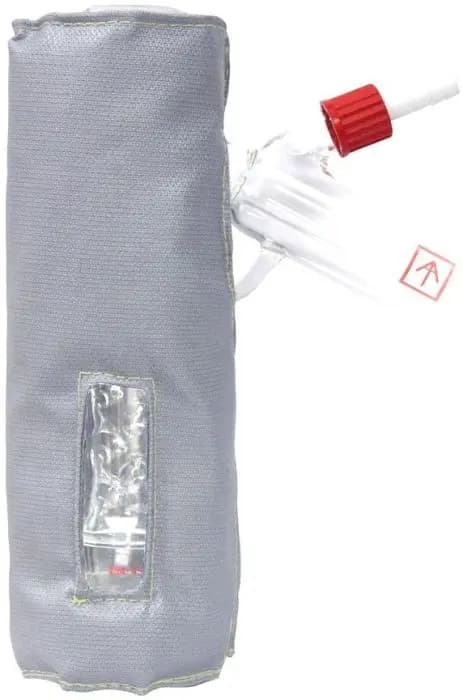
Advanced Thermal Protection: High-performance fabric insulation sleeves and heated shields (up to 400°C) that maintain uniform heat distribution and protect your samples from external fluctuations.
-
Real-Time Process Analytics: Integrated fraction finders and StrataVac kits that take the guesswork out of your distillation, allowing for precise monitoring of molecular transitions.
-
Precision Maintenance Essentials: Specialized low-vapor vacuum grease and high-temp lubricants to maintain an airtight seal and ensure the longevity of your high-vacuum environment.
How to Choose a Short Path Distillation System
Flask capacity and batch size
Short path distillation is a batch process. Lab-scale systems are available for 0.5 L, 1 L, 2 L, 5 L, 10 L, and 20 L flask charges. Choose the flask capacity that matches your batch size with 50 to 70% fill (overfilling a distillation flask causes bumping and carryover). For continuous processing at higher throughput, specify a wiped film short path still or a thin film distillation system.
Heating flask temperature and distillation temperature
The heating mantle or oil bath sets the temperature of the flask containing the feed material. For molecular distillation of cannabinoids, operating temperatures of 150 to 200 degrees C at 0.001 to 0.01 mbar are typical. For fatty acid distillation, 180 to 220 degrees C at 1 to 10 mbar is common. The internal condenser temperature (coolant temperature) determines which components condense vs. pass through to the cold finger (fore-vacuum cold trap). Systematic variation of flask temperature collects fractions at different volatility cuts.
Vacuum system
Short path distillation at the molecular range (0.001 to 0.01 mbar) requires a two-stage rotary vane pump paired with a cold trap cooled to -40 degrees C or below. Some manufacturers supply the pump as part of the system kit; others specify the pump separately. Confirm ultimate vacuum (blank-off pressure) and pumping speed (L/min or m3/h) of the included or recommended pump before purchase. The pump's ultimate vacuum should be at least 10-fold below the target operating pressure of the distillation system.
Borosilicate glass kit components
A complete short path distillation kit includes the distillation flask (round-bottom), distillation head or still body with internal condenser and cold finger, multiple receiving flasks for fractions, a heating mantle or oil bath, a vacuum manifold, connecting glassware with PTFE seals, and thermometer adapters. Confirm that all components are borosilicate 3.3 glass and that PTFE rather than rubber seals are used at all joints exposed to solvent or vacuum.
Cold finger (internal condenser) temperature
The cold finger is the internal condenser: a water- or chiller-cooled central tube around which condensed distillate collects and flows to the receiving flask. Cold finger coolant temperature controls which fractions condense. For cannabinoid purification, cold finger temperatures of 20 to 60 degrees C separate distillate from heavy residue. A secondary external cold trap cooled to -40 degrees C protects the vacuum pump from any low-boiling fraction that passes through the cold finger.
Specifications Context
For cannabinoid purification workflows, pre-processing steps before short path distillation are standard practice: first decarboxylation (heating to convert THCA to THC and CBDA to CBD), then solvent removal by rotary evaporator, then first-pass short path distillation to remove residual terpenes and light fractions before second-pass distillation for final cannabinoid purity. Confirm that the SPD system's operating vacuum is sufficient for your target compound by consulting published vapor pressure data at the intended operating temperature; a compound's vapor pressure must exceed the system operating pressure for distillation to proceed.
Take your purification to the next level—browse our premium short path collection and reach out to the MBP team for a quote today.
FAQ