Thermal Cycler Accessories for PCR Consumables and Workflow Compatibility
Thermal Cycler Accessories covers the consumables and hardware accessories used with PCR thermal cyclers: 0.2 mL individual PCR tubes and 8-tube strip tubes, thin-wall 96-well and 384-well PCR plates, adhesive plate seals for closed-system amplification, optical seals for real-time PCR plates, heated lid adapters for different tube formats, and block inserts for adapting a 96-well block to different tube sizes. These consumables are among the highest-volume PCR lab supplies. Academic and core labs get consumable-selection and compatibility guidance plus academic and bulk pricing.
Contact customerservice@mbpinc.net to identify compatible PCR tubes, plates, seals, and accessories for your thermal cycler platform.
Thermal Cycler Accessories
Showing 1 to 1 of 1 results
What are thermal cycler accessories?
Thermal cycler accessories are the PCR-format consumables and hardware additions that work within a thermal cycler to run PCR reactions, including the plastic tubes, plates, and seals that hold the reaction mix during cycling, and physical block inserts or lid adapters that extend the instrument's compatibility to different tube or plate formats. 0.2 mL individual PCR tubes and 8-tube strip tubes are the most commonly used formats for routine molecular biology PCR; 96-well thin-wall plates are standard for higher-throughput genotyping and screening; and 384-well plates are used for very high-throughput applications.
What you will find:
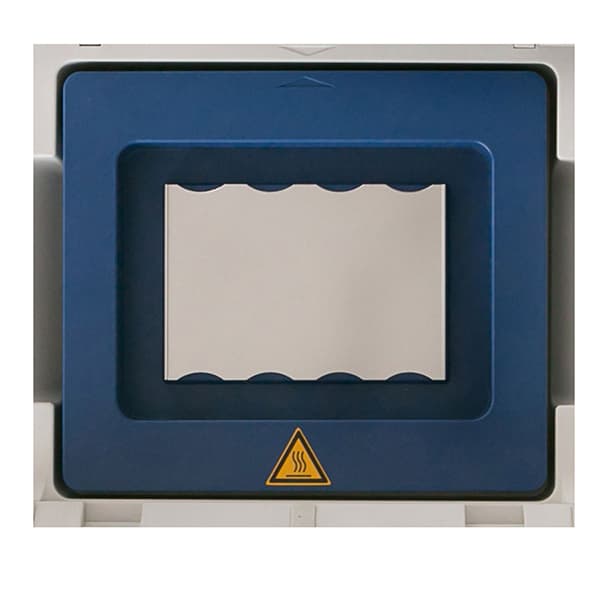
- In-situ PCR adapter: for direct amplification on microscope slides with T5000-96 compatibility for seamless integration with thermal cyclers
How to choose thermal cycler accessories
Confirm tube or plate format compatibility with your cycler block and lid
PCR tubes, strip tubes, and plates must fit the geometry of your thermal cycler's block and heated lid, since a plate that sits too high in the block will not receive adequate lid pressure, degrading cycle reproducibility. Confirm that the consumable's recommended cycler compatibility list includes your specific instrument model or is stated as universally compatible.
Choose thin-wall tubes and plates for fastest heat transfer
Thin-wall PCR tubes and plates have thinner plastic walls than standard microcentrifuge tubes, reducing thermal resistance between the block and the reaction mix and enabling faster, more uniform temperature equilibration during each step. Using standard-wall tubes in a fast-ramp cycler negates part of the instrument's ramp rate advantage.
Use standard adhesive seals for end-point PCR plates
For 96-well or 384-well PCR plates, adhesive plate seals prevent evaporation and cross-contamination between wells during cycling without requiring individual tube caps, and standard opaque or foil seals are adequate for end-point PCR where fluorescence measurement during cycling is not needed.
Use optical plate seals for qPCR plates only
Optical adhesive seals are transparent in the fluorescence excitation and emission wavelengths, allowing real-time fluorescence detection through the sealed plate. They are more expensive than standard seals and should be reserved for qPCR plate applications; standard seals are adequate for end-point PCR amplification.
Check heated lid compatibility before using low-profile plates or domed caps
Some PCR plates have low-profile or skirted designs, and some tubes have domed caps, and the heated lid must accommodate the specific cap or plate rim profile to apply even pressure. Incompatible lid-to-consumable profiles result in uneven lid pressure, condensation in some wells, and inconsistent PCR results.
Specifications context
Thin-wall PCR tubes and plates minimize thermal resistance between the block and the reaction mix, enabling rapid temperature equilibration for fast-ramp cyclers. Modern thin-wall formats are manufactured from polypropylene, combining PCR reagent compatibility, low background fluorescence, and efficient heat transfer. As of 2026, plate-based PCR with adhesive seals is standard for any application processing more than 8–16 reactions per run.
Contact the MBP team today to request a quote and find the right accessories for your PCR thermal cycler.
FAQ