Mini Balances for Portable and Precision Laboratory Weighing
Mini Balances covers compact, portable weighing instruments with high-readability scales suitable for milligram-level mass measurements in the laboratory or field. With capacities typically ranging from 120 to 500 g and readabilities from 0.001 g down to 0.0001 g, these instruments fill the gap between full analytical balances and general-purpose compact balances, combining portability with adequate precision for weighing small reagent amounts. Academic and core laboratories sourcing mini balances can benefit from guidance when selecting the appropriate readability, weighing capacity, and feature set for their applications.
Compare available mini balances by capacity, readability, and portability features by contacting customerservice@mbpinc.net. Our team can help identify the most suitable balance for your laboratory, educational, or field-based weighing requirements.
Mini Balances


Showing 1 to 3 of 3 results
What are mini lab balances?
Mini lab balances are compact, lightweight weighing instruments designed to measure small masses with higher readability than general-purpose balances but in a smaller and more portable form factor than a full analytical balance. They typically offer readabilities of 0.001 g (1 mg) or better, capacities from 120 to 500 g, and small pan sizes suited to weighing out milligram quantities of reagents, standards, or small samples. Many mini balances include battery operation for field or portable use alongside AC adapter options for bench use.
What you will see:
- Accuris™ Mini Balance - Portable mini balance used for routine daily weighing applications
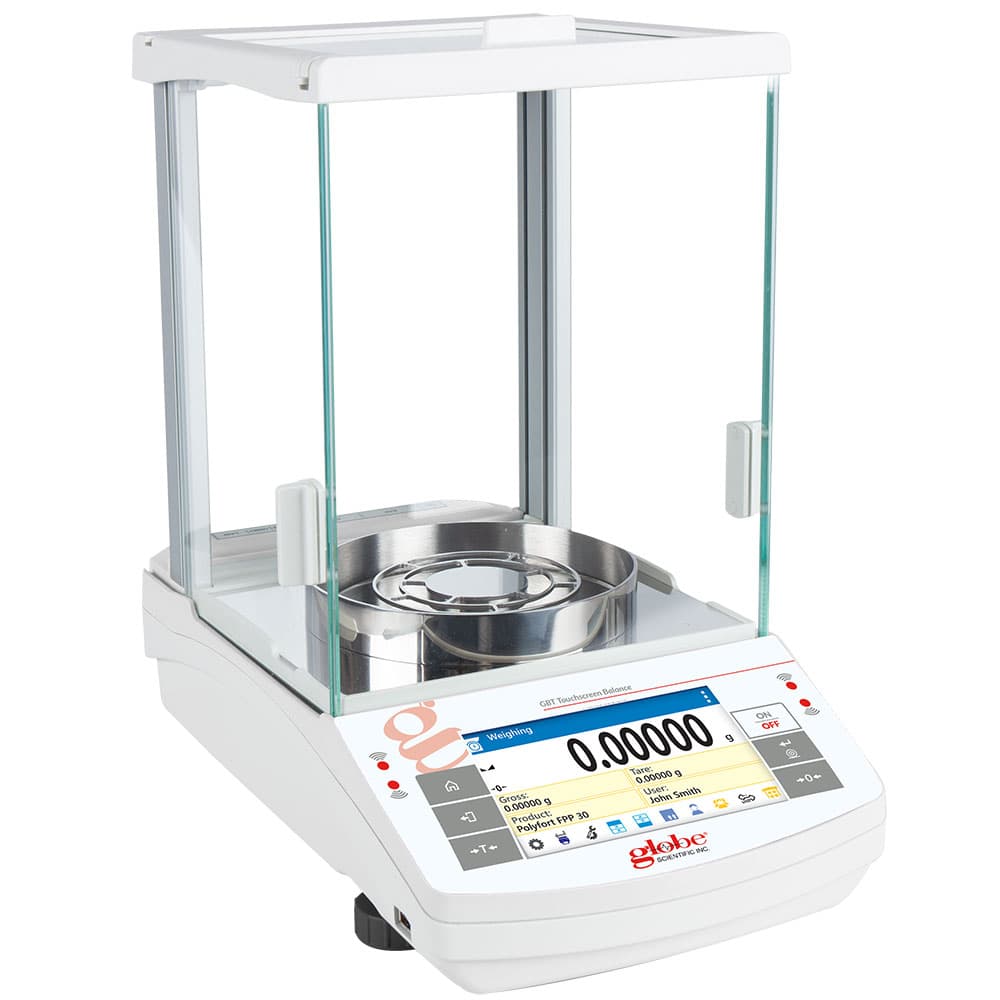
- GBT Semi-Micro Touchscreen Balance Series - Internal - Precision touchscreen mini balance featuring built-in calibration capability
- Radwag 2.1/5.1g Capacity 1µg Readability ø0.6" MicroBalance - Sensitive microbalance with high precision and reliability
How to choose a mini balance
Match readability to your minimum weighing requirement
Balance readability determines the smallest mass difference the instrument can display, but the minimum net sample reliably weighable is typically 100–1000 times the readability, since below this threshold measurement uncertainty becomes significant. For weighing quantities in the range of tens to hundreds of milligrams, 0.001 g readability is generally sufficient; quantities below 10 mg benefit from 0.0001 g readability.
Check maximum capacity against your largest expected weighing task
Mini balances are optimized for small mass measurement and typically have maximum capacities of 120–500 g; exceeding the balance's capacity even momentarily can damage the load cell or shift the calibration. If you regularly weigh both small and larger quantities, a balance with higher maximum capacity or a second instrument for larger loads is more practical.
Confirm calibration method — internal vs external
Some mini balances support internal automatic calibration using a built-in calibration weight, while others require external calibration with a separate weight at set intervals. Internal calibration is more convenient and gives more consistent results across temperature fluctuations, which shift balance readings.
Evaluate whether battery operation is needed
If you need to weigh samples in a biosafety cabinet, fume hood, or field location without mains power, a mini balance with battery operation is necessary. For fixed bench use with reliable power, AC-only models are generally sufficient and may have better long-term stability.
Consider pan size relative to the containers you use
The pan size determines the footprint of vessel that can be placed on the balance; a pan too small for typical containers forces awkward positioning that risks uneven loading and reduced accuracy.
Specifications context
The minimum weight that can be reliably measured is determined by the USP minimum weight standard, which defines the minimum sample mass as the balance readability multiplied by a safety factor (typically 820 for pharmaceuticals), though in general laboratory use, a practical minimum of 100 times the readability is commonly applied to achieve 1% measurement uncertainty. As of 2026, mini balances with 0.001 g readability and internal calibration remain the most commonly purchased format for general reagent weighing at the benchtop or in a biosafety cabinet.
Contact MBP today to get more details about our mini balances products and other lab weighing products.
FAQ