Compact Balances for Routine Laboratory Weighing Applications
Compact Balance covers general-purpose benchtop weighing instruments with capacities from 200 g to 5 kg and readabilities from 0.01 g to 0.1 g, suited to routine laboratory weighing tasks: measuring out gram quantities of reagents, media components, or samples without requiring the precision of an analytical balance or the portability of a mini balance. Compact balances typically feature larger pans, robust construction, multiple weighing units, and USB or RS232 data output options. Academic and core laboratories sourcing routine benchtop scales can benefit from guidance when selecting the appropriate capacity, readability, and connectivity features for their workflow.
Need a balance for everyday laboratory weighing? Contact customerservice@mbpinc.net to discuss your weighing requirements and receive recommendations on suitable compact balance models, capacities, and data connectivity options.
Compact Balances
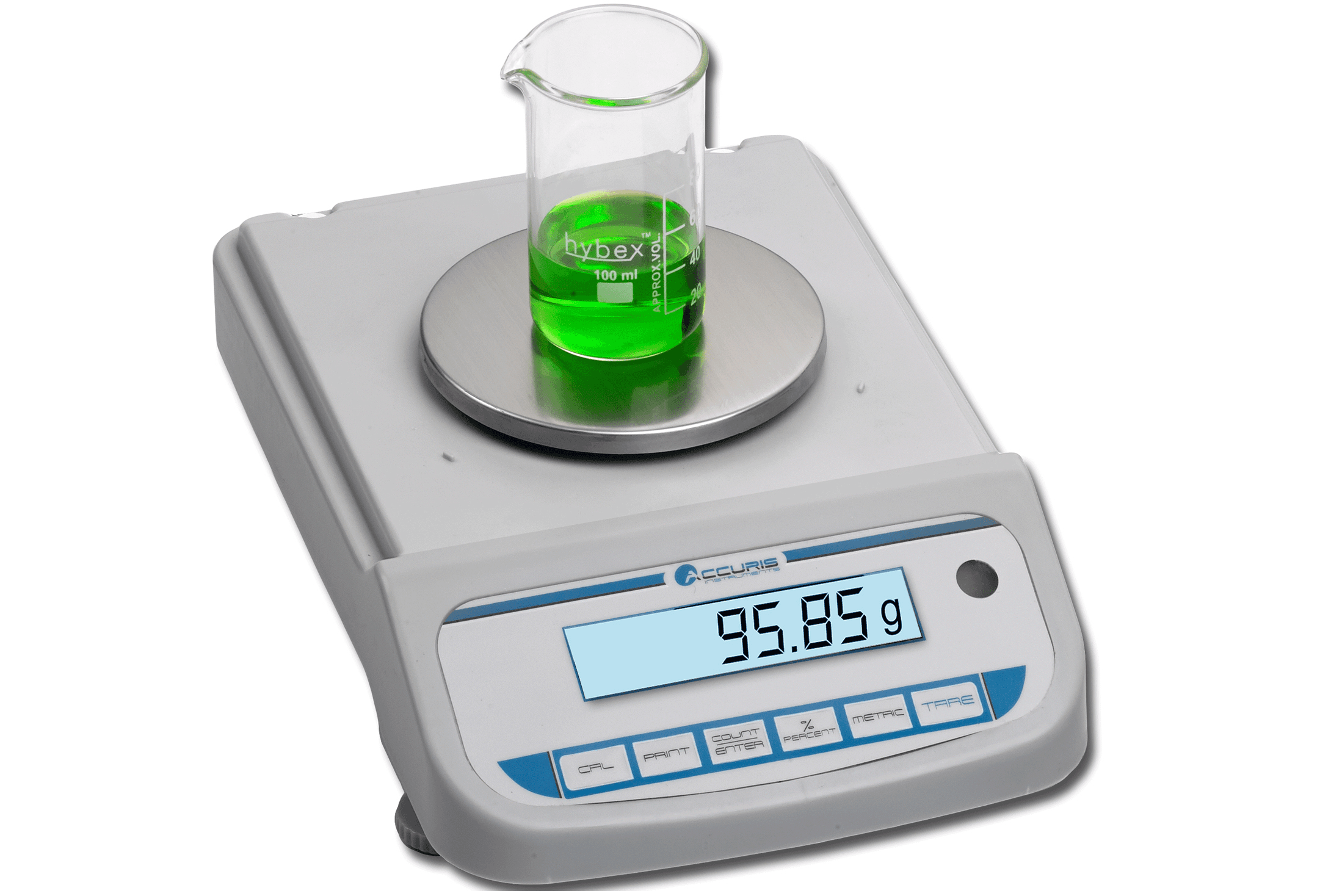
Showing 1 to 1 of 1 results
What are compact lab balances?
Compact lab balances are benchtop weighing instruments for routine laboratory tasks where gram-level readability is adequate: weighing buffer salts and media components, measuring bulk reagents, preparing agar or gel solutions, and other everyday weighing where milligram precision is not required. They typically provide readabilities of 0.01 g to 0.1 g with maximum capacities of 200 g to 5 kg, offering a larger pan and more robust construction than mini balances at a more accessible price point than precision analytical balances.
What you will find:
- Accuris™ Compact Balance Series – Compact laboratory balances with precise weighing performance
- Readability from 0.01g to 0.1g – Supports routine laboratory measurements
- LCD display balances – Clear and easy-to-read measurement display
- RS232 output balances – Data transfer capability for printers and computers
- Multi-mode weighing balances – Standard weighing, counting, and percentage modes
- Compact benchtop balances – Space-saving design for laboratory workflows
How to choose a compact balance
Match the capacity to your most common and largest weighing tasks
Compact balances cover a wide capacity range, and selecting a model whose maximum capacity comfortably exceeds your typical largest task prevents accidental overloading. A mid-range capacity of 1–3 kg covers most routine lab reagent and media preparation needs.
Confirm readability is sufficient for your application
At 0.01 g readability, a compact balance reliably weighs quantities down to approximately 1–2 g with 1% uncertainty, suitable for general reagent preparation where milligram precision is not critical. For weighing quantities below 1 g or when milligram accuracy is needed, a mini balance or analytical balance is more appropriate.
Look for a large, removable, easily cleaned weighing pan
Routine lab weighing involves powder and liquid spillage, and a large stainless steel pan removable for cleaning separately reduces contamination risk. A larger pan accommodates a wider range of container sizes without the risk of uneven loading.
Check for USB or RS232 data output if you record weights digitally
Many compact balances include USB, RS232, or Bluetooth output that allows weight readings to be captured directly into electronic lab notebooks, spreadsheets, or LIMS, reducing transcription errors when multiple weights are recorded in sequence.
Consider GLP/GMP compliance features if required by your lab SOP
Laboratory balances in regulated environments may need to support date/time stamping of readings, balance identification output, and audit trail functionality. Compact balances vary in their support for GLP compliance features.
Specifications context
Compact balances use strain-gauge or electromagnetic force restoration (EMFR) load cells to convert applied force into an electrical signal, with EMFR providing higher linearity and readability at higher cost and strain-gauge providing adequate accuracy for routine applications at lower cost. As of 2026, compact balances with 0.01 g readability, internal calibration, and USB connectivity have become the standard specification for general-purpose molecular biology lab benchtops.
Don't hesitate to contact us and get a quote for your facility. Contact the friendly and helpful MBP team today!
FAQ