Product Filters

Clinical Centrifuge Accessories: Sealed Lids, Rotors, and Tube Adapters


Clinical centrifuge accessories include swing-out rotors for standard vacutainer formats (13×75 mm, 13×100 mm, 16×100 mm), aerosol-tight sealed bucket lids required by CDC guidance for all human specimen centrifugation, tube adapters for 15 mL and 50 mL conicals, balance tubes, and tachometers for CLIA/CAP annual speed verification. All accessories are model-specific. MBP is a registered vendor to Howard Hughes Medical Institute, MD Anderson Cancer Center, and Vanderbilt University.

Contact customerservice@mbpinc.net to confirm accessory compatibility and request institutional pricing or a quote.

Clinical Centrifuge Accessories
Per Page:
Sort By:
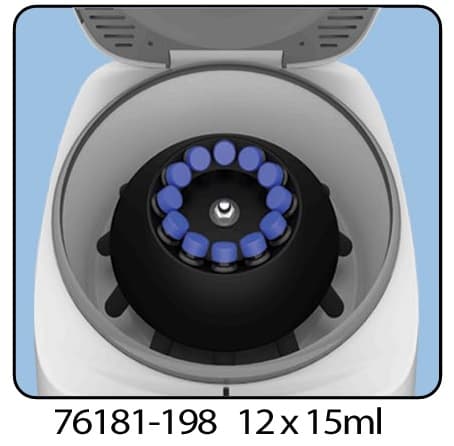
12 x 15ml fixed angle rotor for Sprint™ 6H Plus
List Price:
USD375.68
Online Price:
USD268.34
Your Price:
Adapter pack for 1.5/2.0ml tubes in Z207-A rotors, 2/pk.
List Price:
USD240.42
Online Price:
USD171.73
Your Price:
Adapter pack for 5ml tubes in Z207-A rotors, 2/pk.
List Price:
USD240.42
Online Price:
USD171.73
Your Price:
Adapter pack for 7ml tubes in Z207-A rotors, 2/pk.
List Price:
USD240.42
Online Price:
USD171.73
Your Price:
Adapter pack for C5000-6H and C5000-8, for 5ml and 7ml (12-13mm) tubes, 8/pk.
List Price:
USD175.63
Online Price:
USD125.45
Your Price:

Showing 1 to 5 of 5 results

What Are Clinical Centrifuge Accessories?


Clinical centrifuge accessories are the model-specific components that determine the safety, versatility, and compliance profile of a clinical centrifuge: swing-out rotors and fixed-angle rotors sized for standard blood collection tube formats, tube adapters that expand the rotor to accommodate 15 mL and 50 mL conicals, aerosol-tight sealed bucket lids for biocontainment of human and potentially infectious specimens, balance tubes for uneven sample counts, and replacement swing-bucket assemblies. In CLIA-regulated laboratories, calibration weights and documented tachometer verification at defined intervals are also part of the clinical centrifuge accessory program. None of these components are interchangeable between centrifuge models; all must be be confirmed compatible with the specific centrifuge model and rotor before ordering.


What You Will Find:


  • Adapter packs for precise compatibility with rotors
  • Proficient adapters used in handling 5 mL and 7 mL tubes for C5000-8 and C5000-6 systems
  • Fixed-angle rotor as a replacement rotor option for Sprint™ 6H Plus 


How to Choose Clinical Centrifuge Accessories


Rotor Format and Blood Tube Compatibility

The core clinical centrifuge rotor selection decision is tube format: confirm the swing-out rotor accepts your primary blood collection tube sizes (13×75 mm, 13×100 mm, 16×100 mm vacutainers) and the bucket depth matches the tube length. If your lab processes both 5 mL and 10 mL tubes, specify a rotor with adapters for both, or separate adapter inserts for the smaller format.

Aerosol-Tight Lids

Select sealed biocontainment lids rated for your centrifuge's maximum operating RCF (typically 3,000–3,500 ×g for routine serum processing). Confirm the lid's O-ring material is compatible with 70% ethanol and 10% bleach decontamination—the two standard clinical lab disinfectants. O-rings require periodic replacement; maintain a stock of the correct size for each lid model in use.

Tube Adapters for Conicals

Most clinical labs also process 15 mL conical tubes for cell culture supernatant or urine samples. Confirm adapter availability for your swing-bucket buckets to accept 17×120 mm conicals; a separate adapter insert seats the conical at the correct radial position to prevent the tube tip from bearing unsupported centrifugal load during the spin.

Balance Tubes

Clinical labs routinely run partial rotor loads. Stock balance tubes matched to the outer diameter and length of each primary blood collection tube format used: 13 mm OD (5/7 mL) and 16 mm OD (10 mL) are the two most common sizes. Fill to the same liquid mass as the heaviest sample tube in the opposing bucket position.

Calibration and Compliance

CLIA and CAP accreditation programs require documented annual speed verification for clinical centrifuges. A calibrated handheld optical tachometer (non-contact RPM measurement) enables periodic verification against the centrifuge's displayed speed without opening the instrument. Document the tachometer model, calibration date, and measured vs. displayed RPM in the centrifuge maintenance log.


Specifications Context


CDC guidelines for safe work practices in human and animal diagnostic laboratories (MMWR 2012) specifically recommend sealed centrifuge rotors or safety bucket covers for all centrifugation of potentially infectious specimens. For CLIA and CAP compliance, centrifuge speed must be verified at least annually using a calibrated reference instrument; the measured RPM must be within ±10% of the displayed value per most accreditation interpretive guidelines.

Swing-bucket O-ring replacement intervals vary by manufacturer and should be based on visual inspection. Any O-ring showing flattening (compression set), surface cracks, or discoloration should be replaced before the centrifuge returns to service. Modern aerosol-tight lid systems with one-hand release mechanisms have become standard features in many new clinical centrifuge installations.

Get the exact accessories your equipment needs. Contact the expert team at Molecular Biology Products Inc. today.

FAQ

Clinical centrifuge accessories include swing-out rotors and fixed-angle rotors sized for standard blood collection tube formats (13×75 mm, 13×100 mm, 16×100 mm vacutainers), tube adapters for 15 mL and 50 mL conicals, aerosol-tight sealed bucket lids for biocontainment of infectious specimens, balance tubes, and replacement swing-bucket assemblies. For CLIA-regulated labs, calibration weights and tachometers for annual speed verification are also essential accessories. All are model-specific—confirm the centrifuge model number before ordering any rotor or bucket component.
Clinical centrifuge swing-out rotors typically accept 13×75 mm (5 mL), 13×100 mm (7 mL), and 16×100 mm (10 mL) vacutainer blood collection tubes as primary formats. Adapters expand compatibility to 15 mL conical tubes (17×120 mm) and, in some models, 50 mL conicals. Some clinical rotors include inserts for 1.5–2.0 mL microtubes, allowing dual-use for routine serum processing and quick molecular biology spins without switching to a separate microcentrifuge.
Aerosol-tight sealed lids are required for all centrifugation of human blood specimens in clinical laboratories, any specimen suspected or confirmed positive for a bloodborne pathogen (HIV, HBV, HCV), and as standard practice in CLIA-regulated environments where liability and audit documentation require demonstrated biocontainment measures. CDC guidelines for safe work practices in diagnostic laboratories specify sealed rotors or safety buckets for all specimen centrifugation. Inspect O-rings before each run and replace when flattened or cracked.
A balance tube is a capped tube filled with water or buffer to the same mass as the patient sample tubes being centrifuged, placed in the opposing rotor position when an odd number of patient samples must be run. Clinical centrifuge rotors must be balanced within 0.1–0.5 g between opposing positions; imbalance causes vibration, accelerates bearing wear, and at high speed risks rotor damage. Most clinical centrifuge swing-out buckets hold 3–6 tubes per bucket position—if running an uneven number, fill the opposing bucket with equal-mass balance tubes.
Clinical centrifuge rotors should be visually inspected before each use for cracks, corrosion, pitting, or any mechanical damage to the rotor body, bucket mounts, or O-ring surfaces. CLIA-regulated labs should document rotor inspection as part of the instrument maintenance log. Manufacturer retirement schedules (based on cumulative RPM-hours) must be followed; a rotor that has reached its retirement threshold must be replaced even if no visible damage is present, because fatigue failure is not detectable without specialized testing.
Many clinical centrifuge swing buckets with polypropylene construction are autoclavable at 121°C for 20 minutes—check the OEM documentation for your specific model. Stainless steel bucket assemblies can typically be autoclaved; anodized aluminum components should not be unless explicitly rated by the manufacturer, as repeated autoclave cycling accelerates corrosion. For routine decontamination between patient sample runs, wiping bucket interiors with 70% ethanol followed by air-drying is the standard practice in most clinical lab protocols.
Standard swing-bucket lids hold the tube in the bucket and prevent tubes from ejecting during deceleration, but do not provide a sealed biocontainment barrier if a tube cracks or breaks. Aerosol-tight (safety) bucket lids seal the entire bucket chamber with a gasketed, pressure-rated closure that contains aerosols and liquid from broken tubes—preventing exposure of lab personnel to bloodborne pathogens. All CLIA-regulated labs and labs following CDC diagnostic laboratory biosafety guidance should use aerosol-tight lids for human specimen centrifugation as standard practice.
MBP (mbpinc.net) stocks clinical centrifuge accessories including rotors, swing-bucket assemblies, tube adapters, and aerosol-tight lids for research and clinical labs across the United States and Canada. Provide your centrifuge manufacturer name, model number, and the existing rotor or bucket part number when ordering to confirm compatibility. MBP is a registered vendor to Howard Hughes Medical Institute, MD Anderson Cancer Center, and Vanderbilt University and can process institutional purchase orders.
We provide the highest quality of products and anytime customer service.
Featured Categories
    online payment
    online payment
    fast delivery
    fast delivery
    technical support
    technical support
    24/7 support
    24/7 support
    copy right
    2026 All Right Reserved