Product Filters

Microplate Pipetting Stations: 96-Channel Automated Liquid Handling for ELISA, PCR, and NGS


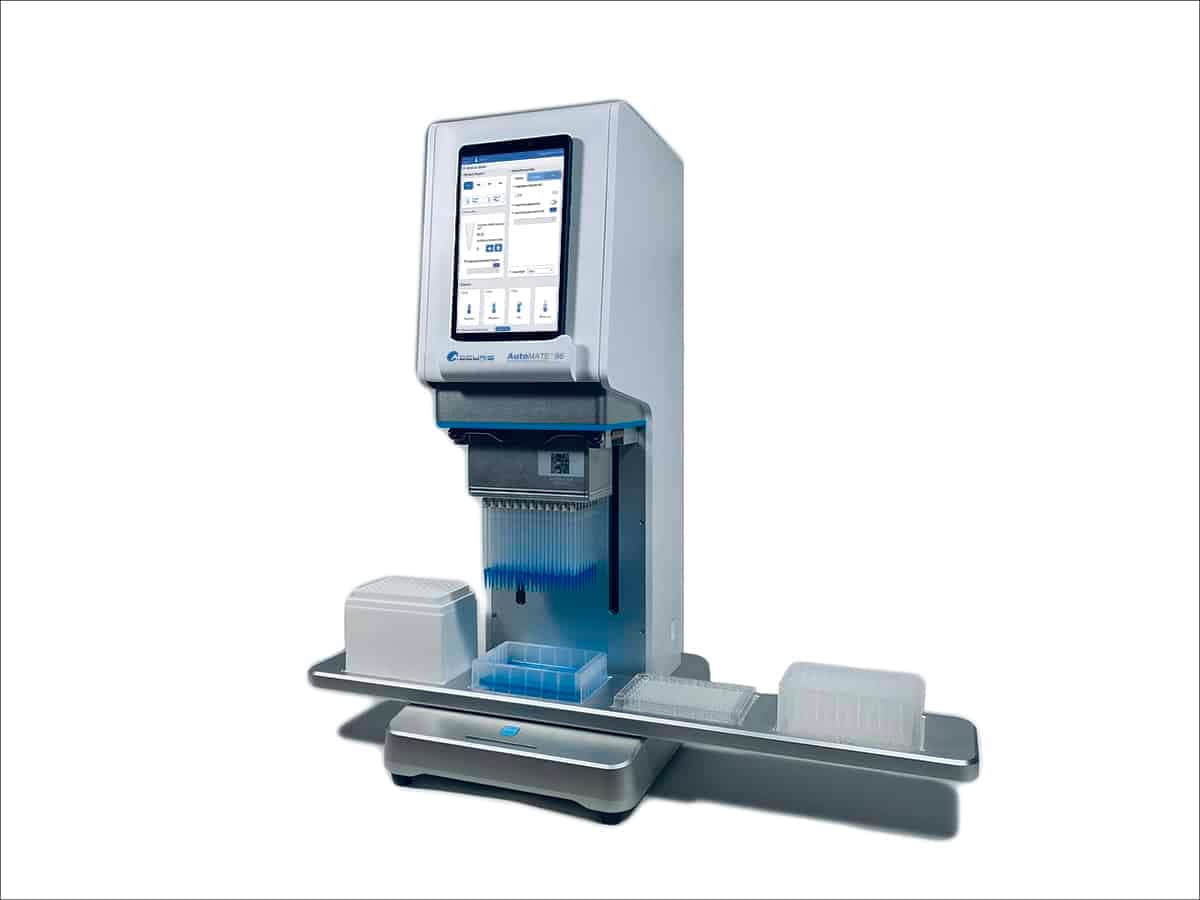
Microplate pipetting stations simultaneously dispense or aspirate across all 96 wells of a standard SBS-format plate in a single automated step—replacing 15–20 minutes of manual 8-channel multichannel pipetting with a single sub-60-second operation. The Accuris AutoMATE 96 covers 1–1,000 µL across three interchangeable heads, six programmable pipetting modes, motorized hands-free tip loading, and SLAS/ANSI compatibility with 96/384-well plates and PCR plates. MBP is a registered vendor to Howard Hughes Medical Institute, MD Anderson Cancer Center, and Vanderbilt University.

Contact customerservice@mbpinc.net to compare microplate pipetting station options and request pricing or availability information.

Microplate Pipetting Station
Per Page:
Sort By:
AutoMATE Pipetting
List Price:
USD22,585.48 - USD22,585.48
Online Price:
USD16,132.49 - USD16,132.49
Your Price:

Showing 1 to 1 of 1 results

What Are Microplate Pipetting Stations?


A microplate pipetting station (96-channel pipetting workstation) is a benchtop automated liquid handling system that aspirates and dispenses liquid across all 96 wells of a microplate simultaneously using 96 air-displacement channels and disposable pipette tips. It is designed to automate repetitive pipetting tasks in workflows such as ELISA, PCR setup, cell-based assays, and serial dilutions.

These systems typically include interchangeable pipetting heads for different volume ranges, a motorized plate platform for positioning, and software for protocol programming and execution.


What you will find:


  • AutoMATE™ 96 microplate pipetting station with 96-channel automated dispensing and interchangeable volume heads, used for plate filling, mixing, and serial dilutions


How to Choose a Microplate Pipetting Station


Volume Range and Head Configuration
Select a system that matches your application volume requirements. Low-volume heads are used for molecular biology applications, while mid- and high-volume heads support ELISA, cell culture, and reagent dispensing workflows.

Throughput Requirements
Evaluate how many plates are processed daily. High-throughput labs benefit most from full 96-channel automation, while lower-throughput environments may not require full automation systems.

Plate Format Compatibility
Ensure compatibility with your lab’s plate types, including standard 96-well, 384-well (with adapter), and PCR plates. Proper alignment and depth control are important for accuracy.

Tip and Consumable Compatibility
Confirm that compatible pipette tips and consumables are readily available and not limited to a single supplier. This helps reduce operational dependency and long-term cost.

Software and Workflow Control
Check whether the system supports easy protocol programming, including serial dilutions, mixing, and multi-step dispensing without requiring external software.


Specifications Context


Microplate pipetting stations provide simultaneous multi-channel liquid handling to significantly reduce manual pipetting time and improve reproducibility across assays. These systems are widely used in research, clinical diagnostics, and pharmaceutical laboratories.

Modern platforms emphasize ease of use, programmable workflows, and compatibility with standard microplate formats, enabling consistent results across high-throughput experiments.

Equip your lab with the microplate pipette station it deserves. Contact the expert team at Molecular Biology Products Inc. (MBP).

FAQ

A microplate pipetting station (96-channel pipetting workstation) is a benchtop automated instrument that simultaneously aspirates and dispenses liquid across all 96 wells of a microplate in a single operation, using 96 individual air-displacement piston channels and disposable pipette tips. It replaces manual 8-channel multichannel pipetting across 12 rows—a process that takes approximately 15–20 minutes per plate—with a single automated dispense step that typically completes in under 60 seconds with consistent volume accuracy across all 96 wells.
The Accuris AutoMATE 96 and equivalent 96-channel microplate pipetting stations cover a volume range of 1–1,000 µL across all channels simultaneously, using three interchangeable pipette heads: a 1–20 µL head for low-volume applications (qPCR setup, NGS library prep), a 5–200 µL head for standard ELISA, cell culture, and reagent addition workflows, and a 100–1,000 µL head for larger-volume dispensing. The pipette head must be swapped (sold separately) to change the operational volume range; confirm which head(s) are included versus extra cost before ordering.
The Accuris AutoMATE 96 microplate pipetting station is compatible with all brands of microplates and reservoirs meeting SLAS/ANSI SBS standard footprint dimensions. Included plate adapters extend compatibility to 384-well microplates and PCR plates. Compatible formats include standard 96-well flat-bottom plates, 96-well V-bottom plates, 96-well deep-well plates (shallow and deep), 384-well plates (with adapter), and PCR plates. Reagent reservoirs that meet SLAS/ANSI dimensions are also supported for aspirating bulk reagent.
The Accuris AutoMATE 96 provides six pipetting modes: standard pipetting (aspirate-dispense from reservoir to plate or plate-to-plate); multi-dispensing for repetitive plate filling without re-aspirating; secondary dispensing for adding multiple reagents to the same plate (with optional mixing step between each); serial dilution for automated dilution series across rows or columns; mixing (adjustable-speed aspiration/dispense cycles for reagent homogenization); and reverse pipetting for high-precision small-volume dispensing of biological fluids. Programs are built on an 8-inch touchscreen tablet and can include multiple sequential steps (load tips → aspirate → dispense → mix → eject tips) run unattended to completion.
The Accuris AutoMATE 96 is hands-free: motorized tip loading and ejection automatically seats 96 tips simultaneously from a standard SBS-format tip rack and ejects them into a waste container without operator intervention. This eliminates the uneven tip attachment that causes volume inaccuracy and leakage in manual 96-well tip loading, and ensures consistent tip seal across all 96 channels for every aspirate-dispense cycle. Once a protocol is programmed on the touchscreen tablet, the instrument runs tip loading through completion without further manual adjustment.
The highest-throughput benefit applications for a 96-channel microplate pipetting station are: ELISA plate preparation (plate coating, washing buffer addition, antibody and conjugate dispensing, substrate addition); PCR and qPCR master mix setup into 96-well or PCR plates; NGS library preparation (reagent addition across 96 wells simultaneously); cell-based assay preparation (media addition, compound transfer, lysis buffer addition); serial dilution for drug screening and ADMET studies; and microplate replication (copying one 96-well plate to another). Any protocol requiring the same volume added to every well of a 96-well plate runs faster and more consistently on a 96-channel pipetting station than with manual multichannel pipetting.
The Accuris AutoMATE 96 is described as compact enough to fit onto a standard lab bench or into a biosafety cabinet, with dimensions of 69.0 × 35.0 × 67.3 cm (27.2 × 13.8 × 26.5 in) and weight of 32.6 kg. Confirm the internal work area dimensions of your specific biosafety cabinet model before attempting BSC placement—the depth and width must accommodate the footprint plus clearance for the sliding platform motion.
The primary consumable for a 96-channel microplate pipetting station is standard-format SBS-compliant 96-well disposable pipette tips compatible with the instrument's tip loading system. For the Accuris AutoMATE 96, compatible tips must fit the standard 96-well SBS tip rack footprint; standard filter and non-filter tips in the 0.1–1,000 µL volume range from multiple manufacturers are compatible. Additional consumables include reagent reservoirs for aspirating bulk reagents, and the interchangeable pipette heads (1–20 µL, 5–200 µL, 100–1,000 µL) are durable components rather than consumables.
We provide the highest quality of products and anytime customer service.
Featured Categories
    online payment
    online payment
    fast delivery
    fast delivery
    technical support
    technical support
    24/7 support
    24/7 support
    copy right
    2026 All Right Reserved