Infrared Micro Sterilizers for Flame-Free Loop and Needle Sterilization
Infrared micro sterilizers use a ceramic IR element at 815–900°C to completely sterilize inoculating loops, needles, and small borosilicate glass instruments in 5–7 seconds—matching Bunsen flame efficacy with no open flame, no combustion gases, and no aerosol splash. They are approved for use inside Class II biosafety cabinets and anaerobic chambers. MBP is a registered vendor to Howard Hughes Medical Institute, MD Anderson Cancer Center, and Vanderbilt University.
Contact customerservice@mbpinc.net to compare infrared micro sterilizer models and request current pricing or availability.
Infrared MicroSterilizer
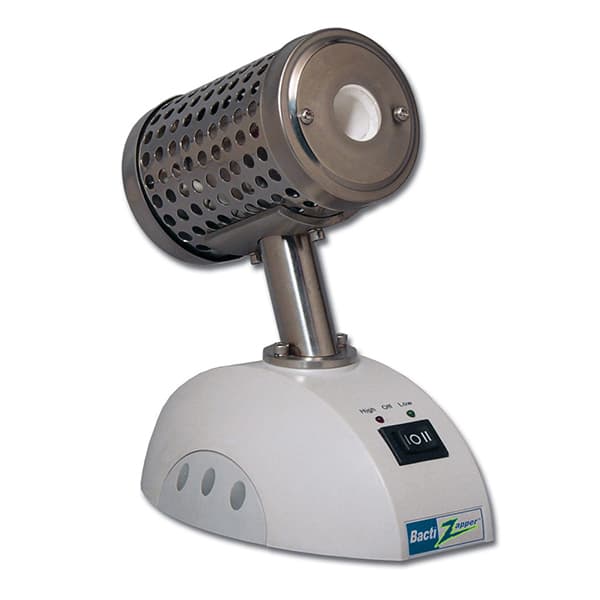
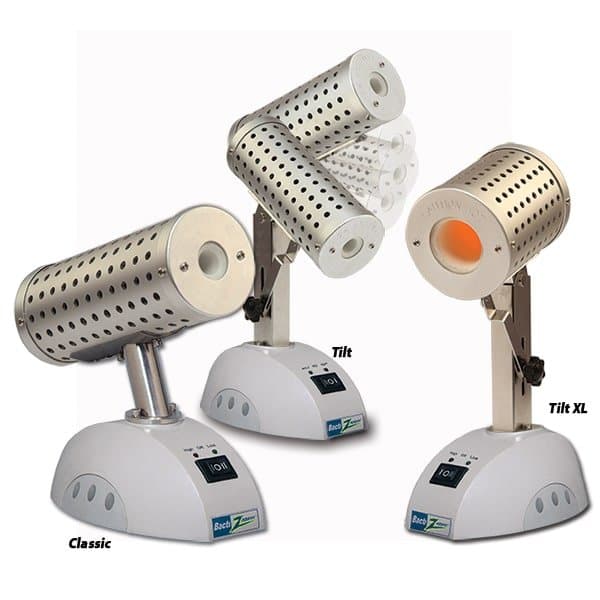
Showing 1 to 2 of 2 results
What Are Infrared Micro Sterilizers?
Infrared micro sterilizers (also called bacti-cinerators or IR loop sterilizers) are compact benchtop instruments that use a ceramic infrared heating element enclosed in a perforated stainless-steel chamber to generate a core temperature of 815–900°C, completely sterilizing inoculating loops, needles, glass pipette mouths, and small borosilicate glass instruments inserted into the aperture in 5–7 seconds. They are the direct flame-free replacement for the Bunsen burner in microbiology, clinical, and research labs—delivering equivalent sterilization speed with no open flame, no combustion gases, no flammable solvents, and no aerosol splash risk from superheated instrument surfaces. Because they produce no flame and no volatile exhaust, they are approved for use inside Class II biosafety cabinets and in anaerobic environments where open flames are strictly prohibited.
What you will find:
-
BactiZapper™ Infrared MicroSterilizer: for standard and rapid sterilization
-
BactiZapper™ TILT MicroSterilizer: for angled access and more convenient sterilization
How to Choose an Infrared Micro Sterilizer
Aperture Diameter (14 mm vs. 35 mm)
Infrared micro sterilizers are available with 14 mm or 35 mm diameter apertures. The 14 mm model is designed for standard inoculating loops and needles; the 35 mm model accommodates wider instruments, glass tube mouths, and larger pipette openings. If your lab sterilizes culture tube mouths or 10 mL pipette openings, specify the larger aperture model.
Core Temperature and Standby Mode
Standard infrared micro sterilizers reach 815–900°C at the element core; some models allow adjustment between a full sterilization setting and a standby mode at approximately 500°C. The standby mode maintains readiness between cycles without cycling the element to full temperature repeatedly, reducing element wear during long work sessions.
Contactless vs. Manual Activation
Standard models activate by a switch or dial; some advanced designs (e.g., berner-safety IR sterilizers with contactless IR sensor technology) start the sterilization cycle automatically when an instrument is inserted into the aperture, reducing the risk of touching a hot element and improving workflow speed.
Tilt Feature
Tilt-adjustable models (e.g., Benchmark BactiZapper Tilt, BactiZapper XL Tilt) allow the aperture angle to be directed toward the operator, improving loop insertion ergonomics and reducing awkward wrist angles during high-frequency sterilization sessions. This is particularly valuable for labs performing many loopfuls per session.
Compatibility with BSC or Anaerobic Chamber
Confirm the model dimensions fit inside your BSC's work area and that the heat output does not create a localized temperature zone that could affect HEPA filter integrity. For anaerobic chambers, verify the model is compatible with the inert gas atmosphere and does not include a gas purge or external vent requirement.
Specifications Context
At 815–900°C, infrared micro sterilizers destroy all vegetative bacteria, spores, and most viruses on metal and borosilicate glass surfaces in 5–7 seconds of exposure—validated against the performance of standard Bunsen flame sterilization in published microbiology laboratory protocols. The ceramic heating element is asbestos-free in all current models (a distinction from older designs); confirm this specification when evaluating any older or non-branded infrared sterilizer. As of 2026, the BactiZapper (Benchmark Scientific) and Crystal Industries micro incinerator represent the most widely distributed IR loop sterilizers in North American research and clinical labs. Allow the sterilized loop to cool for 3–5 seconds after removal from the aperture before contacting agar or liquid media to avoid killing the transferred culture.
Sterilize your lab instruments with the right equipment. Contact the expert team of Molecular Biology Products Inc. (MBP) today to find the perfect match.
FAQ