Product Filters

Laboratory Wash Bottles for Rinsing and Solvent Dispensing


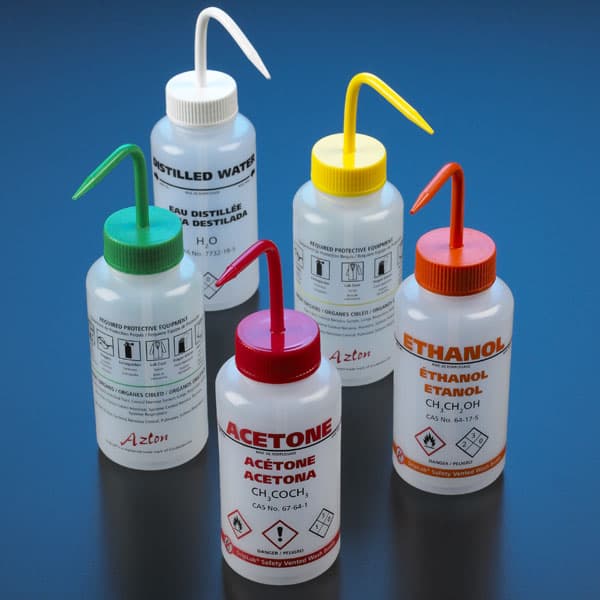
Laboratory wash bottles are flexible LDPE squeeze containers—250 mL, 500 mL, and 1000 mL—with a narrow dispensing nozzle that delivers a controlled liquid stream for rinsing glassware, dispensing solvents, and directing liquid during sample preparation. Globe Scientific wash bottles feature color-coded PP caps (red, blue, yellow, green, white) and safety-vented GHS-labeled versions for ethanol (orange), methanol (green), and isopropanol (yellow), available in wide-mouth formats for easy refilling. MBP ships to labs in the US, Canada, and internationally and is a registered vendor for Howard Hughes Medical Institute, Vanderbilt University, and MD Anderson Cancer Center.

Need help selecting the right laboratory wash bottles for your workflow? — Contact our team at customerservice@mbpinc.net for product recommendations, bulk pricing, and purchasing assistance.

Wash Mouth Bottles
productListingPage:PER_PAGE:
productListingPage:SORT_BY:

What Are Laboratory Wash Mouth Bottles?


Laboratory wash bottles, also known as squeeze bottles or wash mouth bottles, are flexible LDPE containers available in 250 mL, 500 mL, and 1000 mL capacities. They feature a narrow dispensing nozzle or integrated draw-tube spout that delivers a controlled stream of liquid when the bottle is squeezed by hand. The flexibility of LDPE enables this dispensing action, making it the preferred material for wash bottles. These bottles are commonly used for rinsing laboratory glassware with distilled or deionized water, dispensing solvents during sample preparation, flushing residues during titrations and extractions, and directing liquids into narrow-neck vessels. Globe Scientific wash bottles are available with color-coded polypropylene caps and GHS-labeled safety-vented options for handling volatile solvents. Safety-vented wash bottles should always be used with volatile solvents such as ethanol, methanol, isopropanol, and acetone to prevent pressure build-up caused by vapor expansion.


What you will find:

  • Laboratory wash mouth squeeze bottles for controlled rinsing

  • Chemical-resistant LDPE wash bottles for routine lab use

  • Narrow-tip dispensing bottles for precise liquid flow

  • Distilled water wash bottles for cleaning applications

  • Buffer solution dispensing bottles for lab workflows

  • Reagent-grade wash bottles for general handling tasks

  • Durable plastic squeeze bottles for daily laboratory use

  • Flexible wash bottles designed for repeated bench operations

  • General-purpose rinse bottles for multi-use lab environments


How to Choose Wash Mouth Bottles


Vented vs. Non-Vented

Non-vented wash bottles are suitable for deionized water, distilled water, and other non-volatile aqueous solutions. Safety-vented wash bottles include a pressure-relief vent in the dispensing nozzle, allowing solvent vapors to escape safely and reducing the risk of pressure accumulation. These bottles are recommended for volatile solvents such as ethanol, methanol, isopropanol, and acetone. Globe Scientific GHS-labeled wash bottles combine safety venting with pre-printed hazard labeling for improved chemical identification and compliance.


Color-Coded Cap System

Color-coded caps help prevent reagent mix-ups in busy laboratory environments. A commonly used convention is blue for water, red for ethanol, yellow for isopropanol, green for methanol, and white for custom labeling or general use. Establishing a consistent color-coding system throughout the laboratory helps improve safety and workflow efficiency.


Wide Mouth vs. Standard Design

Standard wash bottles use a narrow draw tube extending to the base of the bottle, allowing liquid dispensing while the bottle remains upright. Wide-mouth wash bottles feature a larger neck opening, making refilling from bulk containers, carboys, or reagent bottles faster and easier. Laboratories that refill bottles frequently often prefer wide-mouth designs to reduce spills and simplify handling.


Volume Selection

The 500 mL wash bottle is the most common laboratory size, providing a balance between capacity and ease of handling. A 250 mL bottle is ideal when smaller volumes are sufficient or greater dispensing control is required. For high-throughput environments where liquids are used continuously, 1000 mL bottles minimize refill frequency and improve efficiency.


Wash Bottle Format Comparison


Standard LDPE wash bottles with white caps are commonly used for deionized water and other non-volatile aqueous solutions and are available in 250 mL, 500 mL, and 1000 mL capacities. Red-cap LDPE bottles are often designated for ethanol. GHS-labeled safety-vented bottles with orange, green, or yellow caps are designed for ethanol, methanol, and isopropanol respectively, providing both pressure relief and chemical identification. Wide-mouth wash bottles are available in multiple sizes and offer easier refilling from larger reagent containers while maintaining the same controlled dispensing functionality.


Specifications Context


Globe Scientific Diamond RealSeal LDPE wash bottles feature an integral-seal polypropylene screw cap and draw-tube assembly for reliable dispensing. Wide-mouth models incorporate a larger neck opening to facilitate rapid refilling while retaining the same dispensing performance. GHS-labeled wash bottles are designed to support compliance with Globally Harmonized System (GHS) chemical hazard communication requirements and are widely used for solvent handling in research, pharmaceutical, industrial, and educational laboratories. As of 2026, safety-vented GHS-labeled wash bottles are considered standard practice in laboratories handling flammable solvents on the bench. Explore wide mouth bottles and narrow mouth bottles for applications requiring long-term liquid storage rather than squeeze dispensing.

Request a quote from the MBP team for product specifications, availability, and bulk purchasing support.

FAQ

Laboratory wash bottles are flexible LDPE squeeze bottles—typically 250 mL, 500 mL, or 1000 mL—with a narrow dispensing nozzle or integrated dispensing tip used to direct controlled streams of liquid onto glassware, surfaces, samples, or instruments. Squeezing the flexible LDPE body forces liquid up through the draw tube or integrated spout without tilting the bottle. Applications include rinsing glassware with DI water or ethanol, directing small volumes of solvent during sample preparation, flushing residues in titrations, and wetting filter paper.
Standard laboratory wash bottles are made from low-density polyethylene (LDPE), a flexible plastic that yields under hand pressure to deliver a controlled liquid stream through the dispensing nozzle. LDPE's flexibility is the defining functional property—rigid materials like HDPE or PP cannot be squeezed to generate the dispensing action. Globe Scientific wash bottles use LDPE bodies with polypropylene (PP) screw caps; LDPE provides flexibility and moderate chemical resistance while PP provides a more rigid, chemically stable closure.
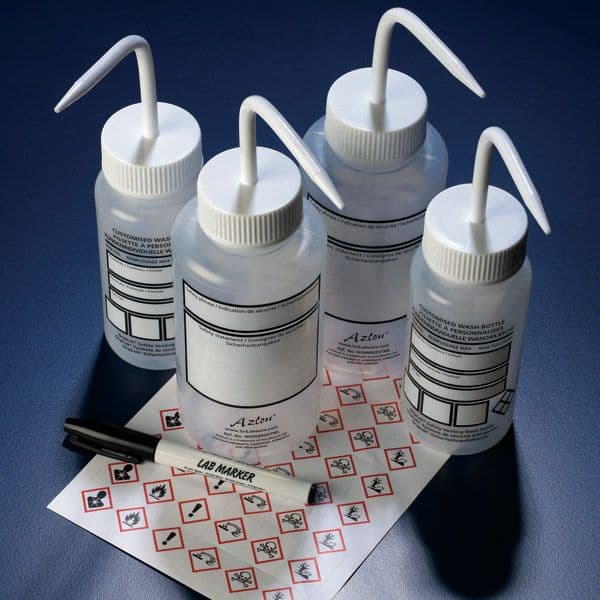
Globe Scientific wash bottles use color-coded PP screw caps to identify contents: white cap is the general-purpose or 'do-it-yourself' write-on format; red cap is conventionally used for ethanol or isopropanol (IPA); blue cap for water (DI or distilled); yellow cap for isopropanol or acetone; green cap for methanol. GHS-labeled versions carry specific chemical hazard pictograms and are available in orange (ethanol), green (methanol), and yellow (isopropanol) for compliance with GHS safety labeling requirements in regulated laboratories.
A safety-vented wash bottle has a small vent hole in the dispensing nozzle cap or spout that relieves pressure buildup inside the bottle caused by volatile chemical vapors or thermal expansion. Without venting, bottles containing volatile solvents (ethanol, methanol, isopropanol, acetone) can build positive internal pressure that causes liquid to drip or spray when the cap is loosened or when the bottle is handled in warm environments. Safety-vented Globe Scientific wash bottles are specifically required when storing volatile organic solvents; non-vented bottles are sufficient for DI water and non-volatile aqueous solutions.
Standard laboratory wash bottles are available in 250 mL, 500 mL, and 1000 mL. The 500 mL size is the most widely used across bench applications, providing a practical volume for daily glassware rinsing and reagent dispensing without excessive weight when full. The 250 mL format suits applications requiring a small, easily controlled squeeze volume. The 1000 mL bottle is used where high-volume rinsing or dispensing frequency makes refilling the standard size impractical.
LDPE wash bottles are compatible with ethanol, methanol, isopropanol, and acetone for short-term bench use; however, LDPE has limited compatibility with chlorinated solvents (chloroform, DCM, methylene chloride), aromatic hydrocarbons (toluene, xylene), and strong oxidizing acids. For chlorinated solvent dispensing, use fluorinated HDPE or PTFE wash bottles designed for aggressive solvent contact. Always confirm chemical compatibility against the manufacturer's resistance chart before filling a wash bottle with any organic solvent other than common alcohols and acetone.
MBP carries Globe Scientific LDPE wash bottles in 250 mL, 500 mL, and 1000 mL including wide-mouth styles and GHS-labeled safety-vented versions for ethanol (orange cap), methanol (green cap), and isopropanol (yellow cap). Color-coded non-labeled wash bottles in red, blue, yellow, green, and white are also available. Globe Scientific is ISO 9001:2015 certified. MBP ships to labs in the US, Canada, and internationally and is a registered vendor for Howard Hughes Medical Institute, Vanderbilt University, and MD Anderson Cancer Center.
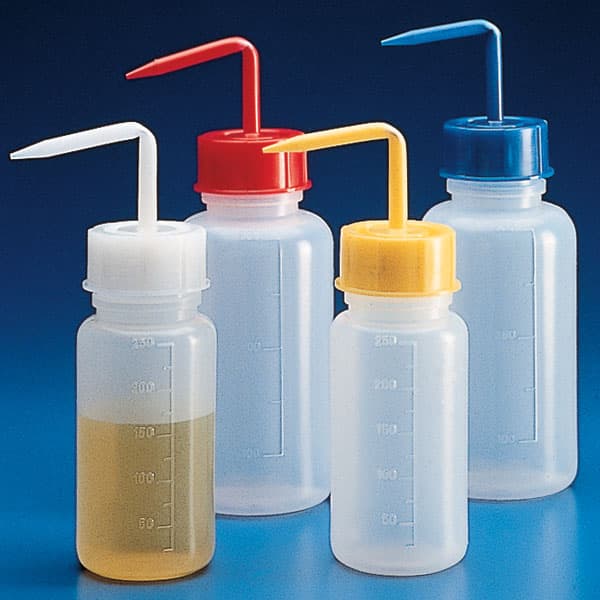
A wide-mouth wash bottle has a broad neck opening (rather than the narrow standard nozzle) that allows easy filling by funnel or direct pour—useful when the bottle will be refilled frequently or filled from a large-volume supply container. Globe Scientific wide-mouth LDPE wash bottles in 250 mL, 500 mL, and 1000 mL include a white screw cap and a separate draw tube; some models feature a write-on panel for content labeling. Choose a wide-mouth wash bottle when filling from a bulk carboy or when the bottle will be refilled several times per day.
We provide the highest quality of products and anytime customer service.
LinkedIn
Featured Categories
online payment
online payment
fast delivery
fast delivery
technical support
technical support
24/7 support
24/7 support
copy right
2026 All Right Reserved