Scintillation Vials for Liquid Scintillation Counting and Sample Storage
Scintillation vials are 7 mL or 20 mL screw-cap vessels used to combine radioactive samples with scintillation cocktail for liquid scintillation counting (LSC) of beta-emitting radioisotopes, including tritium (³H), carbon-14 (¹⁴C), phosphorus-32 (³²P), and sulfur-35 (³⁵S). The 20 mL standard format (28 mm O.D., 22-400 thread) is compatible with Beckman Coulter, PerkinElmer Tri-Carb, and Hidex LSC counters. Low-potassium borosilicate glass minimizes ⁴⁰K background; HDPE plastic is the cost-effective choice for high-throughput routine LSC.
MBP supplies scintillation vials with direct PO ordering for radiotracer labs across the USA, Canada, and worldwide. Contact customerservice@mbpinc.net for further details.
Scintillation Vials
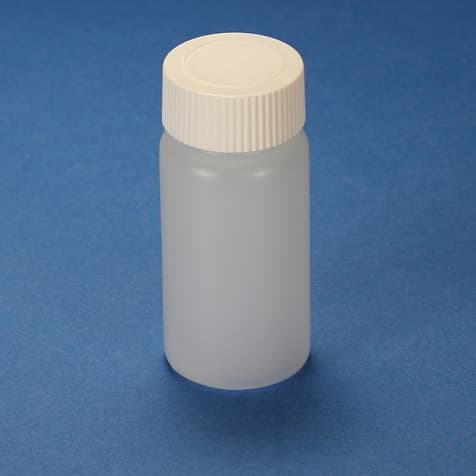
Showing 1 to 1 of 1 results
What are Scintillation Vials?
Scintillation vials are small, screw-cap laboratory vessels used to combine a liquid sample with a scintillation cocktail for the detection of radioactive emissions—primarily beta particles from tritium (³H), carbon-14 (¹⁴C), phosphorus-32 (³²P), and sulfur-35 (³⁵S)—by liquid scintillation counting (LSC). The standard format is a 20 mL vial (28 mm O.D. × 57–61 mm height) with a 22-400 threaded neck, manufactured in borosilicate glass or high-density polyethylene (HDPE). Mini vials (7 mL) reduce sample and scintillant consumption by approximately two-thirds while maintaining counting geometry. Choose glass vials for volatile sample matrices, strong solvents, or applications requiring minimal background; choose HDPE/PET plastic vials for routine tritium and ¹⁴C counting where cost and disposal savings matter.
What you will find:
-
Glass scintillation vials for low-background analytical measurements
-
Polypropylene scintillation vials for general-purpose chemical resistance
-
HDPE scintillation vials for solvent-compatible sample storage
-
PET scintillation vials for clear visibility and unbreakable handling
-
4 mL to 20 mL standard capacity vials for laboratory workflows
-
Screw-cap vials with leak-resistant liners for secure sealing
-
Chemically resistant closure systems for solvent-based assays
How to Choose Scintillation Vials
Glass vs. Plastic
Borosilicate glass (low-potassium grade, Wheaton 180 or equivalent) provides zero solvent permeability, inertness to all scintillation cocktails, and superior optical clarity for low-background counting. Low-potassium glass minimizes background from potassium-40 (⁴⁰K) natural radioactivity. Glass is the first choice for radon counting, volatile organics, and any matrix where solvent permeation through the vial wall would cause cross-contamination. HDPE and PET plastic vials are lighter, less expensive, and safe to incinerate; they offer good UV transmission and ultra-low background for tritium analysis, making them the preferred choice for high-throughput routine LSC.
20 mL vs. Mini Vials (7 mL)
Standard 20 mL vials accept up to 15 mL of scintillant + sample mixture and are compatible with all common liquid scintillation counters (Beckman Coulter LS series, PerkinElmer Tri-Carb, Hidex 300 SL). Mini 7 mL vials use the same radioactive sample volume as 20 mL vials but reduce scintillant consumption and solvent waste by ~60%; some counter models require adapter inserts. Confirm counter compatibility before switching to mini format.
Cap and Liner Type
Cap liner selection affects seal integrity and chemical compatibility. Urea caps with polyethylene (PE) cone liners provide a good seal for aqueous samples. Polypropylene caps with metal foil liners are chemically inert and suited for strong solvents and high-purity chemicals. Cap color (white vs. black) can influence background counts; black caps reduce photon ingress and lower background in very-low-activity samples.
Precapped vs. Separate Caps
Precapped vials (caps attached, trays of 100) speed up high-throughput workflows where vials are filled, capped, and counted in batches. Separate caps in bulk packaging suits labs that mix vial and cap types or need specific liner compatibility.
Potassium-Free Specification
For the lowest possible background in low-activity counting, specify low-potassium borosilicate glass that conforms to ASTM Type I, Class A standards. Potassium in ordinary glass contributes β-background from ⁴⁰K; low-K glass eliminates this contribution in the tritium energy window.
Specifications Context
Standard scintillation vials use a 22-400 threaded neck, fitting all major LSC platforms, including Beckman Coulter LS 6500, PerkinElmer Tri-Carb 3110TR, and Hidex 300 SL. Vial O.D. is 28 mm ± 0.5 mm; overall height with cap is 60–62 mm. Low-potassium borosilicate glass (Wheaton 180 grade) conforms to ASTM Type I, Class A and provides UV transmission >75% at 340 nm, ensuring efficient photomultiplier tube (PMT) response. HDPE vials weigh approximately 60% less than glass equivalents and can be incinerated without special handling after approved radioactive decay. As of 2026, 20 mL scintillation vials are typically packed 100 per tray, 5 trays per case (500 per case) for glass, and 100 or 500 per case for plastic formats.
Contact the MBP team for bulk pricing and PO ordering for radiotracer labs and radiopharmaceutical research facilities across the USA, Canada, and worldwide.
FAQ