Sterile Polystyrene Petri Dishes for Microbiology Laboratories
Petri dishes are shallow, flat-bottomed, lidded containers—standard 90 mm × 15 mm—used to culture bacteria and fungi on solid agar media for isolation, enumeration, antimicrobial susceptibility testing, and organism identification. Disposable polystyrene petri dishes are precision-molded in Class 100,000 cleanrooms, gamma-irradiated to SAL 10⁻⁶ per ISO 11137, and certified DNase/RNase-free. Available in 60 mm, 90 mm, and 150 mm diameters with vented or non-vented lids. MBP ships to research, academic, and clinical labs across the US, Canada, and internationally and is a registered vendor for Howard Hughes Medical Institute, Vanderbilt University, and MD Anderson Cancer Center.
Need help selecting the right petri dishes for your microbiology workflow? — Contact our team at customerservice@mbpinc.net for product recommendations, bulk pricing, and purchasing assistance.
Petri Dishes


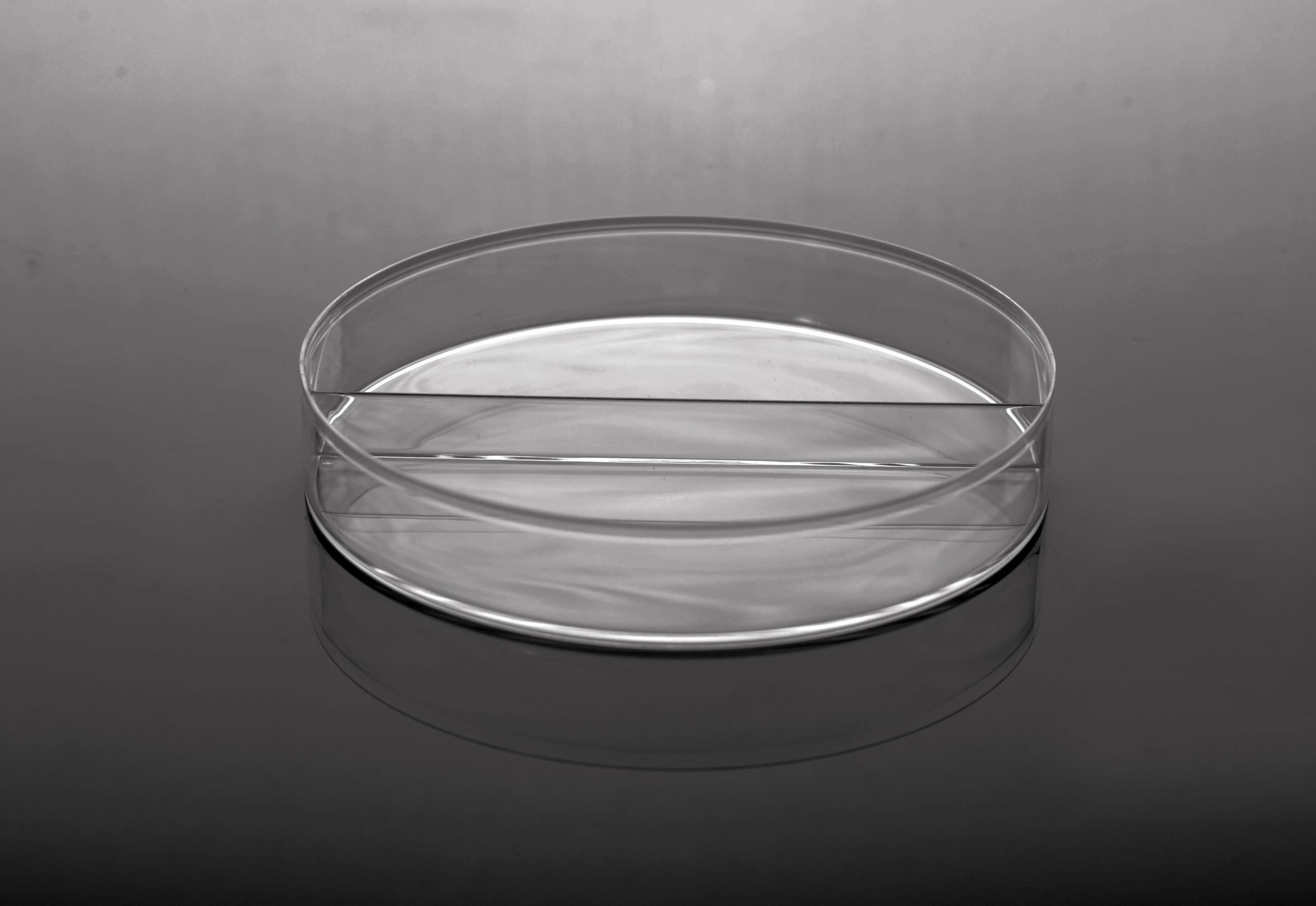
Showing 1 to 3 of 3 results
What Are Laboratory Petri Dishes?
A petri dish is a shallow, circular, flat-bottomed lidded container used for culturing microorganisms such as bacteria and fungi on solid agar-based growth media. The standard laboratory format is 90 mm diameter × 15 mm depth, which provides an optimal surface area for colony isolation, enumeration, and antimicrobial testing. First introduced by Julius Richard Petri in 1887, the petri dish remains one of the most essential tools in microbiology for applications such as streak-plate isolation, colony-forming unit (CFU) counting, antimicrobial susceptibility testing (Kirby-Bauer method), environmental monitoring, and general microbial identification. Disposable polystyrene petri dishes are manufactured under cleanroom conditions, gamma sterilized (SAL 10⁻⁶), and produced as DNase/RNase-free consumables for contamination-sensitive workflows. Polystyrene dishes should not be autoclaved, as high heat can deform the material; reusable glass dishes are used when heat sterilization or chemical resistance is required.
What you will find:
-
Optical clarity for distortion-free observation
-
Ventilated lids for airflow with minimal condensation
-
Stable, stackable design for safe handling
-
Smooth surface for easy inoculation
-
Sterile and available in multiple sizes
How to Choose Petri Dishes
Size
The 90 mm petri dish is the global standard used in most clinical and research laboratories because it fits standard incubator racks and supports typical agar volumes of 15–20 mL. Smaller 60 mm dishes are used for teaching exercises, limited sample volumes, or cost-efficient plating, while larger 150 mm dishes provide increased surface area for dense cultures, slow-growing organisms, or specialized susceptibility testing applications.
Lid: Vented vs. Non-Vented
Vented lids allow controlled gas exchange, helping maintain aerobic conditions and reduce condensation buildup during incubation. Non-vented lids are used when a sealed environment is required, such as in anaerobic systems, transport conditions, or moisture-sensitive applications where evaporation must be minimized.
Material
Polystyrene (PS) is the most commonly used material for disposable microbiology petri dishes due to its clarity, low cost, and consistent manufacturing quality. Polypropylene (PP) dishes offer higher heat resistance and can withstand autoclave conditions, but they are less optically clear. Borosilicate glass petri dishes are reusable, chemically resistant, and suitable for workflows requiring repeated sterilization or harsh chemical exposure.
Surface Treatment
Non-treated polystyrene dishes are used for standard bacterial and fungal culture. Tissue culture (TC)-treated dishes have a surface modification that promotes cell attachment and are intended for mammalian cell culture applications, not routine microbiology work. Selecting the correct surface treatment ensures accurate microbial growth and prevents unnecessary cost.
Specifications Context
Modern laboratory petri dishes are manufactured from high-grade virgin polystyrene under controlled cleanroom conditions to ensure consistency in agar surface quality and colony morphology. Stacking rings on the dish base allow airflow and thermal equilibration during incubation. In standardized microbiology methods such as CLSI, EUCAST, and AOAC protocols, 90 mm petri dishes are the preferred format for CFU counting and antimicrobial susceptibility testing. A typical agar volume of 15–20 mL per 90 mm plate ensures consistent depth and reliable diffusion characteristics for microbiological assays. Together, petri dishes, inoculating loops, and culture media form the foundation of routine bacterial culture workflows in clinical and research laboratories.
Ready to upgrade your incubation standards? Don’t let uneven growth or condensation cloud your data. Reach out to the MBP team today to secure the high-performance Petri dishes your cultures deserve.
FAQ