Product Filters

Tissue Cassettes for Histology and Pathology Laboratories


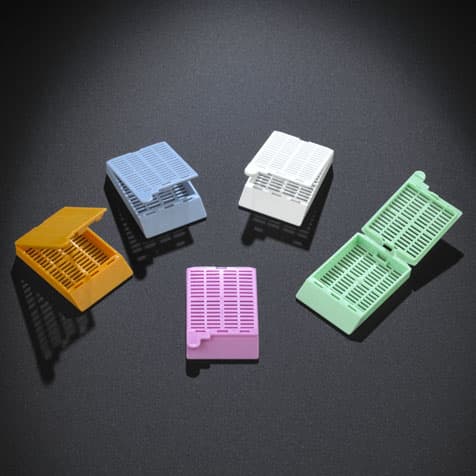
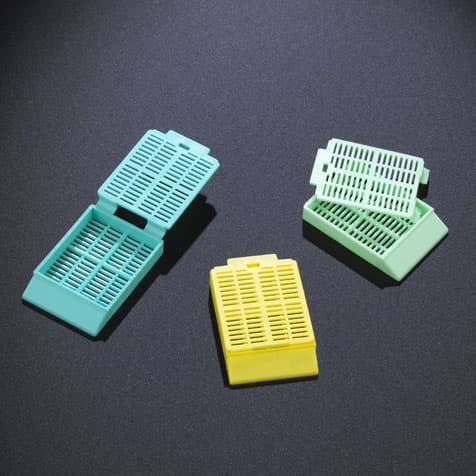
Tissue cassettes are acetal polymer containers with wide-slot openings used to hold surgical resections and large biopsy cores through formalin fixation, automated tissue processing, paraffin embedding, and long-term block storage. Globe Scientific tissue cassettes measure approximately 40 × 28 × 6 mm, resist xylene, alcohols, and decalcifying acids, and are compatible with Leica and Sakura labeling instruments. Available in 10+ colors in 500-count dispenser boxes.

Need help selecting the right tissue cassettes for your laboratory? — Contact our team at customerservice@mbpinc.net for product recommendations, bulk pricing, and purchasing assistance.

Tissue Cassettes
productListingPage:PER_PAGE:
productListingPage:SORT_BY:

What Are Tissue Cassettes?


Tissue cassettes are rectangular acetal polymer (POM) containers used in surgical pathology and research histology to carry gross tissue specimens—including resections, excisions, and large biopsy cores—from the grossing table through the complete paraffin processing workflow. Wide-slot perforations (approximately 1.5 mm) allow rapid reagent penetration and drainage during automated tissue processor cycles while preventing specimen loss for samples measuring 3 mm or larger in their smallest dimension. Following processing, the cassette base fits directly into a metal or disposable plastic base mold for paraffin embedding, and the completed paraffin block is archived with the cassette serving as the primary specimen identifier.

Standard tissue cassettes handle the majority of surgical pathology specimens; use biopsy cassettes for specimens smaller than approximately 3 mm.


What You Will Find:


  • 35° Precision Writing Surface: Ergonomic angle with dual labeling panels for clear marking and smooth printer compatibility.
  • Snap-Secure Integrated Lids: One-piece lid design ensures a tight, permanent seal to prevent sample loss.
  • Optimized Fluid Exchange: High-flow pores allow consistent fixation and efficient paraffin infiltration.
  • Lab-Proven Durability: Solvent-resistant construction prevents warping in xylene or alcohols.


How to Choose Tissue Cassettes


Writing Area Angle: 30° vs. 35°

Globe Scientific tissue cassettes are available with 30° and 35° angled writing surfaces to match Leica and Sakura cassette printer platen angles. Selecting the incorrect angle can create printing alignment issues and slow workflow efficiency. Laboratories should verify printer specifications before ordering case quantities.


Integral Lid vs. Separate Lid

Integral hinged-lid tissue cassettes snap closed without requiring a separate steel lid, reducing handling steps in high-volume grossing environments. Separate-lid cassettes are compatible with standard metal base molds and are often preferred in embedding stations where lids must be removed independently. Both formats are compatible with standard tissue processor baskets.


Color Coding

Globe Scientific offers tissue cassettes in more than ten standard colors. Many laboratories assign colors by specimen type or department to improve organization and reduce the risk of specimen identification errors during high-volume processing.


Pack Format: Standard Box vs. QuickLoad Sleeves

Standard 500-count dispenser boxes meet the needs of most laboratories. QuickLoad® and E-Z Load® sleeve formats provide pre-counted cassette stacks for rapid one-handed dispensing and are particularly useful in grossing stations processing more than 300 specimens per day.


Compatibility with Tissue Processors


The standard 40 × 28 × 6 mm cassette footprint is compatible with Leica ASP, Sakura VIP, Thermo Shandon Excelsior, and most other automated tissue processors without modification. Compatibility should be verified when ordering Mega or deep-body cassette variants.


Compare Tissue Cassette Variants


Standard Tissue Cassette, 35° Writing Angle
This cassette features an integral hinged lid and a 35° angled writing surface designed for compatibility with Leica cassette printers. It is widely used in high-throughput histology laboratories and routine surgical pathology workflows while maintaining a low-cost price point.


Standard Tissue Cassette, 30° Writing Angle
Featuring an integral hinged lid and a 30° angled writing area, this version is intended for laboratories using Sakura and other compatible cassette printers. It delivers the same specimen security and processing performance as the 35° format while ensuring proper printer compatibility.


Standard Tissue Cassette with Separate Lid
This variant utilizes a separate steel lid rather than an attached hinged lid. It is commonly selected for semi-automated embedding centers where independent lid removal is preferred during embedding. It remains fully compatible with standard tissue processor baskets and offers a cost-effective solution for routine histology applications.


Bulk Sleeve (QuickLoad® / E-Z Load®) Tissue Cassette
Bulk sleeve formats are supplied in pre-counted stacks for rapid dispensing in busy grossing rooms processing more than 300 specimens per day. These cassettes improve workflow efficiency and reduce handling time while offering lower per-unit costs through volume packaging.


Mega Tissue Cassette
Mega tissue cassettes are designed for whole-organ sections, oversized surgical specimens, and unusually thick tissue samples that exceed the capacity of standard cassettes. Their larger dimensions provide additional specimen space while maintaining compatibility with select tissue processors and embedding systems.


Specifications Context


Acetal polymer cassettes are dimensionally stable from 4°C refrigerated storage through approximately 65°C during paraffin infiltration. Globe Scientific maintains ISO 9001:2015 quality management certification, and lot-specific conformance documentation is available upon request. The standard 40 × 28 × 6 mm footprint is widely accepted by major tissue processor manufacturers and does not require instrument-specific modification. Tissue cassettes are research-use consumables and are not classified as medical devices or in vitro diagnostic (IVD) products.

Stop worrying about sample loss and switch to the MBP standard. Browse our inventory and hit up the team for a quote today.

FAQ

Standard tissue cassettes measure approximately 40 × 28 × 6 mm (length × width × depth). This footprint is the de facto universal format accepted by Leica ASP, Sakura VIP, Thermo Shandon Excelsior, and most other automated tissue processors without basket modification. Mega cassettes (approximately 40 × 26 × 13 mm deep) accommodate whole-organ or oversized specimens but require processor basket compatibility confirmation.
Standard tissue cassettes have wide slot openings of approximately 1.5 mm, suited for specimens ≥3 mm in their smallest dimension. Biopsy cassettes have 1 mm square mesh openings to retain small endoscopic or needle-core specimens. For specimens between 1–3 mm, use a biopsy cassette, a biopsy foam pad, or wrap the specimen in lens paper inside a standard cassette to prevent loss during processor agitation.
The standard 40 × 28 × 6 mm tissue cassette is compatible with baskets from major tissue processor manufacturers including Leica, Sakura, and Thermo Shandon. Compatibility with Mega or deep-body cassette variants should be confirmed against the specific processor basket specification before use in a new workflow.
The writing-area angle (30° or 35°) must match your cassette labeling instrument's platen geometry. Most Leica cassette printers are designed for 35° cassettes; Sakura and other brands vary by model. Using the wrong angle prevents clean single-pass printing and forces manual re-labeling. Confirm the angle from your printer's specifications or contact MBP's team for compatibility guidance before a bulk order.
After paraffin infiltration, the histotechnician places the cassette base into a metal or disposable plastic base mold, fills it with molten paraffin, and orients the tissue. The cassette face (with specimen ID) remains embedded in the top of the finished paraffin block, serving as both the permanent specimen identifier and the chuck interface for mounting in the microtome. This integrated design means the cassette and block are archived together as a single labeled unit.
Globe Scientific tissue cassettes are available in more than 10 standard colors including white, yellow, blue, green, red, orange, pink, tan, gray, and black. Color coding by specimen type or department (for example, yellow for dermatopathology, blue for GI biopsy) is a widely used approach to reduce specimen mix-up risk during multi-specimen grossing sessions without requiring additional labeling steps.
Globe Scientific tissue cassettes are supplied in 500-count sealed dispenser boxes. QuickLoad and E-Z Load bulk sleeve formats package cassettes in pre-counted stacks for rapid one-handed dispensing at grossing stations handling 300 or more specimens per day. Contact MBP for case pricing, standing PO arrangements, or rush shipment options from the US Houston warehouse.
Lot-specific certificates of conformance (COC) for Globe Scientific tissue cassettes are available on request through MBP. These documents confirm material composition (acetal polymer, ISO 9001:2015 manufacturing), dimensional tolerances, and chemical resistance testing relevant to histological solvent exposure. For quality management, regulatory audit, or institutional vendor qualification purposes, contact MBP's support team directly.
We provide the highest quality of products and anytime customer service.
LinkedIn
Featured Categories
online payment
online payment
fast delivery
fast delivery
technical support
technical support
24/7 support
24/7 support
copy right
2026 All Right Reserved