Product Filters

Biopsy Cassettes for Histology Tissue Processing and Embedding


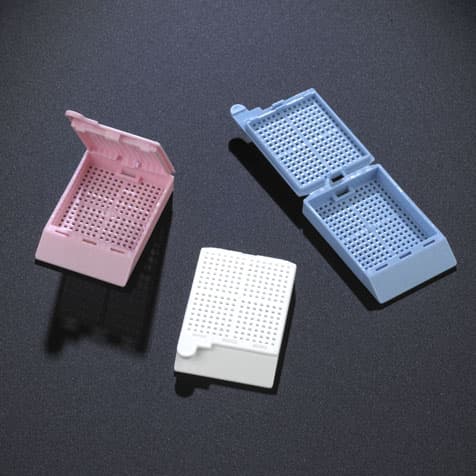
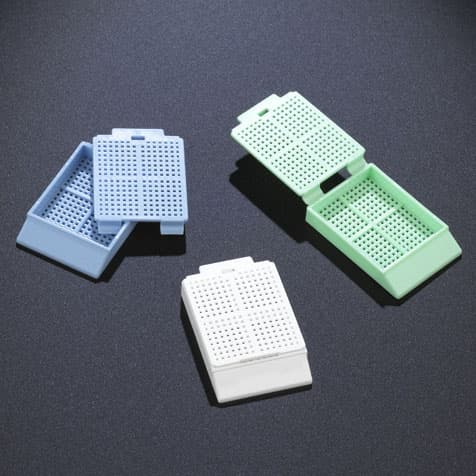
Biopsy cassettes are acetal polymer histology containers with 1 mm square mesh openings designed to retain small tissue fragments—endoscopic biopsies, needle-core biopsies, and prostate sextant cores—through formalin fixation, automated tissue processing, and paraffin embedding. Available as single-compartment and 4- to 6-compartment designs, Globe Scientific biopsy cassettes are compatible with Leica and Sakura labeling instruments and are supplied in 500-count dispenser boxes.

Need help selecting the right biopsy cassettes for your laboratory workflow? — Contact our team at customerservice@mbpinc.net for product recommendations, bulk pricing, and purchasing assistance.

Biopsy Cassettes
productListingPage:PER_PAGE:
productListingPage:SORT_BY:

What Are Biopsy Cassettes?


Biopsy cassettes are specialized histology cassettes manufactured from acetal polymer (POM) and designed with fine 1 mm square mesh openings instead of the wider slots used in standard tissue cassettes. These fine mesh openings securely retain small tissue specimens such as gastric endoscopic biopsies, prostate needle cores, liver biopsies, and skin punch biopsies that could otherwise be lost during tissue processor agitation, vacuum cycles, and reagent exchanges. Like standard tissue cassettes, biopsy cassettes function as the specimen container throughout processing, embedding, and long-term paraffin block storage. Multi-compartment designs allow multiple tissue cores from different anatomical sites to be processed together while maintaining specimen orientation and identification.

Use biopsy cassettes for specimens smaller than approximately 3 mm. The fine 1 mm mesh is the key feature that prevents specimen loss during processing.


What You Will Find:


  • 30° Biopsy Cassettes: Classic angled design with dual labeling panels for clear identification and reliable handling.
  • 35° Biopsy Cassettes: Printer-optimized angle for smoother feeding and high-contrast labeling.
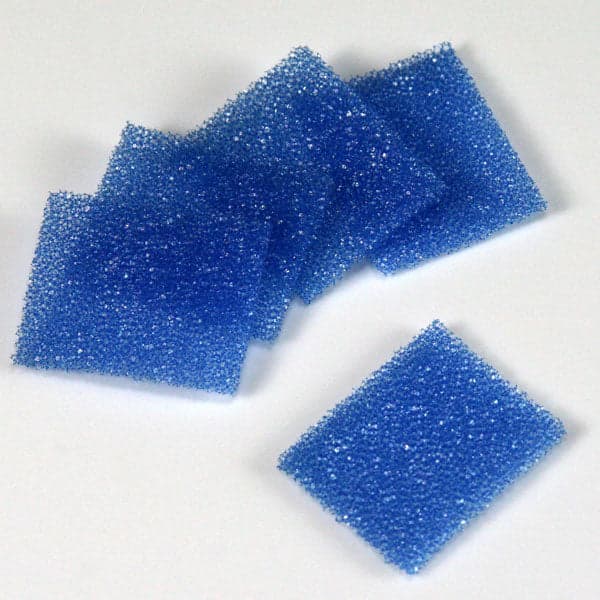
  • Foam Biopsy Pads: Hold delicate tissues firmly in place, preventing movement and damage.


How to Choose Biopsy Cassettes


Single vs. Multi-Compartment

Single-compartment biopsy cassettes are the standard choice for processing one specimen per paraffin block and are suitable for most diagnostic biopsy applications. Multi-compartment cassettes, including four-compartment and six-compartment formats, allow several biopsy cores from different anatomical locations to be processed in the same cassette while preserving their positional identity. These formats are commonly used for prostate biopsy series and other multi-site sampling procedures.


Mesh Opening Size

Standard biopsy cassettes feature 1 mm square mesh openings that provide an effective balance between specimen retention and reagent flow. For ultrafine tissue cores, dispersed cell pellets, or particularly delicate specimens, microbiopsy or biomesh cassettes with smaller openings ranging from approximately 0.38 mm to 0.6 mm may provide better specimen containment.


Lid Design and Printer Compatibility

Globe Scientific biopsy cassettes utilize an integral click-shut hinged lid that closes securely and can be reopened multiple times without compromising closure integrity. This design is particularly useful during grossing procedures where specimens may need to be inspected before processing. Writing surfaces are available in both 30° and 35° angles to ensure compatibility with Leica and Sakura cassette labeling systems.


Foam Biopsy Pads

Biopsy foam pads are commonly used when processing extremely small tissue fragments. These polyester urethane foam inserts help immobilize specimens within the cassette, maintaining proper orientation and preventing movement during tissue processing while still allowing efficient reagent penetration and drainage.


Compatibility with Base Molds

Biopsy cassettes share the standard histology cassette footprint of approximately 40 × 28 × 6 mm, allowing compatibility with standard stainless steel and disposable plastic embedding molds. Multi-compartment designs maintain the same external dimensions while providing internal specimen separation.


Compare Biopsy Cassette Variants


Standard Biopsy Cassette
This cassette features 1 mm square mesh openings and a single compartment, making it the preferred choice for routine endoscopic biopsies, needle-core biopsies, and other small tissue specimens. It provides reliable specimen retention while maintaining excellent reagent exchange during processing.


4-Compartment Biopsy Cassette
Designed with four separate compartments and 1 mm mesh openings, this cassette is commonly used for prostate biopsy series and other multi-site tissue collections where multiple cores must remain individually identifiable within the same paraffin block.


6-Compartment Biopsy Cassette
This format provides six separate specimen compartments and is suitable for extended multi-site biopsy series requiring additional specimen separation and orientation. It is frequently selected for high-detail diagnostic workflows.


Microbiopsy / Biomesh Cassette
Featuring ultra-fine mesh openings ranging from approximately 0.38 mm to 0.6 mm, these cassettes are designed for ultrafine tissue cores, dispersed cell pellets, and highly delicate specimens where maximum specimen retention is required.


Standard Cassette with Foam Pad
When dedicated biopsy cassettes are unavailable, a standard tissue cassette can be paired with a biopsy foam pad to secure small tissue fragments. This approach provides a practical alternative while maintaining adequate reagent flow and specimen protection.


Specifications Context


Globe Scientific biopsy cassettes are manufactured from durable acetal polymer and feature 1 mm square mesh openings engineered to maximize specimen retention while allowing efficient reagent penetration. The fine mesh design provides a large total open surface area for fluid exchange despite the smaller individual openings. These cassettes are resistant to formalin, xylene, graded alcohols, and acidic decalcifying agents commonly used in histology laboratories. The standard footprint of approximately 40 × 28 × 6 mm ensures compatibility with Leica ASP, Sakura VIP, Thermo Shandon Excelsior, and most other automated tissue processors. Globe Scientific maintains ISO 9001:2015 certification, and lot-specific conformance documentation is available upon request through MBP.

Protect your smallest samples with the professional standard. Check out our biopsy range and hit up the MBP team for a quote.

FAQ

Standard biopsy cassettes have 1 mm square mesh openings, compared to the approximately 1.5 mm wide slots of standard tissue cassettes. Multi-compartment biopsy variants (4-well) have 1,676 square openings (0.38 mm) per cassette face for improved fluid exchange. Microbiopsy cassettes use 0.38–0.6 mm openings for ultrafine needle cores or dispersed cell pellets that would escape standard 1 mm mesh.
Use a biopsy cassette for any specimen with a smallest dimension under approximately 3 mm. This includes endoscopic gastric, colonic, and esophageal biopsies; prostate needle cores; liver needle biopsies; and skin punch specimens. Standard tissue cassette slots (approximately 1.5 mm wide) allow small fragments to exit the cassette during automated tissue processor agitation and vacuum cycles, causing irreversible specimen loss.
Four- and six-compartment biopsy cassettes allow multiple needle cores from defined prostate sextant positions to be co-processed in a single cassette while maintaining spatial identity. Each compartment holds one core; the fine 1 mm mesh retains the core during processing. The histotechnician embeds each well separately or in a pre-defined orientation, enabling per-site diagnosis from a single paraffin block set.
Biopsy foam pads are polyester urethane foam inserts placed inside single-compartment biopsy or tissue cassettes to immobilize very small fragments—specimens under 1–2 mm—and maintain their orientation during processing and embedding. The foam is formulated to allow solvent flow, prevent specimen migration, and keep fragile cores flat for correct embedding orientation. They are used as an alternative when dedicated microbiopsy cassettes are not available.
Globe Scientific biopsy cassettes are compatible with Leica and Sakura cassette labeling instruments. As with tissue cassettes, the writing-area angle (30° or 35°) must match your printer model's platen geometry. Confirm the required angle from your printer's specification sheet before ordering; MBP can assist with compatibility verification for Globe Scientific biopsy cassette SKUs.
Biopsy cassettes are sized for specimens up to approximately the same external dimensions as standard tissue cassettes (40 × 28 × 6 mm), but the critical selection criterion is minimum specimen dimension, not maximum. For specimens too large for the 6 mm depth of a standard cassette, a Mega or deep-body cassette is the appropriate choice. The fine mesh (1 mm) is the defining feature; specimen size relative to the mesh is what prevents loss.
Multi-compartment biopsy cassettes are designed for multiple cores from a single patient's anatomically distinct biopsy sites, not for multiple patients. Processing cores from different patients in the same cassette violates specimen integrity standards and creates a cross-contamination and identification risk. Each patient's specimen set requires its own uniquely labeled cassette regardless of the number of compartments.
Globe Scientific biopsy cassettes are packaged in 500-count sealed dispenser boxes with convenient one-handed dispensing. Bulk sleeve formats are available for high-throughput labs. Contact MBP for volume pricing, standing purchase orders, or expedited delivery from the US Houston warehouse. MBP also supports institutional procurement teams with COC documentation and registered-vendor qualification.
Biopsy cassettes are supplied non-sterile; sterility is not a specified requirement for cassettes used in formalin-based fixation and paraffin processing workflows. The cassette material is resistant to standard histological solvents but is not rated for any sterility assurance level. If sterility is required for a specific intraoperative or clinical application, confirm requirements with the manufacturer before use.
We provide the highest quality of products and anytime customer service.
LinkedIn
Featured Categories
online payment
online payment
fast delivery
fast delivery
technical support
technical support
24/7 support
24/7 support
copy right
2026 All Right Reserved